AQA · A-Level · Physical Education
Course version: 7582 · Version from Sept 2016
Cardiovascular system: Sympathetic and parasympathetic.
The autonomic nervous system controls cardiac muscle without conscious input, and its two divisions have opposing effects on the heart.
Checked against the AQA 7582 specification (opens in a new tab) on .
- Point 8 of 25
- 4 key terms
Study notes
From the checked teaching notes for this specification point.
The idea
The autonomic nervous system controls cardiac muscle without conscious input, and its two divisions have opposing effects on the heart. Sympathetic stimulation releases noradrenaline at the sinoatrial node, raising the rate at which it fires, so heart rate, stroke volume and cardiac output increase during exercise. Parasympathetic stimulation releases acetylcholine at the sinoatrial node, slowing its firing rate and reducing heart rate at rest and during recovery. The two divisions act as an antagonistic pair: at any moment the balance of their activity sets the heart rate, and the balance shifts towards sympathetic dominance as exercise intensity rises. A useful method is to trace one pathway: exercise detected, sympathetic activity increases, sinoatrial node fires faster, heart rate rises, then recovery brings parasympathetic dominance and heart rate falls.
What earns the marks
- Sympathetic stimulation increases heart rate by raising the firing rate of the sinoatrial node.
- Sympathetic stimulation increases stroke volume and therefore cardiac output during exercise.
- Parasympathetic stimulation decreases heart rate by slowing the firing rate of the sinoatrial node.
- Parasympathetic activity dominates at rest and during recovery from exercise.
- The two divisions form an antagonistic pair whose balance sets the current heart rate.
- Sympathetic activity is mediated by noradrenaline and parasympathetic activity by acetylcholine at the sinoatrial node.
Common mistakes and how to put them right
Thinking the sympathetic division slows the heart.
Put it right: The sympathetic division speeds the heart up, while the parasympathetic division slows it down.
Believing the two divisions work one at a time.
Put it right: They are antagonistic and both exert some influence, with the balance shifting with exercise intensity.
Confusing the autonomic control of heart rate with voluntary control of skeletal muscle.
Put it right: Cardiac muscle is controlled involuntarily through the autonomic nervous system.
Assuming parasympathetic activity stops completely during exercise.
Put it right: It is reduced rather than necessarily absent, and it returns to dominance during recovery.
Exam tips
- Link each division to a specific effect at the sinoatrial node rather than writing only that it speeds up or slows down the heart.
- Use the antagonistic pair idea to explain changes across exercise and recovery in one continuous account.
- Check that any heart-rate value you quote is consistent with the direction of the division you have named.
Try the lesson
The start of the Cardiovascular system: Sympathetic and parasympathetic. lesson, made from checked teaching notes for this specification point.
Have a go first
Which division of the autonomic nervous system increases heart rate during exercise?
Listen
The autonomic nervous system controls cardiac muscle without conscious input, and its two divisions have opposing effects on the heart. Sympathetic stimulation releases noradrenaline at the sinoatrial node, raising the rate at which it fires, so heart rate, stroke volume and cardiac output increase during exercise. Parasympathetic stimulation releases acetylcholine at the sinoatrial node, slowing its firing rate and reducing heart rate at rest and during recovery. The two divisions act as an antagonistic pair: at any moment the balance of their activity sets the heart rate, and the balance shifts towards sympathetic dominance as exercise intensity rises. A useful method is to trace one pathway: exercise detected, sympathetic activity increases, sinoatrial node fires faster, heart rate rises, then recovery brings parasympathetic dominance and heart rate falls. A strong answer earns marks for these points. Sympathetic stimulation increases heart rate by raising the firing rate of the sinoatrial node. Sympathetic stimulation increases stroke volume and therefore cardiac output during exercise. Parasympathetic stimulation decreases heart rate by slowing the firing rate of the sinoatrial node. Parasympathetic activity dominates at rest and during recovery from exercise. Exam tip: Link each division to a specific effect at the sinoatrial node rather than writing only that it speeds up or slows down the heart.
See it
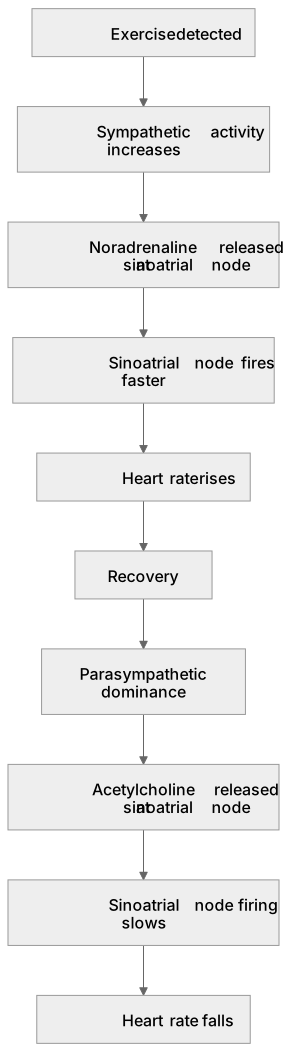
Key words
Say what each word means before you turn the card.
Autonomic control of heart rate
Try answering aloud or in your head before turning the card.
Antagonistic action of the two divisions
Try answering aloud or in your head before turning the card.
Sinoatrial node as the pacemaker
Try answering aloud or in your head before turning the card.
Heart rate changes during exercise and recovery
Try answering aloud or in your head before turning the card.
See every definition
- Autonomic control of heart rate
- The autonomic nervous system controls cardiac muscle without conscious input, and its two divisions have opposing effects on the heart.
- Antagonistic action of the two divisions
- The two divisions act as an antagonistic pair: at any moment the balance of their activity sets the heart rate, and the balance shifts towards sympathetic dominance as exercise intensity rises.
- Sinoatrial node as the pacemaker
- Sympathetic stimulation releases noradrenaline at the sinoatrial node, raising the rate at which it fires, while parasympathetic stimulation releases acetylcholine there, slowing its firing rate.
- Heart rate changes during exercise and recovery
- Heart rate, stroke volume and cardiac output increase during exercise, then recovery brings parasympathetic dominance and heart rate falls.
Label the diagram
Some boxes have lost their names. Pick the right name for each number.
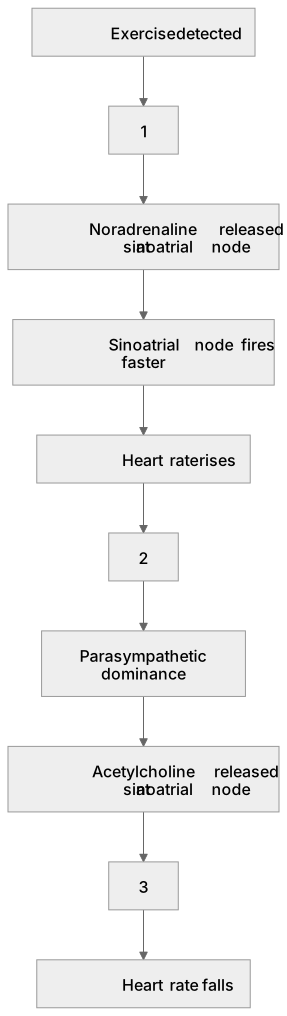
1Box 1
2Box 2
3Box 3
There is more to this lesson
The full lesson goes on to check your understanding and help you earn the marks. Create a free account to carry on, with your progress saved.
A week of Premium from your first lesson · Then the free plan continues · No card, no charge
Test your understanding of Cardiovascular system: Sympathetic and parasympathetic.
Active recall beats re-reading. Take an instant quiz now to test what you’ve learned and lock it into long-term memory.
A week of Premium from your first lesson · Then the free plan continues · No card, no charge