AQA · A-Level · Physical Education
Course version: 7582 · Version from Sept 2016
Cardiovascular system: Variations in response to an exercise session.
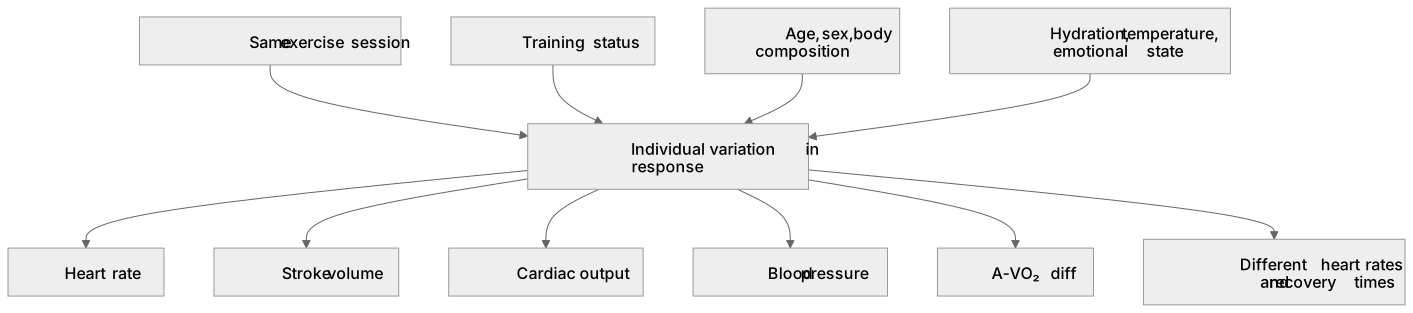
Individuals differ in how their cardiovascular systems respond to the same exercise session.
Checked against the AQA 7582 specification (opens in a new tab) on .
- Point 23 of 25
- 4 key terms
Study notes
From the checked teaching notes for this specification point.
The idea
Individuals differ in how their cardiovascular systems respond to the same exercise session. Heart rate, stroke volume, cardiac output, blood pressure and A-VO₂ diff may rise by different amounts and at different speeds from person to person. Training status is a major factor: a trained performer often has a lower resting heart rate and a larger stroke volume, so a set workload produces a smaller heart-rate rise. Age, sex, body composition, hydration, temperature and emotional state also shift the response. Two students running the same speed for the same time can therefore show different heart rates and recovery times, and both responses can still be normal.
What earns the marks
- Identifies that individuals vary in heart rate, stroke volume, cardiac output, blood pressure and A-VO₂ diff responses to the same session.
- Explains that training status affects the size and speed of the response, with trained performers often showing a lower resting heart rate and larger stroke volume.
- Names additional factors such as age, sex, body composition, hydration, temperature and emotional state.
- Recognises that the same absolute workload can produce different responses in different people.
- Uses correct units, such as beats per minute for heart rate and dm³ per minute for cardiac output.
Common mistakes and how to put them right
Treating one response as universal.
Put it right: Training status and individual factors change the response.
Confusing cardiac output with heart rate.
Put it right: Cardiac output is heart rate multiplied by stroke volume.
Ignoring recovery: the error is only comparing peak values; the correction is that the speed of return to resting values also varies between individuals.
Assuming a higher heart rate always means poorer fitness.
Put it right: The same heart rate can reflect different workloads, conditions and individuals.
Exam tips
- Compare responses using named variables such as heart rate, stroke volume and cardiac output rather than saying fitness differs.
- Link variation to at least two specific factors, for example training status and temperature.
- Use correct units when quoting values so comparisons are meaningful.
Try the lesson
The start of the Cardiovascular system: Variations in response to an exercise session. lesson, made from checked teaching notes for this specification point.
Have a go first
Which immediate cardiovascular response occurs at the onset of a single bout of submaximal aerobic exercise?
Listen
Individuals differ in how their cardiovascular systems respond to the same exercise session. Heart rate, stroke volume, cardiac output, blood pressure and A-VO₂ diff may rise by different amounts and at different speeds from person to person. Training status is a major factor: a trained performer often has a lower resting heart rate and a larger stroke volume, so a set workload produces a smaller heart-rate rise. Age, sex, body composition, hydration, temperature and emotional state also shift the response. Two students running the same speed for the same time can therefore show different heart rates and recovery times, and both responses can still be normal. A strong answer earns marks for these points. Identifies that individuals vary in heart rate, stroke volume, cardiac output, blood pressure and A-VO₂ diff responses to the same session. Explains that training status affects the size and speed of the response, with trained performers often showing a lower resting heart rate and larger stroke volume. Names additional factors such as age, sex, body composition, hydration, temperature and emotional state. Recognises that the same absolute workload can produce different responses in different people. A common slip: Treating one response as universal: the error is assuming everyone shows the same heart-rate rise. Instead, training status and individual factors change the response. Exam tip: Compare responses using named variables such as heart rate, stroke volume and cardiac output rather than saying fitness differs.
See it
Key words
Say what each word means before you turn the card.
Individual variation
Try answering aloud or in your head before turning the card.
Exercise response
Try answering aloud or in your head before turning the card.
Training status
Try answering aloud or in your head before turning the card.
Cardiovascular variables
Try answering aloud or in your head before turning the card.
See every definition
- Individual variation
- Individuals differ in how their cardiovascular systems respond to the same exercise session.
- Exercise response
- Heart rate, stroke volume, cardiac output, blood pressure and A-VO₂ diff may rise by different amounts and at different speeds from person to person.
- Training status
- A major factor, as a trained performer often has a lower resting heart rate and a larger stroke volume, so a set workload produces a smaller heart-rate rise.
- Cardiovascular variables
- Heart rate, stroke volume, cardiac output, blood pressure and A-VO₂ diff, which may rise by different amounts and at different speeds from person to person.
Label the diagram
Some boxes have lost their names. Pick the right name for each number.
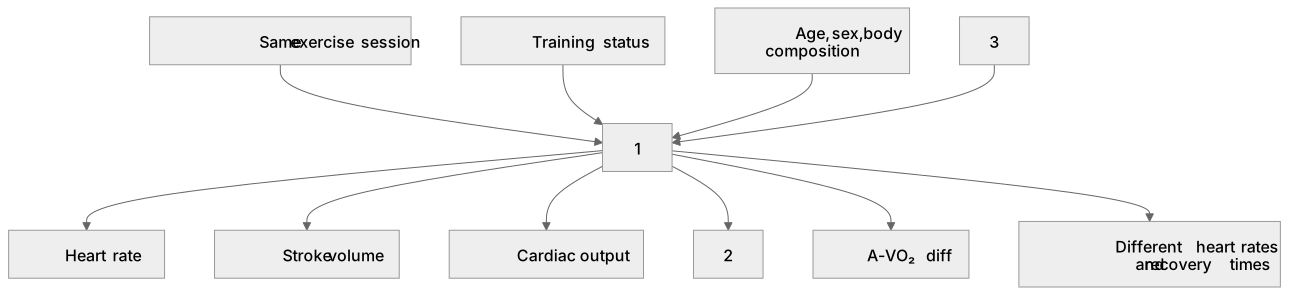
1Box 1
2Box 2
3Box 3
There is more to this lesson
The full lesson goes on to check your understanding and help you earn the marks. Create a free account to carry on, with your progress saved.
A week of Premium from your first lesson · Then the free plan continues · No card, no charge
Test your understanding of Cardiovascular system: Variations in response to an exercise session.
Active recall beats re-reading. Take an instant quiz now to test what you’ve learned and lock it into long-term memory.
A week of Premium from your first lesson · Then the free plan continues · No card, no charge