AQA · A-Level · Physical Education
Course version: 7582 · Version from Sept 2016
Cardiovascular system: Arterio-venous oxygen difference (A-VO₂ diff).
The arterio-venous oxygen difference, written A-VO₂ diff, is the gap between the oxygen content of arterial blood arriving at a tissue and that of venous blood leaving it.
Checked against the AQA 7582 specification (opens in a new tab) on .
- Point 22 of 25
Study notes
From the checked teaching notes for this specification point.
The idea
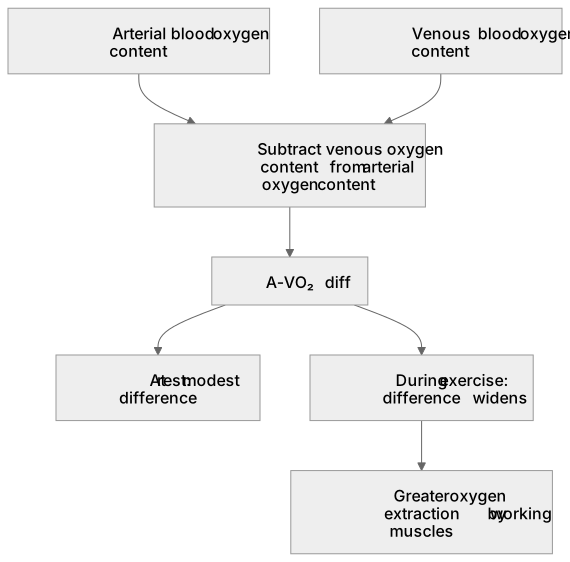
The arterio-venous oxygen difference, written A-VO₂ diff, is the gap between the oxygen content of arterial blood arriving at a tissue and that of venous blood leaving it. At rest, tissues extract only part of the oxygen carried, so the difference is modest. During exercise, working muscles extract more oxygen, so venous blood returns with less oxygen and the difference widens. You calculate it by subtracting the venous oxygen content from the arterial oxygen content, for example 20 cm³ of oxygen per 100 cm³ of blood minus 15 cm³ per 100 cm³ gives an A-VO₂ diff of 5 cm³ per 100 cm³. A larger difference shows greater oxygen extraction by the tissues.
What earns the marks
- Defines A-VO₂ diff as the difference in oxygen content between arterial blood and venous blood.
- States that it is calculated by subtracting venous oxygen content from arterial oxygen content.
- Explains that a larger A-VO₂ diff indicates greater oxygen extraction by the tissues, especially working muscles.
- Recognises that the difference widens during exercise and is smaller at rest.
- Uses correct units, such as cm³ of oxygen per 100 cm³ of blood, when quoting values.
Common mistakes and how to put them right
Reversing the subtraction: the error is taking arterial content away from venous content; the correction is arterial minus venous, so the value is positive.
Confusing A-VO₂ diff with cardiac output.
Put it right: It is an oxygen content difference per 100 cm³ of blood.
Assuming the difference stays constant.
Put it right: It increases during exercise as muscles take up more oxygen.
Mixing up which vessel carries more oxygen.
Put it right: Arterial blood has the higher oxygen content.
Exam tips
- Learn the subtraction direction as arterial minus venous so the value is always positive.
- Link a widening A-VO₂ diff to increased oxygen extraction by working muscles during exercise.
- Quote a numerical example with units to show you understand the scale of the difference.
Try the lesson
The start of the Cardiovascular system: Arterio-venous oxygen difference (A-VO₂ diff). lesson, made from checked teaching notes for this specification point.
Have a go first
What does the arterio-venous oxygen difference (A-VO₂ diff) measure?
Listen
The arterio-venous oxygen difference, written A-VO₂ diff, is the gap between the oxygen content of arterial blood arriving at a tissue and that of venous blood leaving it. At rest, tissues extract only part of the oxygen carried, so the difference is modest. During exercise, working muscles extract more oxygen, so venous blood returns with less oxygen and the difference widens. You calculate it by subtracting the venous oxygen content from the arterial oxygen content, for example 20 cm³ of oxygen per 100 cm³ of blood minus 15 cm³ per 100 cm³ gives an A-VO₂ diff of 5 cm³ per 100 cm³. A larger difference shows greater oxygen extraction by the tissues. A strong answer earns marks for these points. Defines A-VO₂ diff as the difference in oxygen content between arterial blood and venous blood. States that it is calculated by subtracting venous oxygen content from arterial oxygen content. Explains that a larger A-VO₂ diff indicates greater oxygen extraction by the tissues, especially working muscles. Recognises that the difference widens during exercise and is smaller at rest. A common slip: Reversing the subtraction: the error is taking arterial content away from venous content. Instead, arterial minus venous, so the value is positive. Exam tip: Learn the subtraction direction as arterial minus venous so the value is always positive.
See it
Label the diagram
Some boxes have lost their names. Pick the right name for each number.
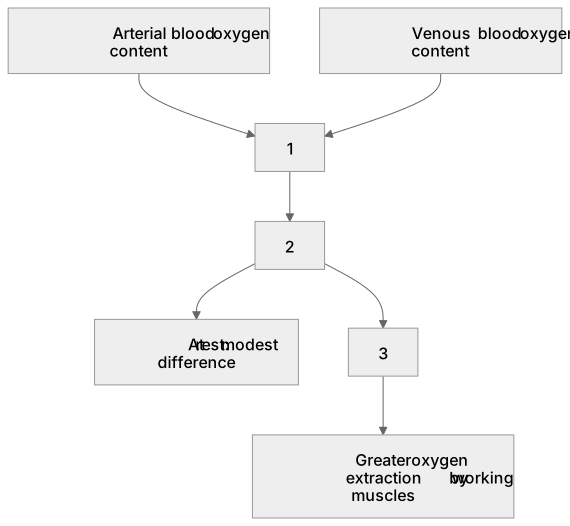
1Box 1
2Box 2
3Box 3
There is more to this lesson
The full lesson goes on to check your understanding and help you earn the marks. Create a free account to carry on, with your progress saved.
A week of Premium from your first lesson · Then the free plan continues · No card, no charge
Test your understanding of Cardiovascular system: Arterio-venous oxygen difference (A-VO₂ diff).
Active recall beats re-reading. Take an instant quiz now to test what you’ve learned and lock it into long-term memory.
A week of Premium from your first lesson · Then the free plan continues · No card, no charge