AQA · A-Level · Physical Education
Course version: 7582 · Version from Sept 2016
Concepts of physical activity and sport: Physical education.
Physical education is the planned, progressive learning experience taking place in school curriculum time, where students develop movement competence, tactical understanding, physical fitness and…
Checked against the AQA 7582 specification (opens in a new tab) on .
- Point 4 of 5
- 4 key terms
Study notes
From the checked teaching notes for this specification point.
The idea
Physical education is the planned, progressive learning experience taking place in school curriculum time, where students develop movement competence, tactical understanding, physical fitness and confidence to take part throughout life. It differs from casual play because a teacher sets intended outcomes, sequences activities and assesses progress. For example, a unit on invasion games might teach passing and decision making, then assess those in conditioned games. Physical education also builds wider skills such as cooperation, leadership and fair play, acting as a route into lifelong participation, school sport and community clubs. Understanding this concept means separating the curriculum subject from the broader activity it feeds.
What earns the marks
- Defines physical education as planned, progressive learning within curriculum time rather than unstructured activity.
- Identifies intended learning outcomes set and assessed by a teacher or coach.
- Recognises development of movement competence, tactical understanding and physical fitness.
- Explains the link between physical education, wider personal skills and lifelong participation.
- Distinguishes physical education from school sport and from recreational physical activity.
Common mistakes and how to put them right
Treating physical education and school sport as identical.
Put it right: Physical education is the timetabled curriculum subject with set learning outcomes, while school sport is voluntary competitive or recreational activity beyond lessons.
Assuming physical education only develops physical fitness.
Put it right: It also develops movement competence, tactical understanding, personal skills and confidence.
Believing physical education is only for young children.
Put it right: It is a lifelong concept, though formal curriculum provision is concentrated in school years.
Describing physical education as unstructured play.
Put it right: It is planned and progressive, with teaching and assessment.
Exam tips
- Read each option and check whether it describes planned curriculum learning or voluntary activity, because the distinction is the usual discriminator.
- Eliminate options that reduce physical education to fitness alone, since the concept is broader.
- Look for the option that names both learning outcomes and progression, as these are defining features.
Try the lesson
The start of the Concepts of physical activity and sport: Physical education. lesson, made from checked teaching notes for this specification point.
Have a go first
Which aim is most characteristic of physical education in schools?
Listen
Physical education is the planned, progressive learning experience taking place in school curriculum time, where students develop movement competence, tactical understanding, physical fitness and confidence to take part throughout life. It differs from casual play because a teacher sets intended outcomes, sequences activities and assesses progress. For example, a unit on invasion games might teach passing and decision making, then assess those in conditioned games. Physical education also builds wider skills such as cooperation, leadership and fair play, acting as a route into lifelong participation, school sport and community clubs. Understanding this concept means separating the curriculum subject from the broader activity it feeds. A strong answer earns marks for these points. Defines physical education as planned, progressive learning within curriculum time rather than unstructured activity. Identifies intended learning outcomes set and assessed by a teacher or coach. Recognises development of movement competence, tactical understanding and physical fitness. Explains the link between physical education, wider personal skills and lifelong participation. A common slip: Treating physical education and school sport as identical. Instead, physical education is the timetabled curriculum subject with set learning outcomes, while school sport is voluntary competitive or recreational activity beyond lessons. Exam tip: Read each option and check whether it describes planned curriculum learning or voluntary activity, because the distinction is the usual discriminator.
See it
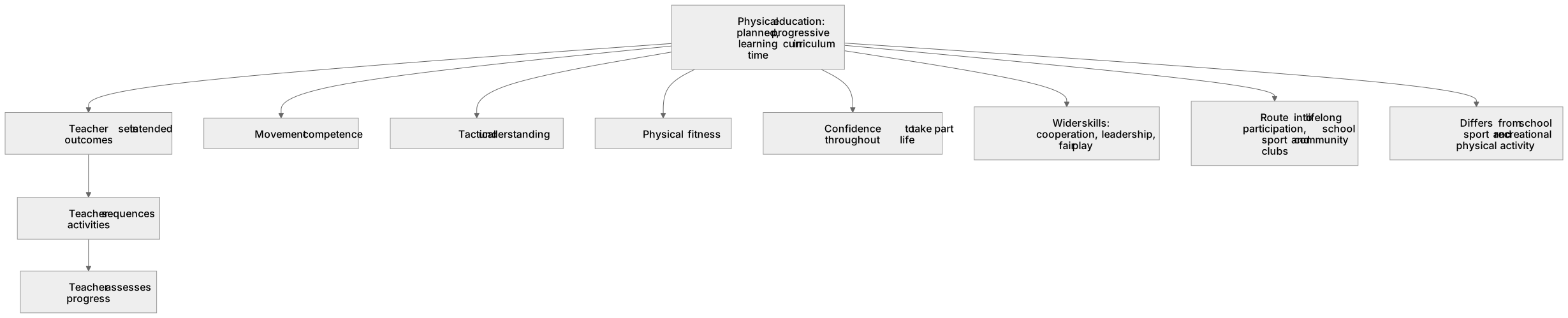
Key words
Say what each word means before you turn the card.
Curriculum learning
Try answering aloud or in your head before turning the card.
Progression and assessment
Try answering aloud or in your head before turning the card.
Movement competence
Try answering aloud or in your head before turning the card.
Lifelong participation
Try answering aloud or in your head before turning the card.
See every definition
- Curriculum learning
- Planned, progressive learning experience taking place in school curriculum time, with intended outcomes set and assessed by a teacher.
- Progression and assessment
- A teacher sets intended outcomes, sequences activities and assesses progress, which distinguishes it from casual play.
- Movement competence
- One of the outcomes students develop, alongside tactical understanding, physical fitness and confidence to take part throughout life.
- Lifelong participation
- A route into taking part throughout life, along with school sport and community clubs, supported by wider skills such as cooperation, leadership and fair play.
Label the diagram
Some boxes have lost their names. Pick the right name for each number.
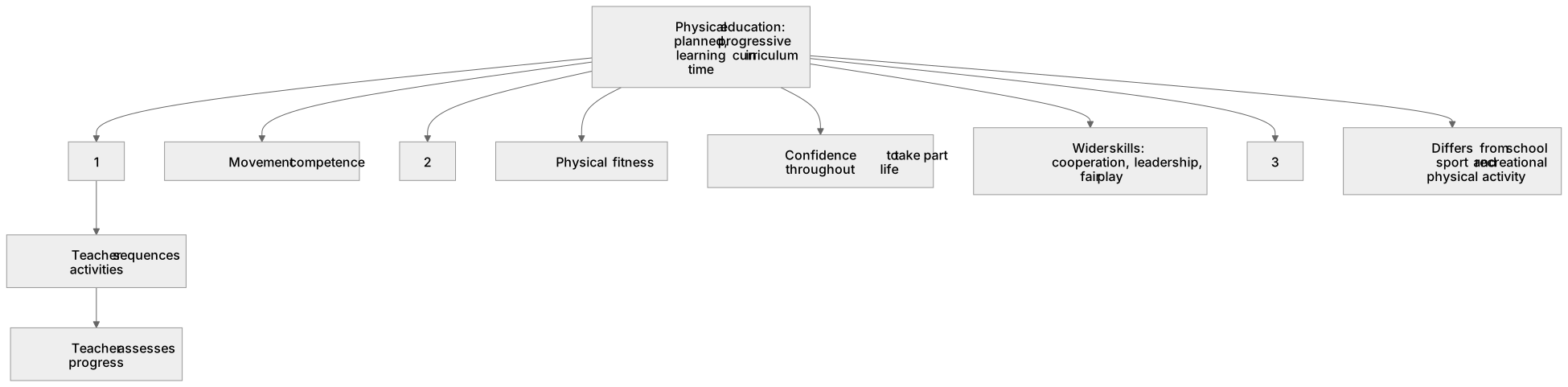
1Box 1
2Box 2
3Box 3
There is more to this lesson
The full lesson goes on to check your understanding and help you earn the marks. Create a free account to carry on, with your progress saved.
A week of Premium from your first lesson · Then the free plan continues · No card, no charge
Test your understanding of Concepts of physical activity and sport: Physical education.
Active recall beats re-reading. Take an instant quiz now to test what you’ve learned and lock it into long-term memory.
A week of Premium from your first lesson · Then the free plan continues · No card, no charge