AQA · A-Level · Physical Education
Course version: 7582 · Version from Sept 2016
Concepts of physical activity and sport: Sport.
Sport is physical activity that is organised, competitive and governed by rules, with outcomes decided by performance and often involving structured training, fixtures and officials.
Checked against the AQA 7582 specification (opens in a new tab) on .
- Point 3 of 5
- 3 key terms
Study notes
From the checked teaching notes for this specification point.
The idea
Sport is physical activity that is organised, competitive and governed by rules, with outcomes decided by performance and often involving structured training, fixtures and officials. Participants aim to win or achieve a measurable standard, and competition may occur at school, club, regional, national or international level. Sport typically has codified rules, defined roles, equipment and scoring systems, and is regulated by governing bodies that run leagues, tournaments and disciplinary procedures. It can be professional or amateur, team or individual, and may overlap with physical recreation when the same activity is done casually, so classification depends on the presence of competition, organisation and performance focus rather than the activity name alone.
What earns the marks
- Sport is physical activity involving competition, where participants strive to win or achieve a performance standard.
- Participation often involves structured training, fixtures and progression through levels such as club, regional, national and international.
- Sport may be amateur or professional, team or individual, and can overlap with physical recreation when the same activity is pursued casually.
- Classification depends on the dominant features of competition, organisation and performance outcome rather than the activity name alone.
Common mistakes and how to put them right
Assuming all physical activity is sport.
Put it right: Sport requires organisation and competition, so a casual walk or recreational swim is not sport unless those features are present.
Believing sport must be professional or elite.
Put it right: Amateur and grassroots sport count as sport provided competition, rules and organisation are present.
Thinking sport cannot overlap with recreation.
Put it right: The same activity, such as football, can be recreational in a casual kickabout and sport in a governed league fixture.
Ignoring the role of governing bodies.
Put it right: Codified rules, leagues and disciplinary procedures are central to how sport is organised and regulated.
Exam tips
- Look for competition, codified rules and governing-body organisation in the options, as these are the strongest indicators of sport.
- Reject options that describe free, casual activity with no competitive outcome, because those describe physical recreation.
- Use a contrasting example, such as a governed league football match versus a casual kickabout, to test each option.
- Check whether the option mentions structured training, fixtures or officials, which support a sport classification.
Try the lesson
The start of the Concepts of physical activity and sport: Sport. lesson, made from checked teaching notes for this specification point.
Have a go first
Which feature best distinguishes sport from other forms of physical activity?
Listen
Sport is physical activity that is organised, competitive and governed by rules, with outcomes decided by performance and often involving structured training, fixtures and officials. Participants aim to win or achieve a measurable standard, and competition may occur at school, club, regional, national or international level. Sport typically has codified rules, defined roles, equipment and scoring systems, and is regulated by governing bodies that run leagues, tournaments and disciplinary procedures. It can be professional or amateur, team or individual, and may overlap with physical recreation when the same activity is done casually, so classification depends on the presence of competition, organisation and performance focus rather than the activity name alone. A strong answer earns marks for these points. Sport is physical activity involving competition, where participants strive to win or achieve a performance standard. Participation often involves structured training, fixtures and progression through levels such as club, regional, national and international. Sport may be amateur or professional, team or individual, and can overlap with physical recreation when the same activity is pursued casually. Classification depends on the dominant features of competition, organisation and performance outcome rather than the activity name alone. A common slip: Assuming all physical activity is sport. Instead, sport requires organisation and competition, so a casual walk or recreational swim is not sport unless those features are present. Exam tip: Look for competition, codified rules and governing-body organisation in the options, as these are the strongest indicators of sport.
See it
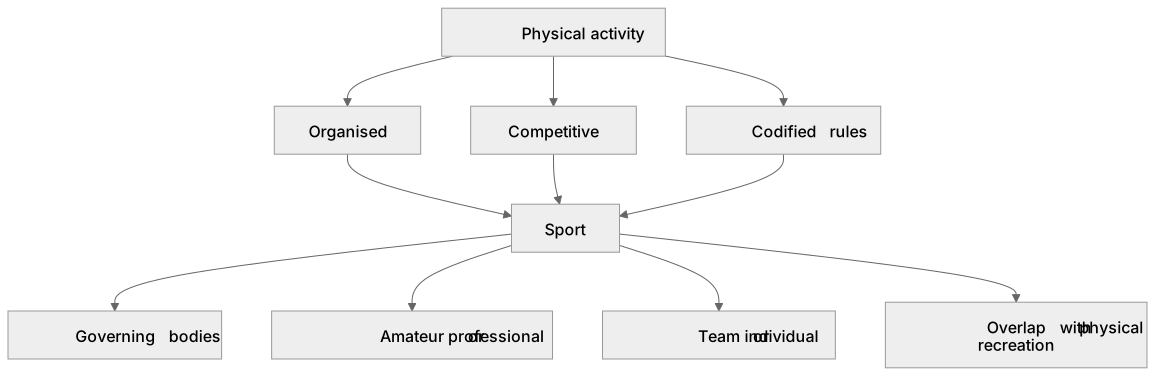
Key words
Say what each word means before you turn the card.
Competition and performance outcome
Try answering aloud or in your head before turning the card.
Codified rules and organisation
Try answering aloud or in your head before turning the card.
Governing bodies and structured competition
Try answering aloud or in your head before turning the card.
See every definition
- Competition and performance outcome
- Participants strive to win or achieve a performance standard, with outcomes decided by performance.
- Codified rules and organisation
- Sport has codified rules, defined roles, equipment, scoring systems and often officials.
- Governing bodies and structured competition
- National or international governing bodies organise leagues, tournaments and disciplinary processes, with structured training and fixtures.
Label the diagram
Some boxes have lost their names. Pick the right name for each number.
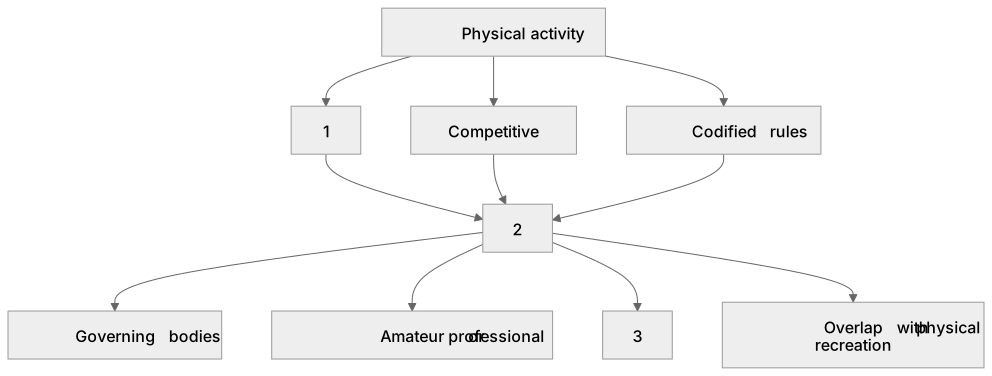
1Box 1
2Box 2
3Box 3
There is more to this lesson
The full lesson goes on to check your understanding and help you earn the marks. Create a free account to carry on, with your progress saved.
A week of Premium from your first lesson · Then the free plan continues · No card, no charge
Test your understanding of Concepts of physical activity and sport: Sport.
Active recall beats re-reading. Take an instant quiz now to test what you’ve learned and lock it into long-term memory.
A week of Premium from your first lesson · Then the free plan continues · No card, no charge