AQA · A-Level · Physical Education
Course version: 7582 · Version from Sept 2016
Concepts of physical activity and sport: Physical recreation.
Physical recreation is activity undertaken in leisure time, chosen freely, with the main aim of enjoyment, relaxation, health or social contact rather than competition or reward.
Checked against the AQA 7582 specification (opens in a new tab) on .
- Point 2 of 5
- 3 key terms
Study notes
From the checked teaching notes for this specification point.
The idea
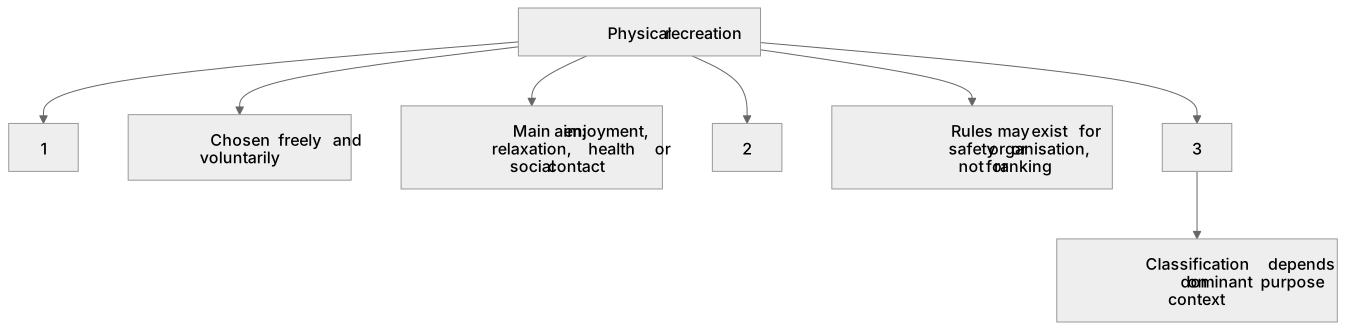
Physical recreation is activity undertaken in leisure time, chosen freely, with the main aim of enjoyment, relaxation, health or social contact rather than competition or reward. It is usually non-competitive, self-paced and flexible: a student might swim lengths at a local pool, cycle a towpath on a Sunday or join a casual five-a-side kickabout. Participation is voluntary, so the participant decides when, how often and how hard to take part, and can stop without consequence. Rules may exist for safety or organisation but are not enforced for ranking. Physical recreation can overlap with sport and with physical education, yet its defining emphasis is personal satisfaction and wellbeing rather than performance outcome.
What earns the marks
- Physical recreation is activity done in free or leisure time, chosen voluntarily by the participant.
- Its primary purposes are enjoyment, relaxation, health, fitness and social interaction rather than competition or extrinsic reward.
- Rules and organisation may exist for safety or convenience but are not used to rank participants or produce winners.
- Examples include recreational swimming, recreational cycling, casual jogging and informal games played for fun.
Common mistakes and how to put them right
Assuming any activity with rules is automatically sport.
Put it right: Physical recreation can have rules for safety or organisation, but the defining emphasis is voluntary enjoyment rather than competition and outcome.
Believing physical recreation must be low intensity.
Put it right: Intensity is chosen by the participant, so a recreational runner may train hard, but the purpose remains personal satisfaction rather than competitive ranking.
Treating physical recreation and physical education as identical.
Put it right: Physical education is a timetabled, taught and assessed curriculum experience, whereas physical recreation is freely chosen leisure activity.
Thinking an activity is fixed in one category.
Put it right: The same activity, such as swimming, can be recreation, sport or physical education depending on purpose, context and organisation.
Exam tips
- Read the stem for purpose words such as enjoyment, relaxation or free choice, because these signal physical recreation rather than sport.
- Eliminate options that make competition, trophies or external reward the central feature, since those point away from recreation.
- Check whether participation is voluntary and self-directed; if the option describes compulsion or formal ranking, it is unlikely to be physical recreation.
- Use one clear example, such as recreational swimming, to test each option against the defining characteristics.
Try the lesson
The start of the Concepts of physical activity and sport: Physical recreation. lesson, made from checked teaching notes for this specification point.
Have a go first
Which feature best distinguishes physical recreation from competitive sport?
Listen
Physical recreation is activity undertaken in leisure time, chosen freely, with the main aim of enjoyment, relaxation, health or social contact rather than competition or reward. It is usually non-competitive, self-paced and flexible: a student might swim lengths at a local pool, cycle a towpath on a Sunday or join a casual five-a-side kickabout. Participation is voluntary, so the participant decides when, how often and how hard to take part, and can stop without consequence. Rules may exist for safety or organisation but are not enforced for ranking. Physical recreation can overlap with sport and with physical education, yet its defining emphasis is personal satisfaction and wellbeing rather than performance outcome. A strong answer earns marks for these points. Physical recreation is activity done in free or leisure time, chosen voluntarily by the participant. Its primary purposes are enjoyment, relaxation, health, fitness and social interaction rather than competition or extrinsic reward. Rules and organisation may exist for safety or convenience but are not used to rank participants or produce winners. Examples include recreational swimming, recreational cycling, casual jogging and informal games played for fun. A common slip: Assuming any activity with rules is automatically sport. Instead, physical recreation can have rules for safety or organisation, but the defining emphasis is voluntary enjoyment rather than competition and outcome. Exam tip: Read the stem for purpose words such as enjoyment, relaxation or free choice, because these signal physical recreation rather than sport.
See it

Key words
Say what each word means before you turn the card.
Voluntary participation in leisure time
Try answering aloud or in your head before turning the card.
Enjoyment, health and social purposes
Try answering aloud or in your head before turning the card.
Non-competitive or loosely competitive nature
Try answering aloud or in your head before turning the card.
See every definition
- Voluntary participation in leisure time
- Activity undertaken in leisure time and chosen freely, so the participant decides when, how often and how hard to take part and can stop without consequence.
- Enjoyment, health and social purposes
- The main aim is enjoyment, relaxation, health or social contact rather than competition or reward.
- Non-competitive or loosely competitive nature
- Typically non-competitive, self-paced and flexible, with rules that may exist for safety or organisation but are not enforced for ranking.
Label the diagram
Some boxes have lost their names. Pick the right name for each number.
1Box 1
2Box 2
3Box 3
There is more to this lesson
The full lesson goes on to check your understanding and help you earn the marks. Create a free account to carry on, with your progress saved.
A week of Premium from your first lesson · Then the free plan continues · No card, no charge
Test your understanding of Concepts of physical activity and sport: Physical recreation.
Active recall beats re-reading. Take an instant quiz now to test what you’ve learned and lock it into long-term memory.
A week of Premium from your first lesson · Then the free plan continues · No card, no charge