AQA · A-Level · Physical Education
Course version: 7582 · Version from Sept 2016
Efficiency of information processing to include:: Choice reaction time.
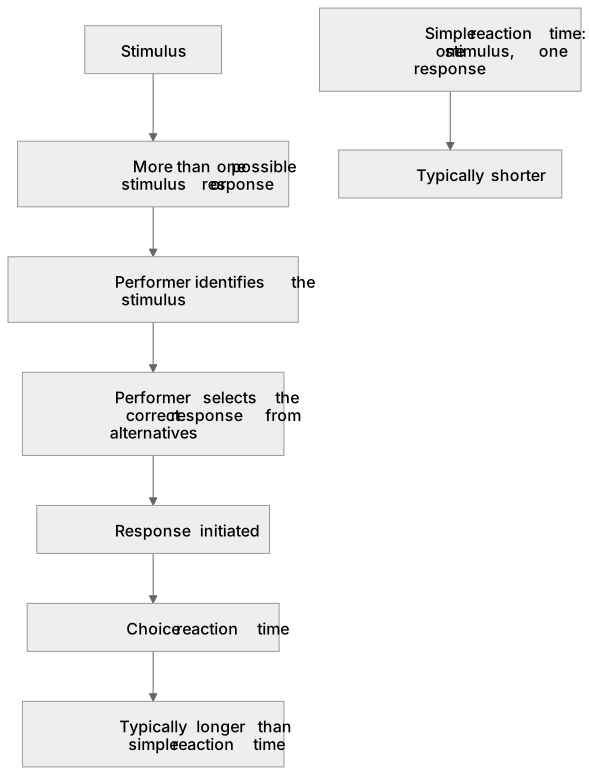
Choice reaction time is the time taken to initiate a response when there is more than one possible stimulus, more than one possible response, or both, so the performer must first decide which…
Checked against the AQA 7582 specification (opens in a new tab) on .
- Point 12 of 30
- 2 key terms
Study notes
From the checked teaching notes for this specification point.
The idea
Choice reaction time is the time taken to initiate a response when there is more than one possible stimulus, more than one possible response, or both, so the performer must first decide which response to make. In AQA A-level Physical Education, it is studied within the efficiency of information processing. For example, a tennis player at the net must read whether the opponent is playing a passing shot or a lob, then select the appropriate movement. Because the performer must identify the stimulus and choose among responses, choice reaction time is typically longer than simple reaction time. It is assessed through multiple-choice questions requiring definition, comparison with simple reaction time, or application to a game situation.
What earns the marks
- Defines choice reaction time as the time from the onset of a stimulus to the initiation of a response when more than one stimulus or response is possible.
- States that the performer must select the correct response from alternatives, which adds a decision-making stage.
- Recognises that choice reaction time is typically longer than simple reaction time because of the additional response-selection demands.
- Applies the concept to a suitable example, such as a tennis player deciding between a passing shot and a lob.
- Explains that increasing the number of possible stimuli or responses generally increases choice reaction time.
Common mistakes and how to put them right
Confusing choice reaction time with simple reaction time.
Put it right: Choice reaction time involves selecting between alternatives, whereas simple reaction time involves one stimulus and one response.
Thinking that choice reaction time is always shorter than simple reaction time.
Put it right: The extra decision-making usually makes it longer.
Assuming that choice reaction time depends only on physical speed.
Put it right: Perceptual and decision-making factors also affect it.
Believing that choice reaction time is the same as movement time.
Put it right: It ends when the chosen response is initiated, not when the movement is completed.
Exam tips
- Check whether the question describes one stimulus and one response or several alternatives; the latter indicates choice reaction time.
- When comparing with simple reaction time, state clearly that choice reaction time is usually longer because of the response-selection stage.
- Use a game example where the performer must read and select, such as a netball player choosing between a pass and a shot.
Try the lesson
The start of the Efficiency of information processing to include:: Choice reaction time. lesson, made from checked teaching notes for this specification point.
Have a go first
Which of the following best describes choice reaction time in a sporting context?
Listen
Choice reaction time is the time taken to initiate a response when there is more than one possible stimulus, more than one possible response, or both, so the performer must first decide which response to make. In AQA A-level Physical Education, it is studied within the efficiency of information processing. For example, a tennis player at the net must read whether the opponent is playing a passing shot or a lob, then select the appropriate movement. Because the performer must identify the stimulus and choose among responses, choice reaction time is typically longer than simple reaction time. It is assessed through multiple-choice questions requiring definition, comparison with simple reaction time, or application to a game situation. A strong answer earns marks for these points. Defines choice reaction time as the time from the onset of a stimulus to the initiation of a response when more than one stimulus or response is possible. States that the performer must select the correct response from alternatives, which adds a decision-making stage. Recognises that choice reaction time is typically longer than simple reaction time because of the additional response-selection demands. Applies the concept to a suitable example, such as a tennis player deciding between a passing shot and a lob. Exam tip: Check whether the question describes one stimulus and one response or several alternatives; the latter indicates choice reaction time.
See it
Key words
Say what each word means before you turn the card.
Choice reaction time
Try answering aloud or in your head before turning the card.
Simple reaction time
Try answering aloud or in your head before turning the card.
See every definition
- Choice reaction time
- The time taken to initiate a response when there is more than one possible stimulus, more than one possible response, or both, so the performer must first decide which response to make.
- Simple reaction time
- Involves one stimulus and one response, and choice reaction time is typically longer than it because of the additional response-selection demands.
Label the diagram
Some boxes have lost their names. Pick the right name for each number.
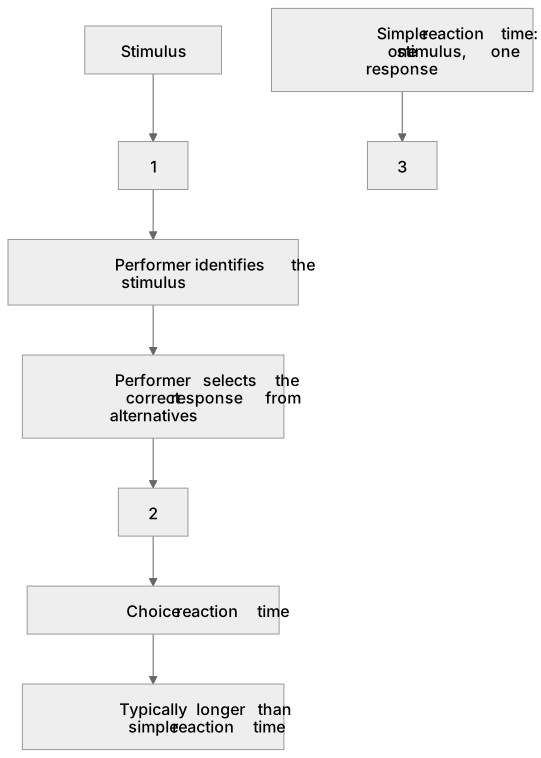
1Box 1
2Box 2
3Box 3
There is more to this lesson
The full lesson goes on to check your understanding and help you earn the marks. Create a free account to carry on, with your progress saved.
A week of Premium from your first lesson · Then the free plan continues · No card, no charge
Test your understanding of Efficiency of information processing to include:: Choice reaction time.
Active recall beats re-reading. Take an instant quiz now to test what you’ve learned and lock it into long-term memory.
A week of Premium from your first lesson · Then the free plan continues · No card, no charge