AQA · A-Level · Physical Education
Course version: 7582 · Version from Sept 2016
Efficiency of information processing to include:: Simple reaction time.
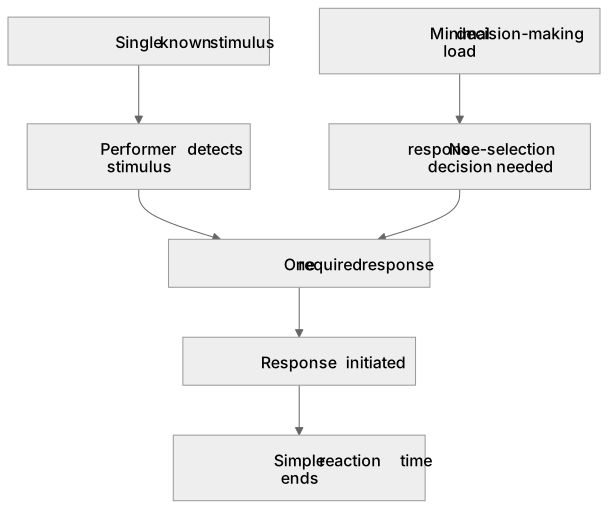
Simple reaction time is the time taken to initiate a single, pre-programmed response to one known stimulus, with no decision about which response to make.
Checked against the AQA 7582 specification (opens in a new tab) on .
- Point 11 of 30
- 2 key terms
Study notes
From the checked teaching notes for this specification point.
The idea
Simple reaction time is the time taken to initiate a single, pre-programmed response to one known stimulus, with no decision about which response to make. In AQA A-level Physical Education, it is studied within the efficiency of information processing. The performer detects the stimulus, such as a starting gun, and executes the one learned action, such as driving out of the blocks. Because there is only one stimulus and one possible response, the decision-making load is minimal, so simple reaction time is typically shorter than choice reaction time. It is assessed through multiple-choice questions that require you to identify the definition, give a sporting example, or explain why a sprinter's start involves simple rather than choice reaction time.
What earns the marks
- Defines simple reaction time as the time from the onset of a single known stimulus to the initiation of the one required response.
- States that there is only one stimulus and only one possible response, so no response-selection decision is needed.
- Recognises that simple reaction time is typically shorter than choice reaction time because processing demands are lower.
- Applies the concept to a suitable example, such as a sprinter reacting to the starting gun by driving out of the blocks.
- Distinguishes simple reaction time from reaction time in general, which can include situations with more than one stimulus or response.
Common mistakes and how to put them right
Confusing simple reaction time with choice reaction time.
Put it right: Simple reaction time involves one stimulus and one response, whereas choice reaction time involves selecting between multiple stimuli or responses.
Thinking that simple reaction time includes movement time.
Put it right: It ends when the response is initiated, not when the action is completed.
Assuming that simple reaction time is always the same for every performer.
Put it right: It varies with factors such as arousal, fatigue, attention and practice.
Believing that a fast simple reaction time guarantees a fast whole-body movement.
Put it right: Reaction time and movement time are separate components of performance.
Exam tips
- Read the question carefully to check whether it asks about simple reaction time, choice reaction time or reaction time in general.
- When giving a sporting example, name the single stimulus and the single response explicitly, for example the starting gun and the sprint start.
- Use the phrase 'one stimulus, one response' as a quick check that your chosen example really is simple reaction time.
Try the lesson
The start of the Efficiency of information processing to include:: Simple reaction time. lesson, made from checked teaching notes for this specification point.
Have a go first
In a simple reaction time test, a swimmer starts when a single light comes on. Which description matches simple reaction time?
Listen
Simple reaction time is the time taken to initiate a single, pre-programmed response to one known stimulus, with no decision about which response to make. In AQA A-level Physical Education, it is studied within the efficiency of information processing. The performer detects the stimulus, such as a starting gun, and executes the one learned action, such as driving out of the blocks. Because there is only one stimulus and one possible response, the decision-making load is minimal, so simple reaction time is typically shorter than choice reaction time. It is assessed through multiple-choice questions that require you to identify the definition, give a sporting example, or explain why a sprinter's start involves simple rather than choice reaction time. A strong answer earns marks for these points. Defines simple reaction time as the time from the onset of a single known stimulus to the initiation of the one required response. States that there is only one stimulus and only one possible response, so no response-selection decision is needed. Recognises that simple reaction time is typically shorter than choice reaction time because processing demands are lower. Applies the concept to a suitable example, such as a sprinter reacting to the starting gun by driving out of the blocks. Exam tip: Read the question carefully to check whether it asks about simple reaction time, choice reaction time or reaction time in general.
See it
Key words
Say what each word means before you turn the card.
Simple reaction time
Try answering aloud or in your head before turning the card.
Reaction time
Try answering aloud or in your head before turning the card.
See every definition
- Simple reaction time
- The time taken to initiate a single, pre-programmed response to one known stimulus, with no decision about which response to make.
- Reaction time
- In general, it can include situations with more than one stimulus or response, and it ends when the response is initiated, not when the action is completed.
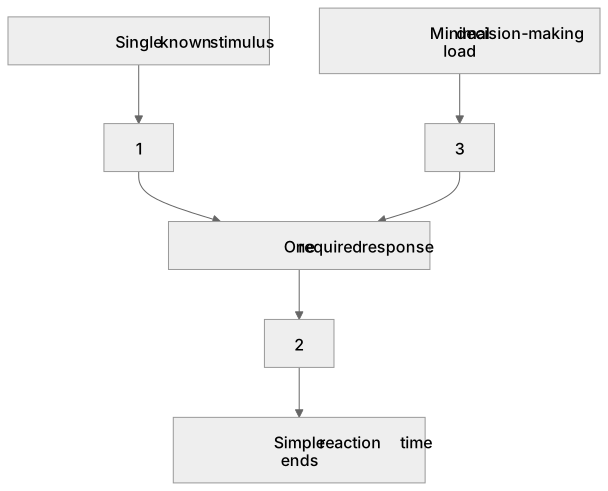
Label the diagram
Some boxes have lost their names. Pick the right name for each number.
1Box 1
2Box 2
3Box 3
There is more to this lesson
The full lesson goes on to check your understanding and help you earn the marks. Create a free account to carry on, with your progress saved.
A week of Premium from your first lesson · Then the free plan continues · No card, no charge
Test your understanding of Efficiency of information processing to include:: Simple reaction time.
Active recall beats re-reading. Take an instant quiz now to test what you’ve learned and lock it into long-term memory.
A week of Premium from your first lesson · Then the free plan continues · No card, no charge