AQA · A-Level · Physical Education
Course version: 7582 · Version from Sept 2016
Efficiency of information processing to include:: Hick’s law.
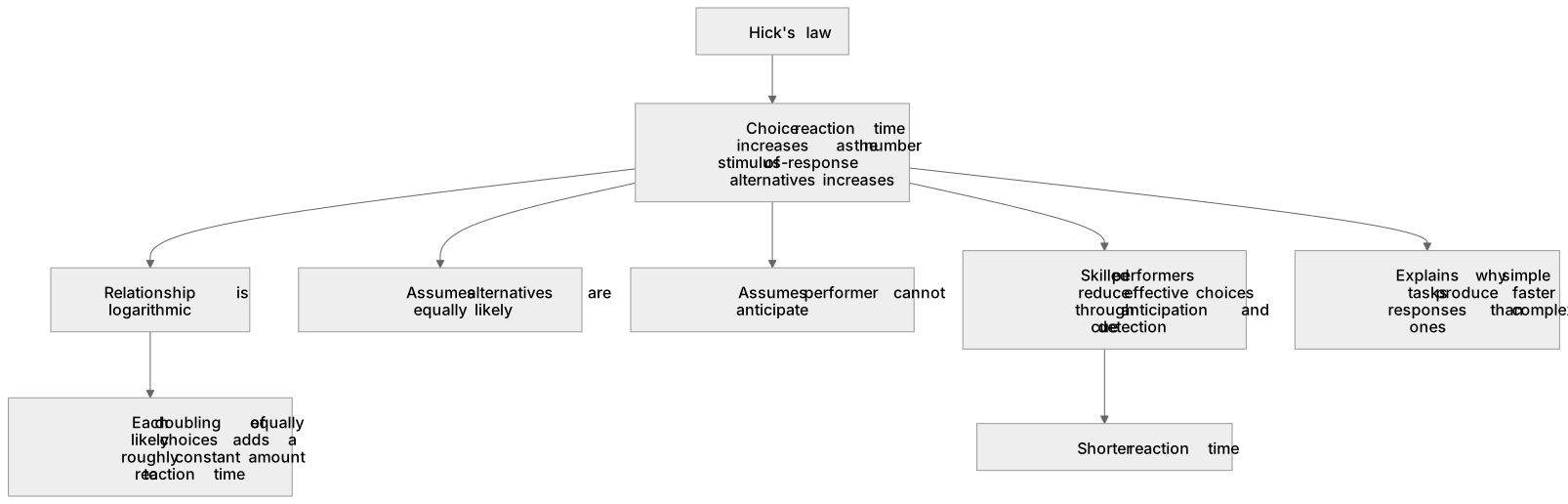
Hick's law describes how choice reaction time increases as the number of stimulus-response alternatives increases.
Checked against the AQA 7582 specification (opens in a new tab) on .
- Point 14 of 30
- 3 key terms
Study notes
From the checked teaching notes for this specification point.
The idea
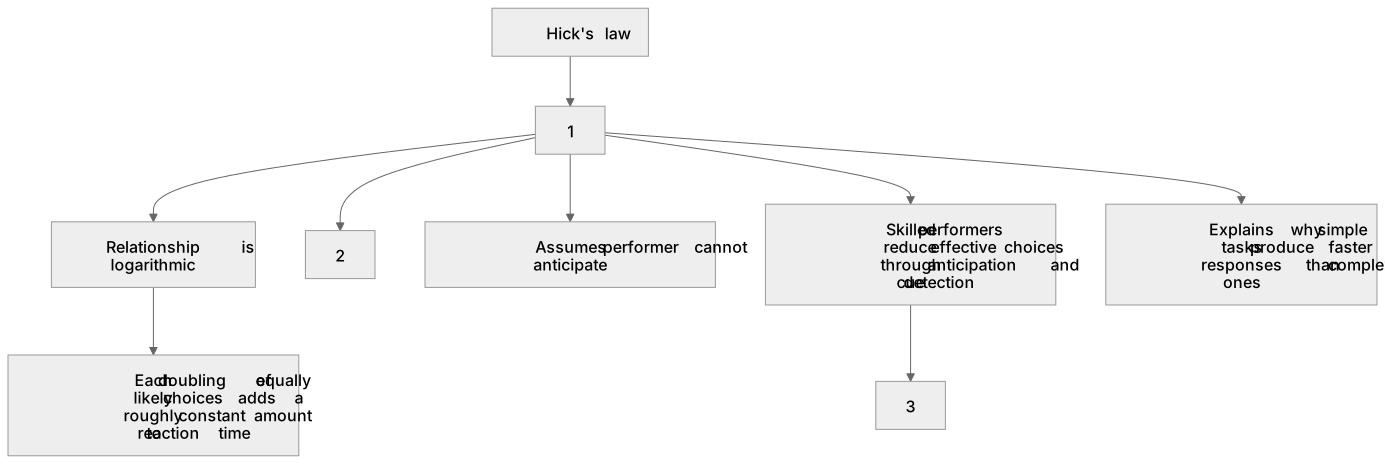
Hick's law describes how choice reaction time increases as the number of stimulus-response alternatives increases. The relationship is logarithmic, so each doubling of equally likely choices adds a roughly constant amount to reaction time. For example, a tennis player returning a serve must choose among a forehand drive, backhand drive, forehand lob or backhand lob, so reaction time is longer than for a swimmer reacting to a single signal. The law assumes alternatives are equally likely and the performer cannot anticipate. Skilled performers reduce the effect through anticipation and cue detection, effectively cutting the number of genuine choices. Hick's law explains why simple tasks produce faster responses than complex ones.
What earns the marks
- Hick's law states that choice reaction time increases as the number of stimulus-response alternatives increases.
- The increase is logarithmic, so reaction time rises by a roughly constant amount each time the number of equally likely choices doubles.
- The law applies to choice reaction time, where the performer must select among several possible responses, not to simple reaction time.
- Skilled performers can reduce the number of effective choices through anticipation and by detecting early cues, which shortens reaction time.
- A sporting example is a tennis return, where reading serve placement creates several response options (e.g., forehand or backhand drive) and lengthens reaction time compared with a single-signal start.
Common mistakes and how to put them right
Thinking reaction time doubles when the number of choices doubles.
Put it right: The relationship is logarithmic, so the increase is smaller and roughly constant per doubling.
Applying Hick's law to simple reaction time.
Put it right: It concerns choice reaction time, where several stimulus-response alternatives exist.
Using an invalid sporting example, such as volleying a tennis serve, which is against the rules and therefore not a valid choice.
Exam tips
- State the direction of the relationship first, then add that it is logarithmic, to show precise understanding.
- Use a concrete, rule-compliant example with a clear number of alternatives, such as a goalkeeper facing a penalty, to contrast choice and simple reaction time.
- Explain how anticipation or cue detection reduces the effective number of choices, linking Hick's law to skilled performance.
Try the lesson
The start of the Efficiency of information processing to include:: Hick’s law. lesson, made from checked teaching notes for this specification point.
Have a go first
According to Hick’s law, what happens to a performer’s reaction time as the number of possible response choices increases?
Listen
Hick's law describes how choice reaction time increases as the number of stimulus-response alternatives increases. The relationship is logarithmic, so each doubling of equally likely choices adds a roughly constant amount to reaction time. For example, a tennis player returning a serve must choose among a forehand drive, backhand drive, forehand lob or backhand lob, so reaction time is longer than for a swimmer reacting to a single signal. The law assumes alternatives are equally likely and the performer cannot anticipate. Skilled performers reduce the effect through anticipation and cue detection, effectively cutting the number of genuine choices. Hick's law explains why simple tasks produce faster responses than complex ones. A strong answer earns marks for these points. Hick's law states that choice reaction time increases as the number of stimulus-response alternatives increases. The increase is logarithmic, so reaction time rises by a roughly constant amount each time the number of equally likely choices doubles. The law applies to choice reaction time, where the performer must select among several possible responses, not to simple reaction time. Skilled performers can reduce the number of effective choices through anticipation and by detecting early cues, which shortens reaction time. Exam tip: State the direction of the relationship first, then add that it is logarithmic, to show precise understanding.
See it
Key words
Say what each word means before you turn the card.
Choice reaction time
Try answering aloud or in your head before turning the card.
Anticipation and cue detection
Try answering aloud or in your head before turning the card.
Hick's law
Try answering aloud or in your head before turning the card.
See every definition
- Choice reaction time
- The time taken when the performer must select among several possible responses rather than reacting to a single signal.
- Anticipation and cue detection
- Ways skilled performers reduce the number of effective choices by predicting and detecting early cues, which shortens reaction time.
- Hick's law
- Choice reaction time increases as the number of stimulus-response alternatives increases, with the increase being logarithmic.
Label the diagram
Some boxes have lost their names. Pick the right name for each number.
1Box 1
2Box 2
3Box 3
There is more to this lesson
The full lesson goes on to check your understanding and help you earn the marks. Create a free account to carry on, with your progress saved.
A week of Premium from your first lesson · Then the free plan continues · No card, no charge
Test your understanding of Efficiency of information processing to include:: Hick’s law.
Active recall beats re-reading. Take an instant quiz now to test what you’ve learned and lock it into long-term memory.
A week of Premium from your first lesson · Then the free plan continues · No card, no charge