AQA · A-Level · Physical Education
Course version: 7582 · Version from Sept 2016
Psychological refractory period.
Full specification wording
Efficiency of information processing to include:: Psychological refractory period.
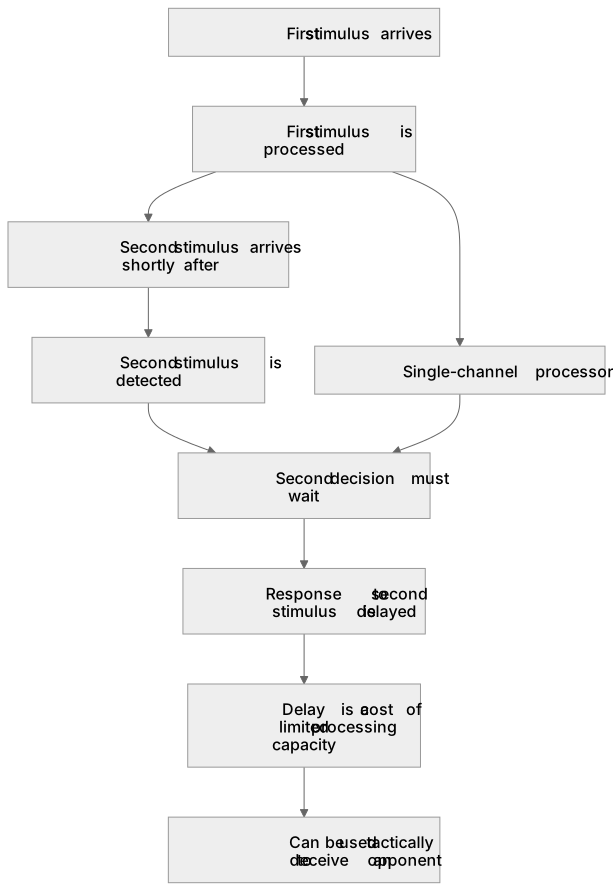
The psychological refractory period (PRP) is the delay in responding to a second stimulus when it arrives shortly after a first stimulus that is still being processed.
Checked against the AQA 7582 specification (opens in a new tab) on .
- Point 15 of 30
- 3 key terms
Study notes
From the checked teaching notes for this specification point.
The idea
The psychological refractory period (PRP) is the delay in responding to a second stimulus when it arrives shortly after a first stimulus that is still being processed. In AQA A-Level Physical Education, this belongs to the study of how efficiently performers process information. A practical example is a badminton player who has committed to a drop shot: while the brain is still selecting and programming that response, the opponent plays a fast drive, and the reply to the second stimulus is slower than normal. The delay occurs because the performer is held to be a single-channel processor, so the second decision must wait until the first has been dealt with. The PRP is therefore a measurable cost of limited processing capacity, and it explains why disguising a first action or presenting a late second stimulus can deceive an opponent.
What earns the marks
- Defines the psychological refractory period as a delay in responding to a second stimulus presented shortly after a first stimulus.
- Explains that the delay arises because the first stimulus is still being processed when the second arrives.
- Links the effect to limited processing capacity or a single-channel processor.
- Applies the concept to a sporting example, such as a performer reacting more slowly to a late second stimulus.
- Recognises that the PRP can be used tactically to deceive an opponent, for example by disguising the first action.
Common mistakes and how to put them right
Thinking the PRP means the second stimulus is not detected at all.
Put it right: The second stimulus is detected, but the response to it is delayed while the first is processed.
Confusing the PRP with a simple reaction-time measure.
Put it right: The PRP specifically concerns the delay caused by a preceding, still-unprocessed stimulus.
Assuming the PRP is a permanent trait of a performer.
Put it right: It is a temporary processing delay that depends on the timing and demands of the stimuli.
Believing that practice removes the PRP completely.
Put it right: Practice can improve processing efficiency, but the underlying single-channel limitation remains.
Exam tips
- Define the term precisely before applying it, so the examiner can see the concept is understood.
- Use a named sporting example and state clearly which stimulus is first and which is second.
- Explain the mechanism, not just the outcome: say that the first stimulus is still being processed when the second arrives.
- If asked to suggest a tactic, link the PRP to deception, such as disguising the first action to delay the opponent's response.
Try the lesson
The start of the Efficiency of information processing to include:: Psychological refractory period. lesson, made from checked teaching notes for this specification point.
Have a go first
What does the psychological refractory period describe in a performer?
Listen
The psychological refractory period (PRP) is the delay in responding to a second stimulus when it arrives shortly after a first stimulus that is still being processed. In AQA A-Level Physical Education, this belongs to the study of how efficiently performers process information. A practical example is a badminton player who has committed to a drop shot: while the brain is still selecting and programming that response, the opponent plays a fast drive, and the reply to the second stimulus is slower than normal. The delay occurs because the performer is held to be a single-channel processor, so the second decision must wait until the first has been dealt with. The PRP is therefore a measurable cost of limited processing capacity, and it explains why disguising a first action or presenting a late second stimulus can deceive an opponent. A strong answer earns marks for these points. Defines the psychological refractory period as a delay in responding to a second stimulus presented shortly after a first stimulus. Explains that the delay arises because the first stimulus is still being processed when the second arrives. Links the effect to limited processing capacity or a single-channel processor. Applies the concept to a sporting example, such as a performer reacting more slowly to a late second stimulus. A common slip: Thinking the PRP means the second stimulus is not detected at all. Instead, the second stimulus is detected, but the response to it is delayed while the first is processed. Exam tip: Define the term precisely before applying it, so the examiner can see the concept is understood.
See it
Key words
Say what each word means before you turn the card.
Psychological refractory period
Try answering aloud or in your head before turning the card.
Limited processing capacity
Try answering aloud or in your head before turning the card.
Tactical deception in sport
Try answering aloud or in your head before turning the card.
See every definition
- Psychological refractory period
- A delay in responding to a second stimulus when it arrives shortly after a first stimulus that is still being processed.
- Limited processing capacity
- The performer is held to be a single-channel processor, so a second decision must wait until the first has been dealt with.
- Tactical deception in sport
- Disguising a first action or presenting a late second stimulus can deceive an opponent.
Label the diagram
Some boxes have lost their names. Pick the right name for each number.
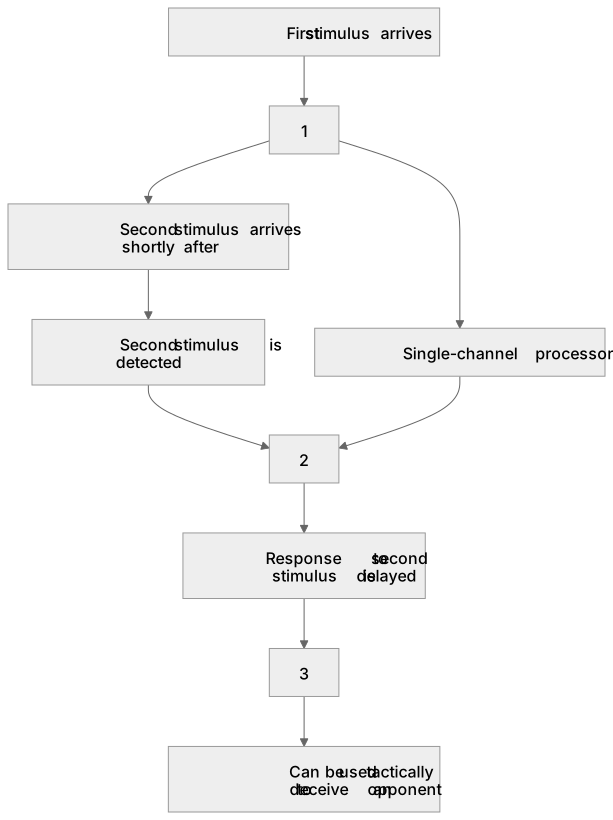
1Box 1
2Box 2
3Box 3
There is more to this lesson
The full lesson goes on to check your understanding and help you earn the marks. Create a free account to carry on, with your progress saved.
A week of Premium from your first lesson · Then the free plan continues · No card, no charge
Test your understanding of Efficiency of information processing to include:: Psychological refractory period.
Active recall beats re-reading. Take an instant quiz now to test what you’ve learned and lock it into long-term memory.
A week of Premium from your first lesson · Then the free plan continues · No card, no charge