AQA · A-Level · Physical Education
Course version: 7582 · Version from Sept 2016
Efficiency of information processing to include:: Initial conditions.
In Schmidt's schema theory, initial conditions are one of the four types of information gathered and stored after a movement is performed.
Checked against the AQA 7582 specification (opens in a new tab) on .
- Point 24 of 30
- 4 key terms
Study notes
From the checked teaching notes for this specification point.
The idea
In Schmidt's schema theory, initial conditions are one of the four types of information gathered and stored after a movement is performed. They refer to the information about the environment and the performer's body position before the movement begins. This includes proprioceptive feedback about posture and visual information about the location of opponents or targets. For example, a basketball player notes their distance from the hoop and their body balance before shooting. Initial conditions are combined with response specifications to form the recall schema, which is responsible for initiating the motor programme.
What earns the marks
- Initial conditions are a key component of Schmidt's schema theory, gathered before a movement begins.
- Initial conditions are stored in memory and combined with response specifications to form the recall schema.
- The recall schema uses this information to select the appropriate parameters to initiate the generalised motor programme.
Common mistakes and how to put them right
Treating initial conditions as a generic information processing factor rather than a specific component of Schmidt's schema theory.
Forgetting that initial conditions include internal bodily information (proprioception) as well as external environmental factors.
Confusing initial conditions with response specifications.
Put it right: Initial conditions are the starting state, while response specifications are the parameters chosen for the movement.
Exam tips
- Always link initial conditions to Schmidt's schema theory and the formation of the recall schema.
- Provide a concrete example of an initial condition, such as a tennis player noting their court position before serving.
- Explain that initial conditions are gathered before the movement starts, setting the baseline for parameter selection.
Try the lesson
The start of the Efficiency of information processing to include:: Initial conditions. lesson, made from checked teaching notes for this specification point.
Have a go first
In Schmidt’s schema theory, which of the following is an example of information stored as 'initial conditions' before a basketball player attempts a free throw?
Listen
In Schmidt's schema theory, initial conditions are one of the four types of information gathered and stored after a movement is performed. They refer to the information about the environment and the performer's body position before the movement begins. This includes proprioceptive feedback about posture and visual information about the location of opponents or targets. For example, a basketball player notes their distance from the hoop and their body balance before shooting. Initial conditions are combined with response specifications to form the recall schema, which is responsible for initiating the motor programme. A strong answer earns marks for these points. Initial conditions are a key component of Schmidt's schema theory, gathered before a movement begins. Initial conditions are stored in memory and combined with response specifications to form the recall schema. The recall schema uses this information to select the appropriate parameters to initiate the generalised motor programme. Exam tip: Always link initial conditions to Schmidt's schema theory and the formation of the recall schema.
See it
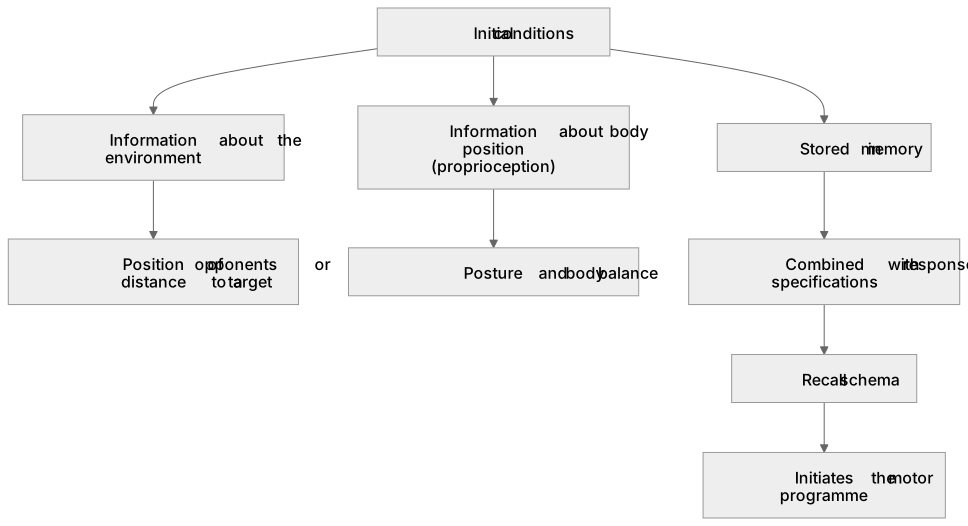
Key words
Say what each word means before you turn the card.
Schmidt's schema theory
Try answering aloud or in your head before turning the card.
Initial conditions
Try answering aloud or in your head before turning the card.
Recall schema
Try answering aloud or in your head before turning the card.
Response specifications
Try answering aloud or in your head before turning the card.
See every definition
- Schmidt's schema theory
- A theory in which initial conditions are one of the four types of information gathered and stored after a movement is performed.
- Initial conditions
- Information about the environment and the performer's body position before the movement begins, including proprioceptive feedback about posture and visual information about the location of opponents or targets.
- Recall schema
- Formed by combining initial conditions with response specifications, and responsible for initiating the motor programme.
- Response specifications
- Combined with initial conditions to form the recall schema.
Label the diagram
Some boxes have lost their names. Pick the right name for each number.
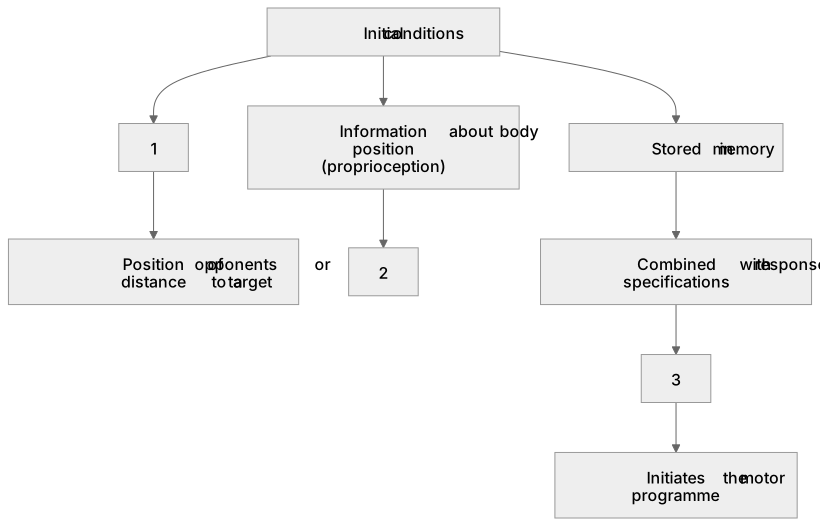
1Box 1
2Box 2
3Box 3
There is more to this lesson
The full lesson goes on to check your understanding and help you earn the marks. Create a free account to carry on, with your progress saved.
A week of Premium from your first lesson · Then the free plan continues · No card, no charge
Test your understanding of Efficiency of information processing to include:: Initial conditions.
Active recall beats re-reading. Take an instant quiz now to test what you’ve learned and lock it into long-term memory.
A week of Premium from your first lesson · Then the free plan continues · No card, no charge