AQA · A-Level · Physical Education
Course version: 7582 · Version from Sept 2016
Muscular system output data.
Full specification wording
Efficiency of information processing to include:: Muscular system output data.
In the information-processing model, muscular system output data refers to the physical motor response or movement produced by muscular contraction following a decision.
Checked against the AQA 7582 specification (opens in a new tab) on .
- Point 8 of 30
- 3 key terms
Study notes
From the checked teaching notes for this specification point.
The idea
In the information-processing model, muscular system output data refers to the physical motor response or movement produced by muscular contraction following a decision. Once the brain (central mechanism) has processed information and selected a motor programme, impulses are sent via the motor nerves to the effector muscles. The resulting action—such as the swing of a tennis racket, a pass in netball, or a tackle in rugby—is the muscular system output. This output is the observable result of the entire information-processing cycle. If the initial perception and decision-making were accurate, the muscular output will likely result in a successful skill execution. Feedback is then gathered based on this output to inform future actions.
What earns the marks
- Defines muscular system output data as the physical motor response or movement produced by muscular contraction.
- Identifies that it occurs after the central mechanism has processed information and made a decision.
- Explains that impulses are sent via motor nerves to the effector muscles to produce the action.
- Gives a sporting example of muscular output, such as executing a tennis forehand or a rugby tackle.
- Links the output to the generation of feedback, which is used to evaluate and adjust future performance.
Common mistakes and how to put them right
Confusing muscular system output data with biomechanical data collection (e.g., force plates or EMG).
Put it right: It refers to the physical movement itself.
Treating output data as the decision itself.
Put it right: Output is the physical execution, not the cognitive choice that preceded it.
Confusing input and output.
Put it right: Sensory information entering the system is input, whereas the resulting muscular movement is output.
Exam tips
- Clearly state that muscular system output is the physical movement or motor response resulting from the decision-making process.
- Use a concrete sporting example, such as a netball pass, to illustrate the observable action.
- Keep the direction of the model clear: sensory input enters, processing occurs centrally, and muscular output results.
Try the lesson
The start of the Efficiency of information processing to include:: Muscular system output data. lesson, made from checked teaching notes for this specification point.
Have a go first
In the information processing model, what is the role of the muscular system output data once a decision has been made?
Listen
In the information-processing model, muscular system output data refers to the physical motor response or movement produced by muscular contraction following a decision. Once the brain (central mechanism) has processed information and selected a motor programme, impulses are sent via the motor nerves to the effector muscles. The resulting action—such as the swing of a tennis racket, a pass in netball, or a tackle in rugby—is the muscular system output. This output is the observable result of the entire information-processing cycle. If the initial perception and decision-making were accurate, the muscular output will likely result in a successful skill execution. Feedback is then gathered based on this output to inform future actions. A strong answer earns marks for these points. Defines muscular system output data as the physical motor response or movement produced by muscular contraction. Identifies that it occurs after the central mechanism has processed information and made a decision. Explains that impulses are sent via motor nerves to the effector muscles to produce the action. Gives a sporting example of muscular output, such as executing a tennis forehand or a rugby tackle. Exam tip: Clearly state that muscular system output is the physical movement or motor response resulting from the decision-making process.
See it
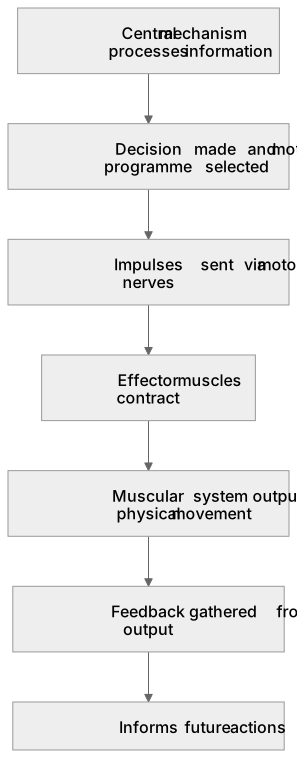
Put it in order
Put these steps in the order they happen.
- 1. Informs future actions
- 2. Feedback gathered from output
- 3. Impulses sent via motor nerves
- 4. Muscular system output: physical movement
- 5. Central mechanism processes information
- 6. Decision made and motor programme selected
- 7. Effector muscles contract
Key words
Say what each word means before you turn the card.
Motor response
Try answering aloud or in your head before turning the card.
Effector mechanism
Try answering aloud or in your head before turning the card.
Feedback and skill execution
Try answering aloud or in your head before turning the card.
See every definition
- Motor response
- The physical motor response or movement produced by muscular contraction following a decision.
- Effector mechanism
- Impulses are sent via the motor nerves to the effector muscles to produce the action.
- Feedback and skill execution
- Feedback is gathered based on the output to inform future actions, and accurate perception and decision-making will likely result in a successful skill execution.
Label the diagram
Some boxes have lost their names. Pick the right name for each number.
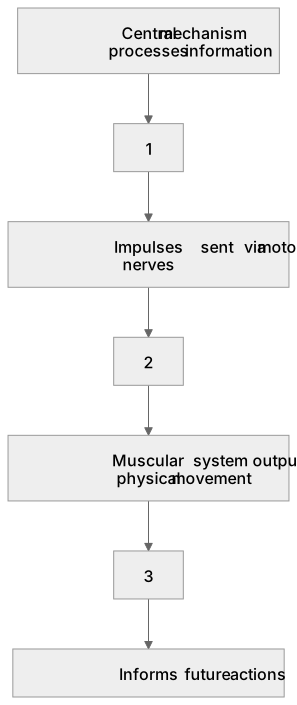
1Box 1
2Box 2
3Box 3
There is more to this lesson
The full lesson goes on to check your understanding and help you earn the marks. Create a free account to carry on, with your progress saved.
A week of Premium from your first lesson · Then the free plan continues · No card, no charge
Test your understanding of Efficiency of information processing to include:: Muscular system output data.
Active recall beats re-reading. Take an instant quiz now to test what you’ve learned and lock it into long-term memory.
A week of Premium from your first lesson · Then the free plan continues · No card, no charge