AQA · A-Level · Physical Education
Course version: 7582 · Version from Sept 2016
Efficiency of information processing to include:: Sensory organs.
Sensory organs are the structures that detect information from the display and send it to the brain for processing.
Checked against the AQA 7582 specification (opens in a new tab) on .
- Point 4 of 30
- 4 key terms
Study notes
From the checked teaching notes for this specification point.
The idea
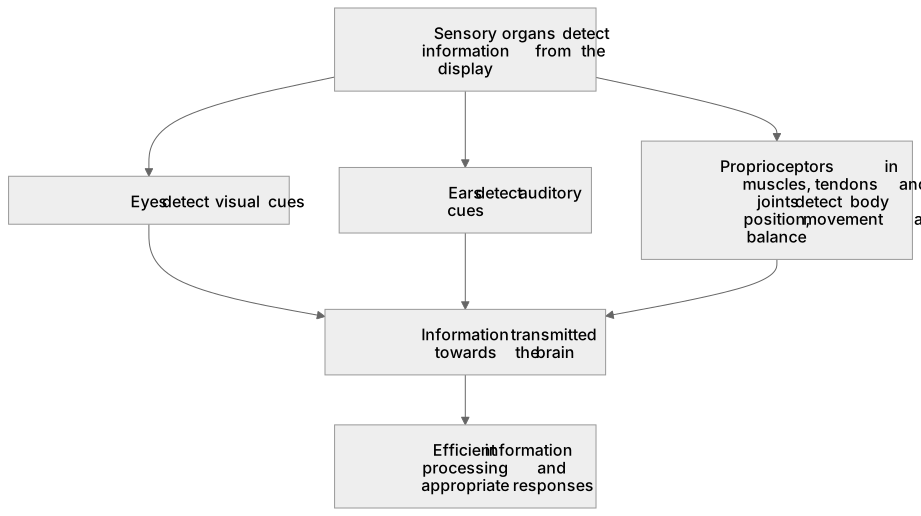
Sensory organs are the structures that detect information from the display and send it to the brain for processing. In AQA A-Level Physical Education, the key sensory organs for movement are the eyes, which detect visual cues such as the flight of a ball, and the ears, which detect auditory cues such as a teammate's call. Proprioceptors in muscles, tendons and joints also provide internal information about body position and movement, which supports balance and coordination. A gymnast landing a vault, for example, uses vision to judge the mat, hearing to pick up a coach's instruction and proprioception to sense limb position. Efficient processing depends on these organs detecting accurate information quickly.
What earns the marks
- Sensory organs detect information from the display and transmit it towards the brain.
- The eyes detect visual cues such as the position of a ball, opponents or teammates.
- The ears detect auditory cues such as instructions, calls or the sound of a whistle.
- Proprioceptors in muscles, tendons and joints detect body position, movement and balance.
- Accurate and rapid detection by sensory organs supports efficient information processing and appropriate responses.
Common mistakes and how to put them right
Listing only the eyes and ears.
Put it right: Proprioceptors are also sensory receptors relevant to movement.
Confusing sensory organs with the brain.
Put it right: The organs detect information, while the brain interprets it.
Assuming sensory organs decide the response.
Put it right: Decision making occurs after perception in the brain.
Ignoring internal senses: proprioception is essential for balance and coordinated movement.
Exam tips
- Name the specific sensory organ and the type of cue it detects in each example.
- Link sensory detection to a sporting action so the role of each organ is clear.
- Use the term proprioception when discussing balance, body awareness or limb position.
Try the lesson
The start of the Efficiency of information processing to include:: Sensory organs. lesson, made from checked teaching notes for this specification point.
Have a go first
Which sensory organ contains the receptors that detect the position and movement of the head, helping a gymnast keep balance during a routine?
Listen
Sensory organs are the structures that detect information from the display and send it to the brain for processing. In AQA A-Level Physical Education, the key sensory organs for movement are the eyes, which detect visual cues such as the flight of a ball, and the ears, which detect auditory cues such as a teammate's call. Proprioceptors in muscles, tendons and joints also provide internal information about body position and movement, which supports balance and coordination. A gymnast landing a vault, for example, uses vision to judge the mat, hearing to pick up a coach's instruction and proprioception to sense limb position. Efficient processing depends on these organs detecting accurate information quickly. A strong answer earns marks for these points. Sensory organs detect information from the display and transmit it towards the brain. The eyes detect visual cues such as the position of a ball, opponents or teammates. The ears detect auditory cues such as instructions, calls or the sound of a whistle. Proprioceptors in muscles, tendons and joints detect body position, movement and balance. Exam tip: Name the specific sensory organ and the type of cue it detects in each example.
See it
Key words
Say what each word means before you turn the card.
Sensory detection
Try answering aloud or in your head before turning the card.
Visual and auditory cues
Try answering aloud or in your head before turning the card.
Proprioception and balance
Try answering aloud or in your head before turning the card.
Information processing in sport
Try answering aloud or in your head before turning the card.
See every definition
- Sensory detection
- Structures detect information from the display and send it to the brain for processing.
- Visual and auditory cues
- The eyes detect visual cues such as the flight of a ball, and the ears detect auditory cues such as a teammate's call.
- Proprioception and balance
- Proprioceptors in muscles, tendons and joints provide internal information about body position and movement, which supports balance and coordination.
- Information processing in sport
- Efficient processing depends on the sensory organs detecting accurate information quickly, supporting efficient information processing and appropriate responses.
Label the diagram
Some boxes have lost their names. Pick the right name for each number.
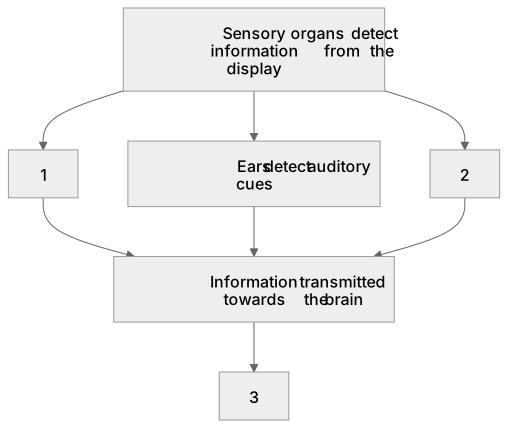
1Box 1
2Box 2
3Box 3
There is more to this lesson
The full lesson goes on to check your understanding and help you earn the marks. Create a free account to carry on, with your progress saved.
A week of Premium from your first lesson · Then the free plan continues · No card, no charge
Test your understanding of Efficiency of information processing to include:: Sensory organs.
Active recall beats re-reading. Take an instant quiz now to test what you’ve learned and lock it into long-term memory.
A week of Premium from your first lesson · Then the free plan continues · No card, no charge