AQA · A-Level · Physical Education
Course version: 7582 · Version from Sept 2016
Efficiency of information processing to include:: Display.
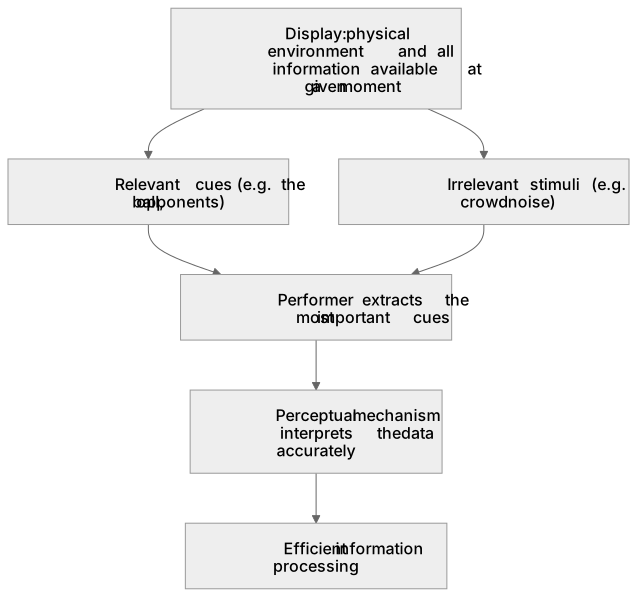
In Whiting's information processing model, the display is the physical environment and all the information available to the performer at a given moment.
Checked against the AQA 7582 specification (opens in a new tab) on .
- Point 3 of 30
- 3 key terms
Study notes
From the checked teaching notes for this specification point.
The idea
In Whiting's information processing model, the display is the physical environment and all the information available to the performer at a given moment. It is the starting point of the model, existing before the performer's sensory organs detect the information or selective attention filters it. For a netball centre preparing to receive a pass, the display includes the ball, the feeder's body position, nearby opponents, teammates, court markings, and crowd noise. The display contains both relevant and irrelevant stimuli. Efficient information processing relies on the performer's ability to extract the most important cues from this display, allowing the perceptual mechanism to interpret the data accurately without being overwhelmed by unnecessary environmental noise.
What earns the marks
- Display is the physical environment and all the information available to the performer at a given time.
- The display contains a mixture of relevant cues (e.g., the ball, opponents) and irrelevant stimuli (e.g., crowd noise).
- Efficient processing requires the performer to extract appropriate cues from the display for the perceptual mechanism.
Common mistakes and how to put them right
Confusing display with selective attention.
Put it right: Display is the external environment, whereas selective attention is the internal filtering of that information.
Defining display as the act of looking or directing attention, rather than the information itself.
Assuming the display only contains useful information.
Put it right: It actually includes all environmental stimuli, both relevant and irrelevant.
Exam tips
- Define display clearly as the environment or available information, not as a process performed by the athlete.
- Give examples of both relevant and irrelevant cues within a specific sporting display to show depth of understanding.
- Place display at the very beginning of Whiting's model, before the sensory organs and perceptual mechanism.
Try the lesson
The start of the Efficiency of information processing to include:: Display. lesson, made from checked teaching notes for this specification point.
Have a go first
In the context of information processing, what is meant by 'display'?
Listen
In Whiting's information processing model, the display is the physical environment and all the information available to the performer at a given moment. It is the starting point of the model, existing before the performer's sensory organs detect the information or selective attention filters it. For a netball centre preparing to receive a pass, the display includes the ball, the feeder's body position, nearby opponents, teammates, court markings, and crowd noise. The display contains both relevant and irrelevant stimuli. Efficient information processing relies on the performer's ability to extract the most important cues from this display, allowing the perceptual mechanism to interpret the data accurately without being overwhelmed by unnecessary environmental noise. A strong answer earns marks for these points. Display is the physical environment and all the information available to the performer at a given time. The display contains a mixture of relevant cues (e.g., the ball, opponents) and irrelevant stimuli (e.g., crowd noise). Efficient processing requires the performer to extract appropriate cues from the display for the perceptual mechanism. Exam tip: Define display clearly as the environment or available information, not as a process performed by the athlete.
See it
Key words
Say what each word means before you turn the card.
Display
Try answering aloud or in your head before turning the card.
Whiting's model
Try answering aloud or in your head before turning the card.
Sporting environment cues
Try answering aloud or in your head before turning the card.
See every definition
- Display
- The physical environment and all the information available to the performer at a given moment.
- Whiting's model
- An information processing model in which the display is the starting point, existing before sensory organs detect information or selective attention filters it.
- Sporting environment cues
- The relevant and irrelevant stimuli within the display, from which the performer must extract the most important cues.
Label the diagram
Some boxes have lost their names. Pick the right name for each number.
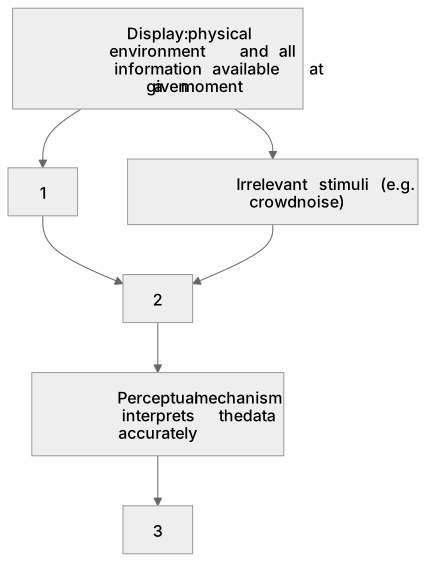
1Box 1
2Box 2
3Box 3
There is more to this lesson
The full lesson goes on to check your understanding and help you earn the marks. Create a free account to carry on, with your progress saved.
A week of Premium from your first lesson · Then the free plan continues · No card, no charge
Test your understanding of Efficiency of information processing to include:: Display.
Active recall beats re-reading. Take an instant quiz now to test what you’ve learned and lock it into long-term memory.
A week of Premium from your first lesson · Then the free plan continues · No card, no charge