AQA · A-Level · Physical Education
Course version: 7582 · Version from Sept 2016
Efficiency of information processing to include:: Single channel hypothesis.
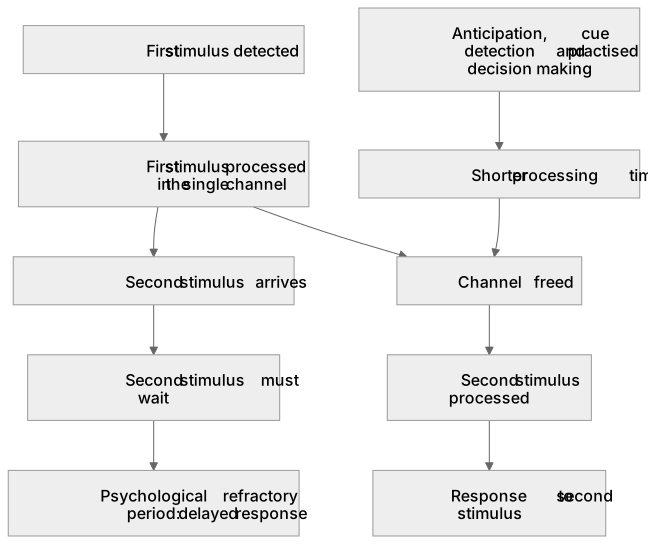
The single channel hypothesis states that a performer can process only one piece of information at a time, so a second stimulus must wait until the first has been processed.
Checked against the AQA 7582 specification (opens in a new tab) on .
- Point 16 of 30
- 2 key terms
Study notes
From the checked teaching notes for this specification point.
The idea
The single channel hypothesis states that a performer can process only one piece of information at a time, so a second stimulus must wait until the first has been processed. In AQA A-Level Physical Education, this hypothesis is used to explain the psychological refractory period and the limits of decision making in fast sports. For example, a cricket batsman facing a disguised slower ball may begin a shot, then have to adjust to a different delivery; the adjustment is delayed because the first decision is still occupying the channel. The hypothesis does not mean that performers cannot attend to several things, but that central decision making is serial. Efficient performers reduce the delay through anticipation, cue detection and practised decision making, which shortens processing time and frees the channel sooner.
What earns the marks
- States that the single channel hypothesis proposes that only one piece of information can be processed at a time.
- Explains that a second stimulus must wait until the first has been processed.
- Links the hypothesis to the psychological refractory period and delayed responses.
- Applies the hypothesis to a sporting example where a performer must adjust to a second stimulus.
- Recognises that anticipation and practice can reduce, but not remove, the processing delay.
Common mistakes and how to put them right
Thinking the single channel hypothesis means a performer cannot see or hear a second stimulus.
Put it right: The stimulus may be detected, but central processing of it is delayed.
Confusing the hypothesis with the psychological refractory period.
Put it right: The hypothesis is the explanation, while the psychological refractory period is the observable delay.
Assuming skilled performers have unlimited parallel processing.
Put it right: Skilled performers process more efficiently and anticipate better, but the single-channel limitation still applies.
Believing that the hypothesis applies only to beginners.
Put it right: It describes a general limitation of information processing for all performers.
Exam tips
- State the hypothesis clearly: one piece of information is processed at a time.
- Use the term 'serial processing' to show understanding of the mechanism.
- Link the hypothesis directly to the psychological refractory period in your explanation.
- Support your answer with a sporting example that shows a delayed response to a second stimulus.
Try the lesson
The start of the Efficiency of information processing to include:: Single channel hypothesis. lesson, made from checked teaching notes for this specification point.
Have a go first
What does the single channel hypothesis state about information processing?
Listen
The single channel hypothesis states that a performer can process only one piece of information at a time, so a second stimulus must wait until the first has been processed. In AQA A-Level Physical Education, this hypothesis is used to explain the psychological refractory period and the limits of decision making in fast sports. For example, a cricket batsman facing a disguised slower ball may begin a shot, then have to adjust to a different delivery; the adjustment is delayed because the first decision is still occupying the channel. The hypothesis does not mean that performers cannot attend to several things, but that central decision making is serial. Efficient performers reduce the delay through anticipation, cue detection and practised decision making, which shortens processing time and frees the channel sooner. A strong answer earns marks for these points. States that the single channel hypothesis proposes that only one piece of information can be processed at a time. Explains that a second stimulus must wait until the first has been processed. Links the hypothesis to the psychological refractory period and delayed responses. Applies the hypothesis to a sporting example where a performer must adjust to a second stimulus. A common slip: Thinking the single channel hypothesis means a performer cannot see or hear a second stimulus. Instead, the stimulus may be detected, but central processing of it is delayed. Exam tip: State the hypothesis clearly: one piece of information is processed at a time.
See it
Key words
Say what each word means before you turn the card.
Serial processing
Try answering aloud or in your head before turning the card.
Psychological refractory period
Try answering aloud or in your head before turning the card.
See every definition
- Serial processing
- Central decision making that deals with one piece of information at a time, so a second stimulus must wait until the first has been processed.
- Psychological refractory period
- The observable delay that occurs when a second stimulus must wait until the first has been processed, as explained by the single channel hypothesis.
Label the diagram
Some boxes have lost their names. Pick the right name for each number.
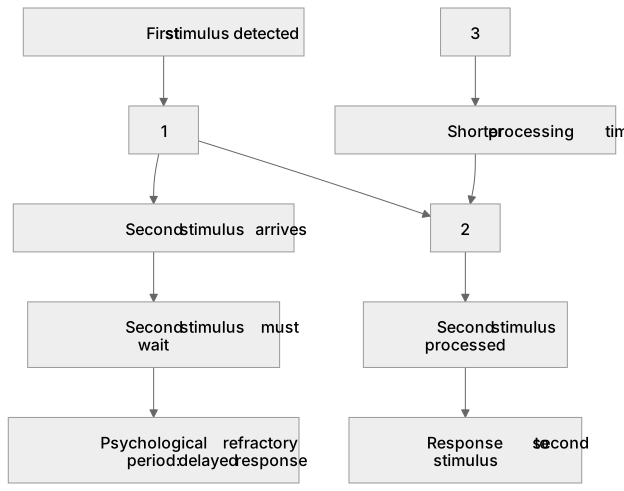
1Box 1
2Box 2
3Box 3
There is more to this lesson
The full lesson goes on to check your understanding and help you earn the marks. Create a free account to carry on, with your progress saved.
A week of Premium from your first lesson · Then the free plan continues · No card, no charge
Test your understanding of Efficiency of information processing to include:: Single channel hypothesis.
Active recall beats re-reading. Take an instant quiz now to test what you’ve learned and lock it into long-term memory.
A week of Premium from your first lesson · Then the free plan continues · No card, no charge