AQA · A-Level · Physical Education
Course version: 7582 · Version from Sept 2016
Efficiency of information processing to include:: Spatial.
Spatial anticipation is a key factor in the efficiency of information processing, involving the prediction of what will happen and where an event will occur in the sporting environment.
Checked against the AQA 7582 specification (opens in a new tab) on .
- Point 19 of 30
- 3 key terms
Study notes
From the checked teaching notes for this specification point.
The idea
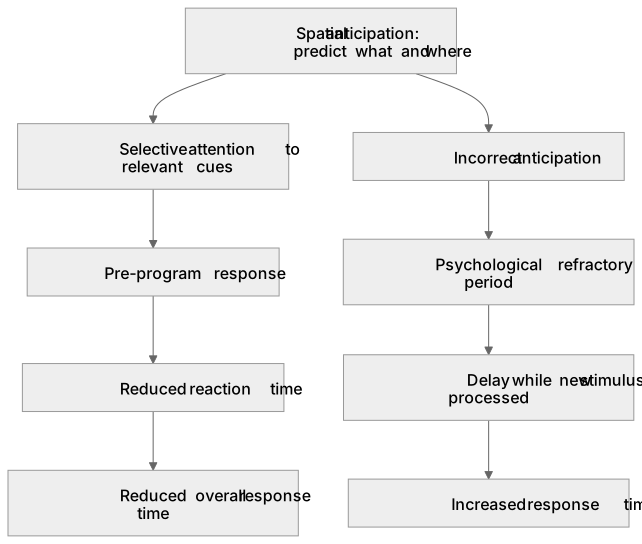
Spatial anticipation is a key factor in the efficiency of information processing, involving the prediction of what will happen and where an event will occur in the sporting environment. In AQA A-Level Physical Education, it is studied alongside temporal anticipation (predicting when it will happen). By correctly anticipating spatial cues—such as a goalkeeper reading a penalty taker's body shape to predict the ball's placement—a performer can pre-program their response. This significantly reduces reaction time and overall response time, making processing more efficient. However, if the spatial anticipation is incorrect, the performer will suffer a delay due to the psychological refractory period, as they must process the new, correct stimulus before responding.
What earns the marks
- Spatial anticipation involves predicting what action will occur and where it will take place in the environment.
- Successful spatial anticipation reduces reaction time and overall response time.
- Incorrect spatial anticipation increases response time due to the psychological refractory period, as the initial response must be inhibited.
Common mistakes and how to put them right
Confusing spatial anticipation with temporal anticipation.
Put it right: Spatial is predicting what and where, while temporal is predicting when.
Assuming anticipation eliminates movement time.
Put it right: It only reduces reaction time, not the time taken to physically move.
Believing anticipation is just guessing.
Put it right: It is an educated prediction based on experience, stored memories and relevant cues.
Exam tips
- Use a specific sporting example, such as a tennis player predicting the direction of a serve, to illustrate spatial anticipation.
- Link spatial anticipation to a reduction in reaction time to show its effect on information processing efficiency.
- Mention the negative consequences of incorrect anticipation, referencing the psychological refractory period.
Try the lesson
The start of the Efficiency of information processing to include:: Spatial. lesson, made from checked teaching notes for this specification point.
Have a go first
A football goalkeeper observes a penalty taker's run-up and body shape to predict which side of the goal the ball will be kicked towards. Which term describes this aspect of information processing?
Listen
Spatial anticipation is a key factor in the efficiency of information processing, involving the prediction of what will happen and where an event will occur in the sporting environment. In AQA A-Level Physical Education, it is studied alongside temporal anticipation (predicting when it will happen). By correctly anticipating spatial cues—such as a goalkeeper reading a penalty taker's body shape to predict the ball's placement—a performer can pre-program their response. This significantly reduces reaction time and overall response time, making processing more efficient. However, if the spatial anticipation is incorrect, the performer will suffer a delay due to the psychological refractory period, as they must process the new, correct stimulus before responding. A strong answer earns marks for these points. Spatial anticipation involves predicting what action will occur and where it will take place in the environment. Successful spatial anticipation reduces reaction time and overall response time. Incorrect spatial anticipation increases response time due to the psychological refractory period, as the initial response must be inhibited. Exam tip: Use a specific sporting example, such as a tennis player predicting the direction of a serve, to illustrate spatial anticipation.
See it
Key words
Say what each word means before you turn the card.
Spatial anticipation
Try answering aloud or in your head before turning the card.
Reaction time
Try answering aloud or in your head before turning the card.
Psychological refractory period
Try answering aloud or in your head before turning the card.
See every definition
- Spatial anticipation
- Predicting what action will occur and where it will take place in the environment.
- Reaction time
- A measure that is reduced, along with overall response time, when spatial anticipation is successful.
- Psychological refractory period
- A delay suffered when spatial anticipation is incorrect, as the new, correct stimulus must be processed before responding.
Label the diagram
Some boxes have lost their names. Pick the right name for each number.
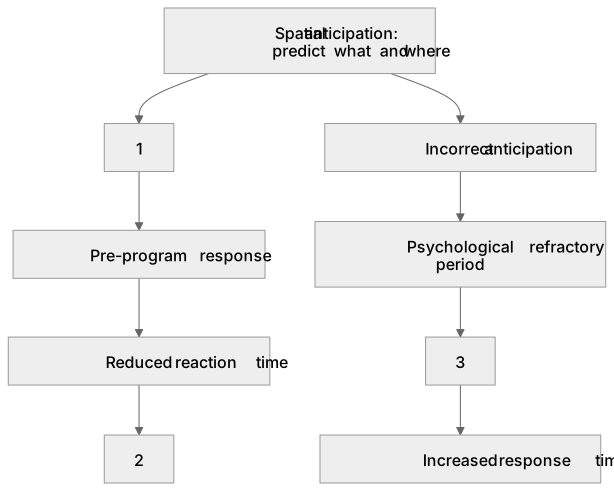
1Box 1
2Box 2
3Box 3
There is more to this lesson
The full lesson goes on to check your understanding and help you earn the marks. Create a free account to carry on, with your progress saved.
A week of Premium from your first lesson · Then the free plan continues · No card, no charge
Test your understanding of Efficiency of information processing to include:: Spatial.
Active recall beats re-reading. Take an instant quiz now to test what you’ve learned and lock it into long-term memory.
A week of Premium from your first lesson · Then the free plan continues · No card, no charge