AQA · A-Level · Physical Education
Course version: 7582 · Version from Sept 2016
Strategies to improve response time.
Full specification wording
Efficiency of information processing to include:: Strategies to improve response time.
Response time is the total time from the onset of a stimulus to the completion of a movement, calculated by adding reaction time and movement time.
Checked against the AQA 7582 specification (opens in a new tab) on .
- Point 20 of 30
- 4 key terms
Study notes
From the checked teaching notes for this specification point.
The idea
Response time is the total time from the onset of a stimulus to the completion of a movement, calculated by adding reaction time and movement time. Strategies to improve response time must target these distinct components. Reaction time can be shortened by improving selective attention to filter out irrelevant cues, using mental rehearsal, and developing spatial and temporal anticipation through practice. For example, a sprinter practising to the gun improves their reaction time. Movement time is improved through physical training, such as developing muscular power, speed, and technique. It is crucial to recognise that improving reaction time does not shorten movement time; they are separate elements, but enhancing either will lead to a faster overall response time.
What earns the marks
- Response time is the sum of reaction time and movement time, and strategies can target either component.
- Reaction time can be improved by developing spatial and temporal anticipation through game-specific practice.
- Enhancing selective attention reduces the time taken to process information, thereby shortening reaction time.
- Movement time can be decreased by improving physical fitness components such as speed, power and technique.
- Mental rehearsal and pre-programming responses can prepare the performer, reducing the decision-making stage of reaction time.
Common mistakes and how to put them right
Stating that improving reaction time shortens movement time.
Put it right: They are separate components of response time.
Using reaction time and response time interchangeably.
Put it right: Response time includes the physical movement, whereas reaction time ends when movement begins.
Believing that physical fitness improves reaction time.
Put it right: Fitness improves movement time, while cognitive strategies and practice improve reaction time.
Exam tips
- Clearly distinguish between strategies that improve reaction time and those that improve movement time.
- State the formula (Response Time = Reaction Time + Movement Time) to structure your answer.
- Provide a specific sporting example for both a cognitive strategy (e.g., anticipation) and a physical strategy (e.g., speed training).
Try the lesson
The start of the Efficiency of information processing to include:: Strategies to improve response time. lesson, made from checked teaching notes for this specification point.
Have a go first
Which of the following strategies is most likely to improve a performer's response time by reducing the time taken to process environmental information?
Listen
Response time is the total time from the onset of a stimulus to the completion of a movement, calculated by adding reaction time and movement time. Strategies to improve response time must target these distinct components. Reaction time can be shortened by improving selective attention to filter out irrelevant cues, using mental rehearsal, and developing spatial and temporal anticipation through practice. For example, a sprinter practising to the gun improves their reaction time. Movement time is improved through physical training, such as developing muscular power, speed, and technique. It is crucial to recognise that improving reaction time does not shorten movement time; they are separate elements, but enhancing either will lead to a faster overall response time. A strong answer earns marks for these points. Response time is the sum of reaction time and movement time, and strategies can target either component. Reaction time can be improved by developing spatial and temporal anticipation through game-specific practice. Enhancing selective attention reduces the time taken to process information, thereby shortening reaction time. Movement time can be decreased by improving physical fitness components such as speed, power and technique. Exam tip: Clearly distinguish between strategies that improve reaction time and those that improve movement time.
See it

Key words
Say what each word means before you turn the card.
Response time
Try answering aloud or in your head before turning the card.
Reaction time
Try answering aloud or in your head before turning the card.
Selective attention
Try answering aloud or in your head before turning the card.
Movement time
Try answering aloud or in your head before turning the card.
See every definition
- Response time
- The total time from the onset of a stimulus to the completion of a movement, calculated by adding reaction time and movement time.
- Reaction time
- The component of response time that ends when movement begins and can be shortened by improving selective attention, using mental rehearsal and developing anticipation through practice.
- Selective attention
- Filtering out irrelevant cues, which shortens reaction time by reducing the time taken to process information.
- Movement time
- The component of response time improved through physical training, such as developing muscular power, speed and technique.
Label the diagram
Some boxes have lost their names. Pick the right name for each number.
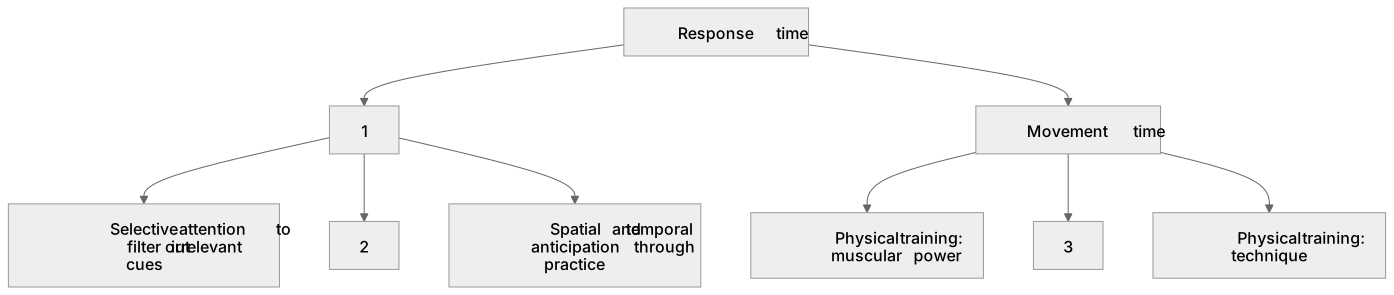
1Box 1
2Box 2
3Box 3
There is more to this lesson
The full lesson goes on to check your understanding and help you earn the marks. Create a free account to carry on, with your progress saved.
A week of Premium from your first lesson · Then the free plan continues · No card, no charge
Test your understanding of Efficiency of information processing to include:: Strategies to improve response time.
Active recall beats re-reading. Take an instant quiz now to test what you’ve learned and lock it into long-term memory.
A week of Premium from your first lesson · Then the free plan continues · No card, no charge