AQA · A-Level · Physical Education
Course version: 7582 · Version from Sept 2016
Efficiency of information processing to include:: Translatory mechanism.
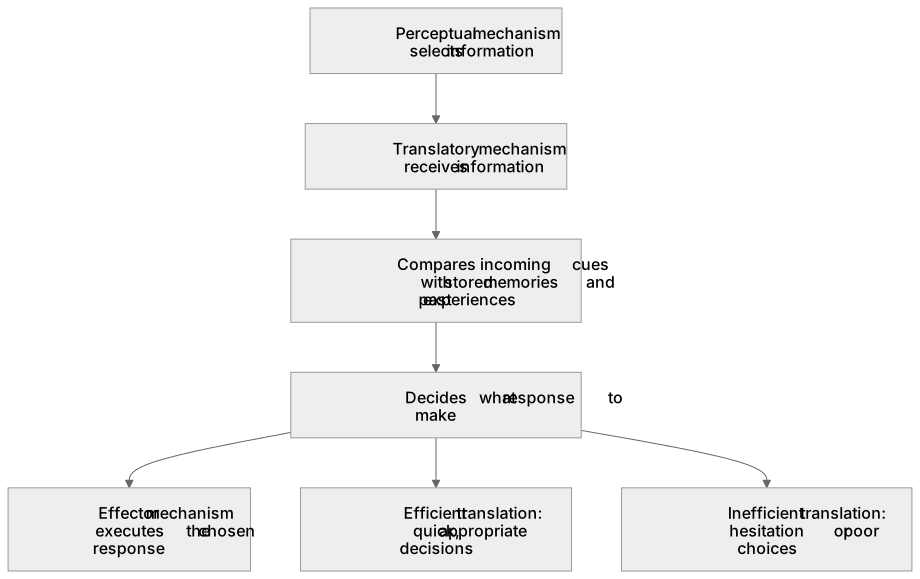
The translatory mechanism is the second stage of information processing: it receives the information selected by the perceptual mechanism and converts it into a decision or action plan.
Checked against the AQA 7582 specification (opens in a new tab) on .
- Point 6 of 30
- 4 key terms
Study notes
From the checked teaching notes for this specification point.
The idea
The translatory mechanism is the second stage of information processing: it receives the information selected by the perceptual mechanism and converts it into a decision or action plan. It compares incoming cues with stored memories and past experiences, then decides what response to make. For example, a football player perceives a teammate's run, the translatory mechanism decides whether to pass, shoot or dribble, and the effector mechanism then sends the chosen movement to the muscles. Efficient translation produces quick, appropriate decisions; inefficient translation causes hesitation or poor choices. The mechanism links perception to action and depends on memory, anticipation and decision-making skills. It does not itself produce movement; it prepares the decision that the effector mechanism will execute.
What earns the marks
- The translatory mechanism receives information selected by the perceptual mechanism.
- Efficient translation produces quick, appropriate decisions; inefficient translation causes hesitation or poor choices.
Common mistakes and how to put them right
Thinking the translatory mechanism produces the muscular movement.
Put it right: It makes the decision, while the effector mechanism sends the impulse to the muscles.
Confusing the translatory mechanism with the perceptual mechanism.
Put it right: Perception detects and interprets information, while translation decides what to do with it.
Believing the translatory mechanism works without memory.
Put it right: It compares current cues with stored memories and past experiences to choose a response.
Assuming the translatory mechanism is only used in complex sports.
Put it right: It operates in all information-processing tasks, from simple reactions to complex game play.
Exam tips
- Look for the word 'decision' or 'action plan' in an option to identify the translatory mechanism, and reject options that describe detection or muscular execution.
- Link each option to a stage of information processing: perceptual, translatory or effector, and choose the one that matches the question's focus.
- Use a sporting example such as a football player deciding to pass to check whether an option describes translation rather than perception or execution.
Try the lesson
The start of the Efficiency of information processing to include:: Translatory mechanism. lesson, made from checked teaching notes for this specification point.
Have a go first
In Whiting's information processing model, what is the specific function of the translatory mechanism during a sporting performance?
Listen
The translatory mechanism is the second stage of information processing: it receives the information selected by the perceptual mechanism and converts it into a decision or action plan. It compares incoming cues with stored memories and past experiences, then decides what response to make. For example, a football player perceives a teammate's run, the translatory mechanism decides whether to pass, shoot or dribble, and the effector mechanism then sends the chosen movement to the muscles. Efficient translation produces quick, appropriate decisions; inefficient translation causes hesitation or poor choices. The mechanism links perception to action and depends on memory, anticipation and decision-making skills. It does not itself produce movement; it prepares the decision that the effector mechanism will execute. A strong answer earns marks for these points. The translatory mechanism receives information selected by the perceptual mechanism. Efficient translation produces quick, appropriate decisions; inefficient translation causes hesitation or poor choices. A common slip: Thinking the translatory mechanism produces the muscular movement. Instead, it makes the decision, while the effector mechanism sends the impulse to the muscles. Exam tip: Look for the word 'decision' or 'action plan' in an option to identify the translatory mechanism, and reject options that describe detection or muscular execution.
See it
Key words
Say what each word means before you turn the card.
Translatory mechanism
Try answering aloud or in your head before turning the card.
Decision making
Try answering aloud or in your head before turning the card.
Comparison with stored memory
Try answering aloud or in your head before turning the card.
Link from perception to action
Try answering aloud or in your head before turning the card.
See every definition
- Translatory mechanism
- The second stage of information processing, which receives the information selected by the perceptual mechanism and converts it into a decision or action plan.
- Decision making
- Deciding what response to make, such as passing, shooting or dribbling in football, which the mechanism depends on along with memory and anticipation.
- Comparison with stored memory
- Comparing incoming cues with stored memories and past experiences in order to decide what response to make.
- Link from perception to action
- The mechanism links perception to action and does not itself produce movement; it prepares the decision that the effector mechanism will execute.
Label the diagram
Some boxes have lost their names. Pick the right name for each number.
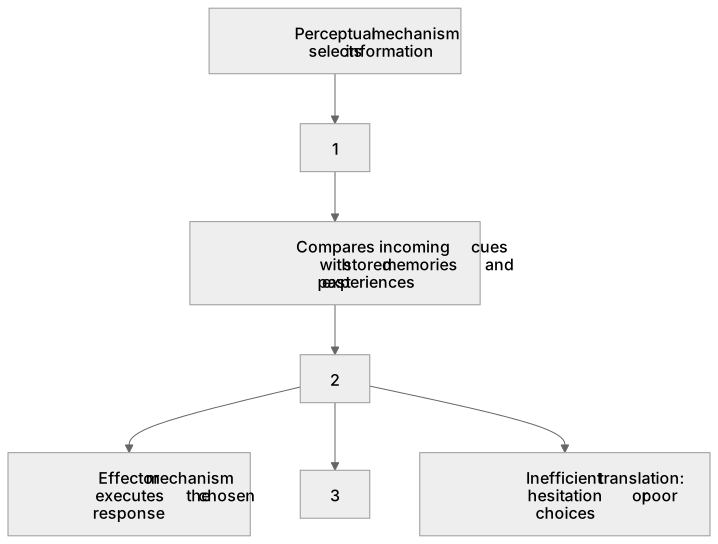
1Box 1
2Box 2
3Box 3
There is more to this lesson
The full lesson goes on to check your understanding and help you earn the marks. Create a free account to carry on, with your progress saved.
A week of Premium from your first lesson · Then the free plan continues · No card, no charge
Test your understanding of Efficiency of information processing to include:: Translatory mechanism.
Active recall beats re-reading. Take an instant quiz now to test what you’ve learned and lock it into long-term memory.
A week of Premium from your first lesson · Then the free plan continues · No card, no charge