AQA · A-Level · Physical Education
Course version: 7582 · Version from Sept 2016
Energy transfer during short duration/high intensity exercise.
Full specification wording
Energy systems: Energy transfer during short duration/high intensity exercise.
During short duration, high intensity exercise, ATP is regenerated mainly anaerobically.
Checked against the AQA 7582 specification (opens in a new tab) on .
- Point 8 of 26
- 4 key terms
Study notes
From the checked teaching notes for this specification point.
The idea
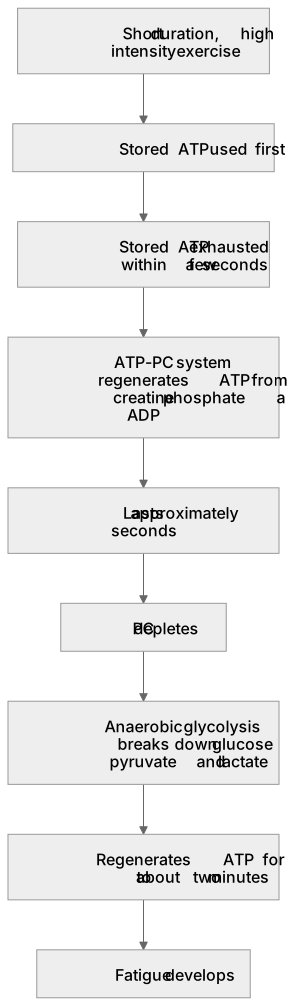
During short duration, high intensity exercise, ATP is regenerated mainly anaerobically. At the very start, stored ATP is used for a few seconds. The phosphocreatine (PC) system then rapidly regenerates ATP from creatine phosphate and ADP, lasting around 10 seconds. As PC depletes, anaerobic glycolysis breaks down glucose to pyruvate and lactate, producing ATP for up to about two minutes. These systems do not require oxygen, so they supply ATP quickly but fatigue develops. A 100 m sprint relies on PC and glycolysis; a 400 m race relies more on glycolysis. Aerobic respiration contributes little at maximal intensity.
What earns the marks
- Short duration, high intensity exercise relies on anaerobic energy transfer because oxygen supply cannot meet demand quickly enough.
- The ATP-PC (phosphocreatine) system regenerates ATP rapidly from creatine phosphate and ADP for approximately the first 10 seconds.
- Anaerobic glycolysis breaks down glucose to pyruvate, forming lactate, and regenerates ATP for up to about two minutes.
- Stored ATP is used first but is exhausted within a few seconds.
- Aerobic respiration contributes little during maximal short duration exercise because it is slower to meet ATP demand.
Common mistakes and how to put them right
Thinking aerobic respiration is the main ATP source in a 100 m sprint.
Put it right: The PC system and anaerobic glycolysis dominate because they do not require oxygen and work faster.
Believing lactate is the cause of all fatigue.
Put it right: Fatigue in short high intensity exercise is multifactorial, including PC depletion and accumulation of metabolites such as hydrogen ions.
Confusing the duration of the PC system with that of anaerobic glycolysis.
Put it right: PC lasts about 10 seconds, while glycolysis can supply ATP for up to roughly two minutes.
Assuming oxygen is completely absent.
Put it right: Oxygen is present but its delivery and use are too slow to meet the ATP demand at maximal intensity.
Exam tips
- Name the specific energy system and give an approximate duration or sporting example to show precise knowledge.
- Use correct terminology such as 'phosphocreatine', 'ADP', 'anaerobic glycolysis' and 'lactate' rather than vague terms like 'energy'.
- Explain why the system is suited to short duration, high intensity exercise by linking speed of ATP regeneration to intensity and fatigue.
Try the lesson
The start of the Energy systems: Energy transfer during short duration/high intensity exercise. lesson, made from checked teaching notes for this specification point.
Have a go first
Which energy system provides most of the ATP during the first few seconds of a maximal effort such as a 100 m sprint start?
Listen
During short duration, high intensity exercise, ATP is regenerated mainly anaerobically. At the very start, stored ATP is used for a few seconds. The phosphocreatine (PC) system then rapidly regenerates ATP from creatine phosphate and ADP, lasting around 10 seconds. As PC depletes, anaerobic glycolysis breaks down glucose to pyruvate and lactate, producing ATP for up to about two minutes. These systems do not require oxygen, so they supply ATP quickly but fatigue develops. A 100 m sprint relies on PC and glycolysis; a 400 m race relies more on glycolysis. Aerobic respiration contributes little at maximal intensity. A strong answer earns marks for these points. Short duration, high intensity exercise relies on anaerobic energy transfer because oxygen supply cannot meet demand quickly enough. The ATP-PC (phosphocreatine) system regenerates ATP rapidly from creatine phosphate and ADP for approximately the first 10 seconds. Anaerobic glycolysis breaks down glucose to pyruvate, forming lactate, and regenerates ATP for up to about two minutes. Stored ATP is used first but is exhausted within a few seconds. A common slip: Thinking aerobic respiration is the main ATP source in a 100 m sprint. Instead, the PC system and anaerobic glycolysis dominate because they do not require oxygen and work faster. Exam tip: Name the specific energy system and give an approximate duration or sporting example to show precise knowledge.
See it
Key words
Say what each word means before you turn the card.
Anaerobic ATP regeneration
Try answering aloud or in your head before turning the card.
Phosphocreatine system
Try answering aloud or in your head before turning the card.
Anaerobic glycolysis and lactate
Try answering aloud or in your head before turning the card.
Fatigue and exercise duration
Try answering aloud or in your head before turning the card.
See every definition
- Anaerobic ATP regeneration
- During short duration, high intensity exercise, ATP is regenerated mainly anaerobically, without requiring oxygen, so ATP is supplied quickly but fatigue develops.
- Phosphocreatine system
- Rapidly regenerates ATP from creatine phosphate and ADP, lasting around 10 seconds.
- Anaerobic glycolysis and lactate
- Breaks down glucose to pyruvate and lactate, producing ATP for up to about two minutes.
- Fatigue and exercise duration
- These anaerobic systems supply ATP quickly but fatigue develops, limiting performance duration.
Label the diagram
Some boxes have lost their names. Pick the right name for each number.
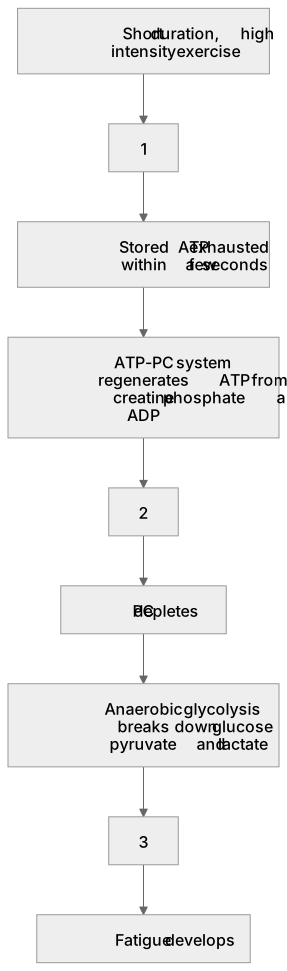
1Box 1
2Box 2
3Box 3
There is more to this lesson
The full lesson goes on to check your understanding and help you earn the marks. Create a free account to carry on, with your progress saved.
A week of Premium from your first lesson · Then the free plan continues · No card, no charge
Test your understanding of Energy systems: Energy transfer during short duration/high intensity exercise.
Active recall beats re-reading. Take an instant quiz now to test what you’ve learned and lock it into long-term memory.
A week of Premium from your first lesson · Then the free plan continues · No card, no charge