Energy systems — AQA A-Level Physical Education
Verified courseTeaching note checked against the official specification.
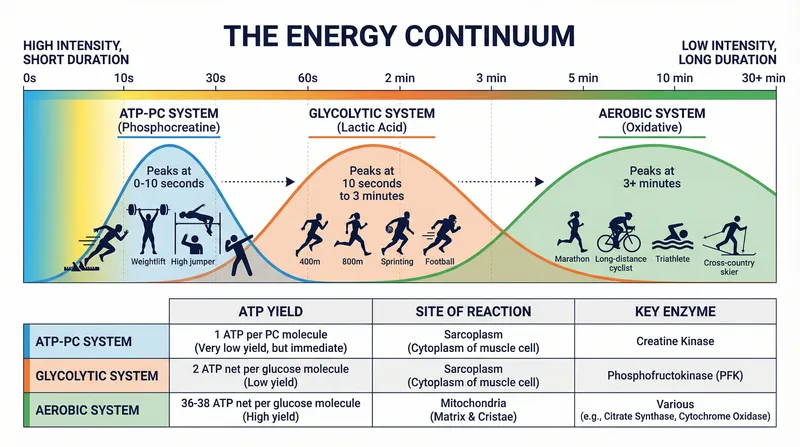
Energy systems are the metabolic pathways the body uses to resynthesise ATP for muscle contraction: the ATP-PC system (immediate, 0-10 seconds), the anaerobic glycolytic system (short-term, 10 seconds-2 minutes), and the aerobic system (long-term, 2 minutes+). Understanding their intensity, duration, fuel sources, and by-products is essential for explaining fatigue, recovery, and training adaptations in AQA A-Level PE.
Energy systems explained
Energy systems covers 26 specification points, including Students should develop knowledge and… and Energy transfer in the body..
Read the full explanation
Open a point below for its explanation and revision guidance.
Students should develop knowledge and understanding of energy systems prior to exercise, during exercise of differing intensities and during recovery.
This outcome asks you to track how the body supplies ATP across three phases. Before exercise, stored ATP and phosphocreatine (PC) provide immediate energy, with the ATP-PC system dominant for the first few seconds. During exercise, intensity selects the system: short maximal work relies on ATP-PC and anaerobic glycolysis, while longer submaximal work shifts towards the aerobic system. During recovery, the body restores ATP and PC stores, clears lactate and replenishes oxygen, using the excess post-exercise oxygen consumption (EPOC) concept. Learn the fuel, duration and by-products of each system, then apply them to a named activity such as a 100 m sprint, a 1500 m race or a marathon.
Energy transfer in the body.
Energy transfer means converting the chemical energy in food into usable cellular energy. ATP is the universal energy currency: breaking its terminal phosphate bond releases energy for muscle contraction. ATP is resynthesised from ADP and inorganic phosphate using energy from three systems. The ATP-PC system transfers phosphate from phosphocreatine to ADP very quickly but briefly. Anaerobic glycolysis breaks glucose or glycogen into pyruvate, yielding ATP without oxygen and forming lactate. The aerobic system uses oxygen in the mitochondria to oxidise glucose, glycogen or fat, producing carbon dioxide, water and large amounts of ATP. Learn the site, fuel, duration and by-products of each transfer route.
Aerobic energy system (glycolosis, kreb/citric acid cycle, beta oxidation, electron transport chain).
The aerobic energy system resynthesises ATP using oxygen and yields far more ATP per molecule of fuel than anaerobic routes, but at a slower rate, so it dominates during prolonged submaximal work. Glycolysis splits glucose (or glycogen) into pyruvate in the sarcoplasm, producing a small net ATP gain and reduced NAD. Pyruvate enters the mitochondrion and is converted to acetyl coenzyme A, which enters the Krebs (citric acid) cycle; this cycle releases carbon dioxide, reduces NAD and FAD, and yields a little ATP. Beta oxidation breaks down fatty acids into acetyl coenzyme A units, so fats feed the same cycle. The electron transport chain on the inner mitochondrial membrane uses the reduced NAD and FAD to pass electrons along carriers, and oxygen acts as the final electron acceptor, forming water; this oxidative phosphorylation generates most of the ATP.
Anaerobic energy systems (ATP-PC system, anaerobic glycolytic system).
Anaerobic systems resynthesise ATP without oxygen and are used at the onset of exercise and during high-intensity efforts. The ATP-PC (phosphocreatine) system uses creatine kinase to break down phosphocreatine, and the energy released rebuilds ATP from ADP and inorganic phosphate; it is very fast but lasts only a few seconds because phosphocreatine stores are small. The anaerobic glycolytic (lactate) system breaks down glucose or glycogen to pyruvate in the sarcoplasm, producing ATP quickly without oxygen; when pyruvate is converted to lactate, hydrogen ions accumulate and contribute to fatigue, limiting the system to roughly ten seconds to about two minutes of maximal work. Both systems have a low ATP yield compared with the aerobic system but a much faster rate, which suits sprinting, jumping and repeated high-intensity efforts.
Energy continuum of physical activity.
The energy continuum describes how the three energy systems — ATP-PC, anaerobic glycolysis and the aerobic system — contribute simultaneously rather than switching on and off. At one end, short, explosive activity such as a 100 m sprint relies mainly on ATP-PC, with anaerobic glycolysis contributing as the effort continues. At the other end, prolonged submaximal activity such as a marathon relies mainly on the aerobic system. Between these extremes, events such as a 400 m or 1500 m race sit at different points, with the dominant system shifting as intensity rises and duration lengthens. The continuum is a model of relative contribution, not an absolute boundary, so a performer never uses only one system.
Consideration for physical activity and sport of different intensities and durations.
Choosing the right energy system for a given activity depends on analysing its intensity and duration together. A maximal 100 m sprint lasts around ten seconds, so ATP-PC dominates. A 400 m race at high intensity lasts longer, so anaerobic glycolysis contributes strongly. A 1500 m race is a continuous, high-intensity event where the aerobic system supports sustained work alongside anaerobic contributions. A football match involves intermittent, repeated high-intensity efforts, so all systems interact, with the aerobic system aiding recovery between sprints. A marathon at submaximal intensity is dominated by the aerobic system. When considering an activity, identify its intensity, duration and whether it is continuous or intermittent to explain which system dominates.
Differences in ATP generation between fast and slow twitch muscle fibre.
Muscle fibres differ in how they regenerate ATP. Slow twitch (type I) fibres rely mainly on aerobic respiration: many mitochondria and capillaries, high myoglobin, so they generate ATP steadily from glucose and fatty acids without fatiguing quickly. Fast twitch (type II) fibres have fewer mitochondria and rely more on anaerobic glycolysis and the phosphocreatine (PC) system, producing ATP rapidly but for a short time. Type IIa are more oxidative than type IIb/IIx, which are most glycolytic. A sprinter's quadriceps uses fast fibres for a 100 m race; a marathon runner's calf uses slow fibres. The ATP yield per glucose is far higher aerobically, but the rate is lower.
Energy transfer during short duration/high intensity exercise.
During short duration, high intensity exercise, ATP is regenerated mainly anaerobically. At the very start, stored ATP is used for a few seconds. The phosphocreatine (PC) system then rapidly regenerates ATP from creatine phosphate and ADP, lasting around 10 seconds. As PC depletes, anaerobic glycolysis breaks down glucose to pyruvate and lactate, producing ATP for up to about two minutes. These systems do not require oxygen, so they supply ATP quickly but fatigue develops. A 100 m sprint relies on PC and glycolysis; a 400 m race relies more on glycolysis. Aerobic respiration contributes little at maximal intensity.
Anaerobic energy system.
The anaerobic energy system supplies ATP without oxygen. It has two parts: the ATP-PC system, which uses phosphocreatine (PC) stored in muscle to rebuild ATP very fast for a few seconds of maximal work, and the lactic acid system, which breaks down glucose to pyruvate and then lactate, releasing energy for high-intensity efforts of roughly ten seconds to about two minutes. Anaerobic means no oxygen is used, so the system works at the start of exercise and during sprints, jumps and heavy lifts. ATP is the only usable energy currency: it splits to ADP and inorganic phosphate, releasing energy for muscle contraction. Recovery uses oxygen to repay the deficit.
ATP-PC system.
The ATP-PC system resynthesises ATP using phosphocreatine (PC) stored in muscle. When ATP splits to ADP and inorganic phosphate, the energy released drives contraction, but ATP stores are tiny. Creatine kinase breaks down PC into creatine and phosphate, and the energy released rebuilds ADP back to ATP. This is the fastest way to make ATP, needs no oxygen and produces no lactate, but PC stores last only a few seconds of maximal effort, such as a 100 m sprint start, a smash in badminton or a heavy lift. Recovery in the minutes afterwards rebuilds PC using oxygen, which is why repeated maximal efforts fade.
Anaerobic glycolytic system (lactate accumulation, lactate threshold, OBLA, lactate producing capacity and sprint/power performance).
The anaerobic glycolytic system breaks down glucose or muscle glycogen without oxygen, yielding ATP quickly for high-intensity work lasting roughly ten seconds to about two minutes. Glycolysis splits each glucose into pyruvate, producing a small net ATP yield, and when oxygen supply cannot meet demand pyruvate is converted to lactate. Lactate accumulation lowers muscle pH, which interferes with enzyme activity and cross-bridge cycling, contributing to fatigue. Lactate threshold is the exercise intensity at which blood lactate begins to rise faster than it can be cleared; OBLA describes the point where lactate reaches a defined concentration, commonly cited as 4 mmol·dm⁻³. Lactate producing capacity reflects how much lactate the system can generate, supporting sprint and power events such as 400 m or repeated sprints.
Energy transfer during long duration/lower intensity exercise.
During long duration, lower intensity exercise the aerobic system dominates energy transfer. Oxygen is available in sufficient supply, so pyruvate from glycolysis enters the Krebs cycle and the electron transport chain, where large ATP yields are produced from glucose, glycogen and fats. Fat oxidation becomes increasingly important as duration extends, sparing limited glycogen stores. The intensity remains below the lactate threshold, so lactate is cleared as quickly as it is produced and does not accumulate. Aerobic ATP resynthesis is slower than anaerobic resynthesis but sustainable for prolonged periods, supporting events such as marathon running, long-distance cycling or a 1500 m swim.
Aerobic energy system.
The aerobic energy system resynthesises ATP when oxygen is available, using carbohydrate and fat as fuels. Glycolysis in the sarcoplasm converts glucose to pyruvate, producing a small ATP yield. Pyruvate then enters the mitochondrion, where the link reaction forms acetylcoenzyme A and the Krebs cycle releases hydrogen. Electrons from hydrogen pass along the electron transport chain, while hydrogen ions are pumped across the membrane and flow through ATP synthase. Oxygen acts as the final electron acceptor to form water. This oxidative phosphorylation yields most of the ATP, with fat oxidation producing more ATP per gram than carbohydrate but at a slower rate. The system dominates during prolonged submaximal exercise, such as a steady 5 km run, because it sustains ATP supply without fatiguing quickly.
Oxygen consumption during exercise (maximal and submaximal oxygen deficit).
Oxygen consumption rises at the start of exercise because aerobic respiration cannot meet ATP demand immediately. The oxygen deficit is the difference between the oxygen actually consumed and the oxygen that would have been consumed if aerobic metabolism had been fully engaged from the start. During submaximal exercise, oxygen consumption rises until it plateaus at a steady state, where ATP demand is met aerobically and the deficit remains small. During maximal exercise, oxygen consumption rises until it reaches maximal oxygen consumption, or VO2 max, and the deficit is larger because anaerobic systems must contribute more ATP. After exercise, excess post-exercise oxygen consumption, or EPOC, repays the deficit by restoring phosphagen stores, clearing lactate and replenishing oxygen stores.
Oxygen consumption during recovery (excess post-exercise oxygen consumption EPOC).
After exercise stops, oxygen consumption does not fall instantly to resting level; it stays elevated for a period. This extra oxygen is called excess post-exercise oxygen consumption (EPOC). EPOC has two components. The fast (alactacid) component restores phosphocreatine (PC) stores and reloads myoglobin with oxygen; it lasts roughly 2–3 minutes. The slow (lactacid) component removes lactate and maintains elevated body temperature, heart rate and ventilation; it can last from minutes to several hours. EPOC is measured as the volume of oxygen consumed above resting baseline during recovery, often expressed in litres (L) or millilitres per kilogram (ml·kg⁻¹). A student should be able to identify what EPOC is, why it occurs and how the two components differ.
Factors affecting VO₂ max/aerobic power.
VO₂ max, also called aerobic power, is the maximum rate at which the body can take up, transport and use oxygen during intense exercise. It can be expressed as an absolute value in litres per minute (L/min) or as a relative value in millilitres of oxygen per kilogram of body mass per minute (ml·kg⁻¹·min⁻¹). Several factors affect it. Genetic makeup sets a ceiling, while training can improve it. Age and sex influence typical values: young adults often have higher values than older adults, and males often have higher values than females. Body composition matters because a higher proportion of lean muscle mass supports a greater VO₂ max. The efficiency of the cardiovascular and respiratory systems, including cardiac output, stroke volume, haemoglobin concentration and muscle capillary density, also affects oxygen delivery and use.
Measurements of energy expenditure.
Energy expenditure is the total energy a performer uses, expressed in kilojoules (kJ) or kilocalories (kcal), where 1 kcal ≈ 4.2 kJ. At rest and during exercise, the body releases energy by aerobic and anaerobic resynthesis of ATP. Measurements of energy expenditure include indirect calorimetry, lactate sampling and VO₂ max tests. Indirect calorimetry estimates expenditure from oxygen uptake and carbon dioxide production, using the respiratory exchange ratio (RER). Lactate sampling measures blood lactate levels to determine the onset of blood lactate accumulation (OBLA) and anaerobic energy expenditure. VO₂ max tests, such as the multi-stage fitness test or laboratory gas analysis, measure the maximum aerobic energy expenditure. These measurements help evaluate fitness, monitor training intensity and estimate the energy cost of specific exercises.
Indirect calorimetry.
Indirect calorimetry estimates energy expenditure without measuring heat directly. A performer breathes through a mouthpiece or mask while oxygen uptake (VO₂) and carbon dioxide production (VCO₂) are measured. The respiratory exchange ratio (RER = VCO₂ ÷ VO₂) indicates the substrate mix: an RER near 0.7 suggests mainly fat oxidation, near 1.0 mainly carbohydrate, and above 1.0 indicates heavy anaerobic contribution. Each litre of oxygen consumed releases roughly 20 kJ when fat is the fuel and roughly 21 kJ when carbohydrate is the fuel, so expenditure is estimated by multiplying oxygen uptake by the appropriate energy equivalent. The method is accurate in the laboratory but requires equipment and can alter normal breathing.
Lactate sampling.
Lactate sampling measures blood lactate concentration to indicate how much the anaerobic glycolytic (lactate) energy system has contributed during exercise. A small blood sample is taken, typically from a fingertip or earlobe, at rest and at set intervals during or after exercise, then analysed with a portable lactate analyser. Rising lactate above resting values shows increasing reliance on anaerobic glycolysis; the point where lactate begins to accumulate faster than it can be cleared is often used to estimate the lactate threshold and to set training intensities. Sampling timing matters: readings taken immediately after a bout differ from those taken during recovery, so results must be interpreted against the protocol used.
VO₂ max test.
A VO₂ max test measures the maximum rate at which the body can take up, transport and use oxygen during maximal exercise. It is usually performed on a treadmill or cycle ergometer with progressive increases in intensity until exhaustion, while the performer breathes through a mouthpiece or mask connected to a gas analyser. The analyser measures oxygen uptake (VO₂) and carbon dioxide production, and VO₂ max is recorded when oxygen uptake plateaus despite further increases in work rate, or when secondary criteria such as a respiratory exchange ratio above a set value and near-maximal heart rate are met. Results are expressed in cm³·kg⁻¹·min⁻¹ or dm³·min⁻¹ and reflect aerobic power.
Respiratory exchange ratio (RER).
The respiratory exchange ratio compares the volume of carbon dioxide a performer exhales with the volume of oxygen they consume over the same period, so RER = VCO₂ ÷ VO₂. At rest, fat oxidation dominates and the ratio sits near 0.7; as exercise intensity rises and carbohydrate becomes the main fuel, the ratio climbs towards 1.0, and values slightly above 1.0 can occur during very intense work as extra carbon dioxide is driven off by hyperventilation and buffering. A student should be able to read a ratio, state which fuel mixture it suggests, and explain why the value shifts with intensity. For example, an RER of 0.85 indicates a mixed contribution from fat and carbohydrate, whereas 0.95 points strongly towards carbohydrate use.
Impact of specialist training methods on energy systems.
Specialist training methods are designed to stress particular energy systems so that the body adapts to produce energy more effectively for a given event. Continuous training at low to moderate intensity develops the aerobic system by improving oxygen delivery and mitochondrial density. Interval and high-intensity interval training repeatedly challenge the ATP-PC and glycolytic systems, increasing phosphocreatine stores, buffering capacity and tolerance of lactate accumulation. Sprint and resistance work can raise maximal power output of the ATP-PC system. A student should match a method to the system it targets, explain the adaptation, and justify the choice for a performer's event. For example, a 100 m sprinter benefits from short maximal repetitions with long recoveries, while a marathon runner needs prolonged continuous work.
Altitude training.
Altitude training means living or training at high altitude, where the partial pressure of oxygen in the air is lower than at sea level, so less oxygen diffuses into the blood. The body responds to this hypoxic stress by increasing production of erythropoietin (EPO) from the kidneys, which stimulates red blood cell production in bone marrow. More red blood cells raise the oxygen-carrying capacity of the blood, improving aerobic performance when the athlete returns to sea level. A common method is live high, train low: the athlete lives at altitude to gain the blood adaptation but performs high-intensity training near sea level so intensity and technique are not compromised. Altitude training is relevant to the aerobic energy system because improved oxygen delivery supports aerobic respiration.
High Intensity Interval Training (HIIT).
High Intensity Interval Training (HIIT) alternates short bursts of maximal or near-maximal exercise with brief recovery periods. The work intervals are intense enough to rely heavily on the ATP-PC system and anaerobic glycolysis, while the recovery intervals allow partial resynthesis of phosphocreatine and removal of metabolic by-products. A typical session might use 20 to 30 seconds of sprinting followed by 30 to 60 seconds of walking or light jogging, repeated for several rounds. HIIT improves both anaerobic power and aerobic capacity, because the intense efforts stress the anaerobic systems and the repeated nature of the session also challenges oxygen delivery. It is time-efficient compared with continuous steady-state training.
Plyometrics.
Plyometrics is a training method that uses the stretch-shortening cycle to develop explosive power. A muscle is rapidly stretched (eccentric phase), held briefly (amortisation phase), then shortened forcefully (concentric phase). The stored elastic energy in the tendon and the stretch reflex both increase the force of the subsequent contraction. A typical example is a depth jump: the performer steps off a box, lands and immediately jumps upward. The shorter the amortisation phase, the more elastic energy is reused. Plyometrics is assessed by its ability to improve power for activities such as jumping and sprinting, and it links to the ATP-PC energy system because the work is short and intense.
Speed Agility Quickness.
Speed, agility and quickness (SAQ) is a training approach that develops the ability to move quickly and change direction efficiently. Speed is the ability to cover a distance in the shortest time; agility is the ability to change direction rapidly while maintaining control and balance; quickness is the ability to react and move explosively over short distances. SAQ drills include ladder runs, cone shuttles and reaction sprints. These efforts are short and intense, so they depend mainly on the ATP-PC energy system, with some contribution from anaerobic glycolysis during repeated efforts. SAQ training improves neuromuscular coordination, reaction time and the ability to produce force quickly, which transfers to sports such as football, rugby and tennis.
Watch and listen
Listen: Energy systems audio lesson
Read the full guideVisual Resources
1 diagram and illustration
Interactive Diagrams
1 interactive diagram to visualise key concepts
Conceptual Flow Outline
The Energy Continuum showing the shift in dominant energy systems over time.
Your focus
- Describe the role of ATP and the three energy systems in supplying energy for exercise.
- Explain which energy system dominates at different exercise intensities and durations.
- Explain the physiological processes that occur during recovery, including EPOC and restoration of ATP and PC stores.
Show all 78 objectives
- Describe how ATP releases energy and how it is resynthesised from ADP and inorganic phosphate.
- Describe the three energy transfer systems, including their fuels, sites and by-products.
- Apply the correct energy transfer system to exercise of different intensities and durations.
- Describe the stages of the aerobic energy system and where each occurs.
- Explain how beta oxidation and the Krebs cycle feed reduced coenzymes to the electron transport chain.
- Compare the rate and yield of the aerobic system with anaerobic systems in relation to exercise intensity.
- Describe how the ATP-PC system resynthesises ATP and why it is short-lived.
- Explain how anaerobic glycolysis produces ATP and how hydrogen ion accumulation limits performance.
- Compare the rate, yield and duration of the anaerobic systems with the aerobic system.
- State the three energy systems and their order along the continuum.
- Explain that all systems contribute simultaneously with changing dominance.
- Apply the continuum to place named activities at appropriate points.
- Analyse an activity's intensity and duration to identify the dominant energy system.
- Explain how recovery affects energy system contribution in intermittent activity.
- Justify system dominance using named sporting examples.
- Identify the main ATP-generating pathways used by slow twitch and fast twitch muscle fibres.
- Compare fast and slow twitch fibres in terms of mitochondrial density, capillary supply, myoglobin and fatigue resistance.
- Apply knowledge of fibre types to explain ATP generation during different intensities of exercise.
- Describe the sequence of energy systems used during short duration, high intensity exercise.
- Explain how the ATP-PC system and anaerobic glycolysis regenerate ATP without oxygen.
- Relate the characteristics of anaerobic energy transfer to fatigue and performance in high intensity activities.
- Define the anaerobic energy system as ATP resynthesis without oxygen.
- Distinguish the ATP-PC and lactic acid components by fuel and duration.
- Apply the anaerobic system to short, high-intensity sporting examples.
- Describe how phosphocreatine rebuilds ATP from ADP.
- Explain why the ATP-PC system suits only short, maximal efforts.
- Relate phosphocreatine depletion and recovery to repeated sprint performance.
- Describe the anaerobic glycolytic breakdown of glucose or glycogen to pyruvate and lactate.
- Explain how lactate accumulation lowers pH and contributes to fatigue.
- Distinguish lactate threshold from OBLA and relate lactate producing capacity to sprint and power performance.
- Describe how the aerobic system transfers energy during long duration, lower intensity exercise.
- Explain the roles of the Krebs cycle, electron transport chain and fat oxidation in sustained work.
- Relate intensity below the lactate threshold to lactate clearance and endurance performance.
- Describe the stages of the aerobic energy system and where each stage occurs.
- Explain the role of oxygen in the electron transport chain and the formation of water.
- Compare carbohydrate and fat as fuels in terms of ATP yield and rate of energy release.
- Define oxygen deficit and distinguish it from EPOC.
- Explain how oxygen consumption changes during submaximal and maximal exercise.
- Describe the functions of EPOC in restoring the body after exercise.
- Define EPOC as oxygen consumption above resting baseline during recovery.
- Distinguish between the fast (alactacid) and slow (lactacid) components of EPOC.
- Describe the main processes associated with each component of EPOC.
- Define VO₂ max and state its absolute and relative units.
- Identify genetic, training, age, sex and body composition factors that affect VO₂ max.
- Explain how cardiovascular and respiratory efficiency influences aerobic power.
- State the units used to express energy expenditure and convert between kJ and kcal.
- Describe indirect calorimetry, lactate sampling and VO₂ max tests as methods of measuring energy expenditure.
- Explain how these measurements assess aerobic and anaerobic energy systems.
- Calculate the respiratory exchange ratio from oxygen uptake and carbon dioxide production.
- Interpret RER values to identify the predominant fuel source.
- Estimate energy expenditure from oxygen uptake using the energy equivalent of oxygen.
- Describe how a blood lactate sample is taken and analysed.
- Explain what a rise in blood lactate indicates about energy system contribution.
- Interpret lactate sampling data to estimate the lactate threshold and inform training intensity.
- Describe the protocol and equipment used in a direct VO₂ max test.
- Explain how VO₂ max is identified from oxygen uptake data during progressive exercise.
- Interpret VO₂ max values, including the difference between absolute and relative measurements.
- State the formula for respiratory exchange ratio.
- Interpret a given RER value in terms of fat and carbohydrate contribution.
- Explain why RER changes as exercise intensity increases.
- Identify which energy system each specialist training method predominantly targets.
- Describe physiological adaptations produced by each training method.
- Justify a training method for a performer based on the energy demands of their event.
- Describe what happens to oxygen availability at altitude and how the body responds.
- Explain how increased red blood cell production improves aerobic performance.
- Apply the live high, train low method to a practical training scenario.
- Describe the structure of a HIIT session, including work and recovery intervals.
- Explain which energy systems supply ATP during the work intervals and why.
- Evaluate how HIIT can develop both anaerobic power and aerobic capacity.
- Describe the three phases of the stretch-shortening cycle in a plyometric action.
- Explain how stored elastic energy and the stretch reflex increase power output.
- Identify the energy system that fuels short, intense plyometric work.
- Define speed, agility and quickness and distinguish between them.
- Describe named SAQ drills and the component each develops.
- Explain why short, intense SAQ work relies mainly on the ATP-PC energy system.
Which command word is this?
Give a detailed account of the characteristics of an energy system, including fuel source, duration, intensity, ATP yield, and by-products. No explanation of why is required.
Energy systems exam tips
Topic Overview
The energy systems topic covers how the body resynthesises ATP (adenosine triphosphate) to provide energy for muscle contraction. It examines three systems: the ATP-PC system (immediate), the anaerobic glycolytic system (short-term), and the aerobic system (long-term). Each system differs in fuel source, duration, intensity, ATP yield, and by-products, and they interact during physical activity.
This topic is fundamental to understanding fatigue, recovery, and training adaptations in A-Level PE. It links to other areas such as muscle contraction, sports performance, and training programmes. Exam questions often require application to sporting examples, analysis of data, and evaluation of energy system contribution.
Key Concepts
- →ATP is the only usable form of energy for muscle contraction; it is broken down into ADP + Pi, releasing energy, and must be resynthesised continuously.
- →The ATP-PC system uses phosphocreatine to rapidly resynthesise ATP anaerobically for up to 10 seconds, producing creatine and phosphate as by-products.
- →The anaerobic glycolytic system breaks down glucose to pyruvate, producing 2 ATP per glucose and lactic acid as a by-product, lasting up to 2 minutes.
- →The aerobic system uses oxygen to break down glucose, fats, or proteins, producing large amounts of ATP (up to 38 per glucose) with carbon dioxide and water as by-products.
- →The interplay of energy systems means all three contribute to ATP resynthesis at any time, but the dominant system depends on exercise intensity and duration.
Marking Points
- Identifies that ATP is the immediate energy currency and that stored ATP is limited, so it must be resynthesised continuously.
- States that the ATP-PC (phosphocreatine) system is anaerobic, uses creatine phosphate to rebuild ATP and dominates the first few seconds of maximal exercise.
- States that anaerobic glycolysis breaks down glucose or glycogen to pyruvate, producing ATP quickly and forming lactate when oxygen supply is insufficient.
- States that the aerobic system uses oxygen to break down glucose, glycogen or fat in the mitochondria, yielding large amounts of ATP for prolonged submaximal work.
- Explains that during recovery, oxygen consumption stays elevated above resting level (EPOC) to restore ATP and PC stores, clear lactate and replace oxygen.
- Applies the correct dominant system to a named intensity, for example ATP-PC for a 100 m sprint and aerobic for a marathon.
- Recognises that the systems overlap and that the dominant contributor changes as intensity and duration change.
- States that ATP is the universal energy currency and that its breakdown to ADP and inorganic phosphate releases energy for muscle contraction.
- States that ATP must be resynthesised from ADP and inorganic phosphate, and that this requires energy from food fuels.
- Describes the ATP-PC system as a fast, anaerobic transfer using phosphocreatine to rebuild ATP for short maximal bursts.
- Describes anaerobic glycolysis as the breakdown of glucose or glycogen to pyruvate, producing ATP without oxygen and forming lactate.
- Describes the aerobic system as oxygen-dependent oxidation of glucose, glycogen or fat in the mitochondria, producing carbon dioxide, water and large amounts of ATP.
- Identifies the by-products and limitations of each system, such as fatigue from lactate accumulation and the slow start of aerobic transfer.
- Applies the correct transfer route to a named activity or intensity.
- Glycolysis occurs in the sarcoplasm and converts glucose or glycogen to pyruvate, giving a small net ATP yield and reduced NAD.
- Pyruvate is converted to acetyl coenzyme A before entering the Krebs (citric acid) cycle in the mitochondrial matrix.
- The Krebs cycle releases carbon dioxide, reduces NAD and FAD, and produces a small amount of ATP.
- Beta oxidation breaks fatty acids into acetyl coenzyme A units that enter the Krebs cycle.
- The electron transport chain uses reduced NAD and FAD to generate most ATP, with oxygen as the final electron acceptor forming water.
- The aerobic system has a high ATP yield but a slower rate than anaerobic systems, suiting prolonged submaximal exercise.
- The ATP-PC system uses phosphocreatine breakdown, catalysed by creatine kinase, to resynthesise ATP from ADP and inorganic phosphate.
- The ATP-PC system is very fast but limited by small phosphocreatine stores, lasting only a few seconds.
- The anaerobic glycolytic system breaks down glucose or glycogen to pyruvate in the sarcoplasm without oxygen.
- Pyruvate conversion to lactate is associated with hydrogen ion accumulation, which contributes to fatigue and limits duration.
- Anaerobic systems have a low ATP yield but a fast rate, suiting high-intensity, short-duration exercise.
- Anaerobic glycolysis supplies ATP for roughly ten seconds to about two minutes of maximal work.
- The three energy systems are ATP-PC, anaerobic glycolysis and the aerobic system.
- All three systems contribute at the same time; the continuum shows their relative contribution.
- ATP-PC dominates very short, very high-intensity efforts such as a 100 m sprint.
- Anaerobic glycolysis contributes increasingly as high-intensity effort continues beyond the initial seconds.
- The aerobic system dominates prolonged submaximal activity such as a marathon.
- The dominant system shifts with both intensity and duration, not duration alone.
- Intensity and duration must be considered together when judging the dominant energy system.
- Very short maximal efforts such as a 100 m sprint are dominated by ATP-PC.
- High-intensity efforts lasting longer, such as a 400 m race, involve strong anaerobic glycolysis contribution.
- Continuous high-intensity events like a 1500 m race rely on the aerobic system for sustained work alongside anaerobic systems.
- Prolonged submaximal activity such as a marathon is dominated by the aerobic system.
- Intermittent activities such as team games require interaction of all systems, with the aerobic system aiding recovery between efforts.
- Recovery periods allow partial resynthesis of ATP-PC and clearance of metabolic by-products.
- Slow twitch (type I) fibres generate ATP mainly by aerobic respiration, using oxygen, with high mitochondrial density and capillary supply.
- Fast twitch (type II) fibres generate ATP mainly by anaerobic glycolysis and the phosphocreatine system, with fewer mitochondria.
- Aerobic ATP generation has a higher yield per glucose molecule but a slower rate than anaerobic generation.
- Type IIa fibres are more oxidative than type IIb/IIx fibres, which are the most glycolytic.
- Slow twitch fibres are more resistant to fatigue; fast twitch fibres fatigue quickly.
- Myoglobin content is higher in slow twitch fibres, supporting oxygen storage and aerobic ATP production.
- Short duration, high intensity exercise relies on anaerobic energy transfer because oxygen supply cannot meet demand quickly enough.
- The ATP-PC (phosphocreatine) system regenerates ATP rapidly from creatine phosphate and ADP for approximately the first 10 seconds.
- Anaerobic glycolysis breaks down glucose to pyruvate, forming lactate, and regenerates ATP for up to about two minutes.
- Stored ATP is used first but is exhausted within a few seconds.
- These anaerobic systems produce ATP quickly but lead to fatigue, limiting performance duration.
- Aerobic respiration contributes little during maximal short duration exercise because it is slower to meet ATP demand.
- Anaerobic means ATP is resynthesised without oxygen.
- The anaerobic system has two components: the ATP-PC (phosphocreatine) system and the lactic acid (anaerobic glycolysis) system.
- ATP is the usable energy currency; it splits into ADP and inorganic phosphate, releasing energy for muscle contraction.
- The ATP-PC system uses stored phosphocreatine to rebuild ATP rapidly for short, maximal bursts.
- The lactic acid system breaks down glucose to pyruvate and then lactate, supplying ATP for high-intensity work lasting roughly ten seconds to about two minutes.
- Anaerobic contributions dominate at the start of exercise and during high-intensity efforts; oxygen is used afterwards to repay the oxygen deficit.
- The ATP-PC system resynthesises ATP using phosphocreatine stored in muscle.
- ATP splits to ADP and inorganic phosphate, releasing energy for muscle contraction.
- Creatine kinase breaks down phosphocreatine into creatine and phosphate, and the energy released rebuilds ADP to ATP.
- It is the fastest ATP-producing system, is anaerobic and produces no lactate.
- Phosphocreatine stores are limited, so the system supports only a few seconds of maximal work.
- Recovery rebuilds phosphocreatine using oxygen, so repeated maximal efforts decline until stores are restored.
- Glycolysis breaks down glucose or glycogen anaerobically to pyruvate, producing a small net ATP yield before lactate formation.
- Without sufficient oxygen, pyruvate is converted to lactate, and lactate accumulation lowers muscle pH and impairs enzyme activity and contraction.
- Lactate threshold is the intensity at which blood lactate rises faster than clearance; OBLA is the point where lactate reaches a defined concentration such as 4 mmol·dm⁻³.
- Lactate producing capacity supports high-intensity sprint and power performance, for example 400 m or repeated sprints lasting roughly ten seconds to two minutes.
- The aerobic system dominates during long duration, lower intensity exercise because oxygen supply meets demand.
- Pyruvate enters the Krebs cycle and electron transport chain, producing large ATP yields from glucose, glycogen and fats.
- Fat oxidation increases as duration extends, sparing glycogen stores and supporting sustained work.
- Intensity stays below the lactate threshold, so lactate is cleared as quickly as it is produced and does not accumulate.
- Aerobic resynthesis of ATP requires oxygen and occurs mainly in the mitochondria.
- Glycolysis breaks glucose into pyruvate in the sarcoplasm and yields a small amount of ATP.
- The link reaction converts pyruvate into acetylcoenzyme A, which enters the Krebs cycle.
- Hydrogen removed in the Krebs cycle provides electrons that pass along the electron transport chain.
- Hydrogen ions are pumped across the membrane and flow through ATP synthase to produce ATP.
- Oxygen is the final electron acceptor, combining with hydrogen to form water.
- Oxidative phosphorylation produces the largest ATP yield of the three energy systems.
- Fat oxidation yields more ATP per gram than carbohydrate but at a slower rate.
- The aerobic system predominates during prolonged submaximal exercise.
- Oxygen deficit is the shortfall between actual oxygen consumption and the oxygen that aerobic metabolism would have required from the start of exercise.
- At the onset of exercise, anaerobic systems such as ATP-PC and anaerobic glycolysis supply ATP before aerobic respiration accelerates.
- Submaximal exercise allows oxygen consumption to plateau at a steady state, so the oxygen deficit is relatively small.
- Maximal exercise drives oxygen consumption to VO2 max, and the oxygen deficit is larger because anaerobic contribution is greater.
- EPOC is the elevated oxygen consumption after exercise that helps restore the body to its pre-exercise state.
- EPOC supports replenishment of phosphagen stores, lactate clearance and restoration of myoglobin and blood oxygen stores.
- Trained performers reach steady state faster and have a higher VO2 max, which reduces the relative oxygen deficit at a given intensity.
- EPOC is the volume of oxygen consumed above resting baseline after exercise ends.
- The fast (alactacid) component lasts about 2–3 minutes and replenishes PC stores and myoglobin oxygen.
- The slow (lactacid) component lasts longer and is associated with lactate removal, elevated heart rate, ventilation and body temperature.
- EPOC can be expressed as a volume in litres (L) or millilitres per kilogram (ml·kg⁻¹).
- EPOC is not the same as the oxygen deficit at the start of exercise.
- VO₂ max is the maximum rate of oxygen uptake, transport and use during exercise, expressed in L/min (absolute) or ml·kg⁻¹·min⁻¹ (relative).
- Genetic makeup sets an individual's upper limit for VO₂ max.
- Training, especially aerobic training, can increase VO₂ max by improving cardiac output, stroke volume and capillary density.
- Age and sex affect typical VO₂ max values: it tends to be higher in young adults and often higher in males than females.
- Body composition, particularly a high proportion of lean muscle mass, is associated with a higher VO₂ max.
- Cardiovascular and respiratory efficiency, including haemoglobin concentration and oxygen delivery, influences VO₂ max.
- Energy expenditure is the energy used by the body for ATP resynthesis, measured in kJ or kcal (1 kcal ≈ 4.2 kJ).
- Indirect calorimetry estimates energy expenditure by measuring oxygen uptake and carbon dioxide production to calculate the respiratory exchange ratio (RER).
- Lactate sampling measures blood lactate concentration to assess anaerobic energy expenditure and identify the lactate threshold or OBLA.
- VO₂ max tests evaluate maximum aerobic energy expenditure and can be conducted via laboratory gas analysis or field tests.
- These measurements are used to monitor training intensity, evaluate fitness levels and estimate the energy cost of exercise.
- Indirect calorimetry estimates energy expenditure from oxygen uptake (VO₂) and carbon dioxide production (VCO₂) rather than from heat loss.
- The respiratory exchange ratio (RER) is calculated as VCO₂ ÷ VO₂ and indicates the substrate being oxidised.
- An RER near 0.7 indicates mainly fat oxidation; near 1.0 indicates mainly carbohydrate; above 1.0 indicates a large anaerobic contribution.
- Energy expenditure is estimated by multiplying oxygen uptake by the energy equivalent of oxygen (about 20 kJ per litre for fat and about 21 kJ per litre for carbohydrate).
- The method is accurate in laboratory conditions but needs specialist equipment and a mouthpiece or mask that can alter breathing.
- Lactate sampling measures blood lactate concentration, usually from a fingertip or earlobe blood sample.
- A portable lactate analyser is used to read the concentration, often in mmol·dm⁻³.
- Lactate rises when the anaerobic glycolytic (lactate) system contributes more to ATP resynthesis than lactate can be cleared.
- The lactate threshold is the exercise intensity at which blood lactate begins to accumulate above resting levels.
- Sampling timing (during exercise versus recovery) affects the reading, so results are interpreted against the protocol used.
- Lactate sampling can be used to monitor training intensity and to estimate the lactate threshold.
- A VO₂ max test measures the maximum rate of oxygen uptake, transport and use during maximal exercise.
- It is typically performed on a treadmill or cycle ergometer with progressive intensity increases until exhaustion.
- Expired air is analysed with a gas analyser while the performer breathes through a mouthpiece or mask.
- VO₂ max is identified when oxygen uptake plateaus despite further increases in work rate, or when secondary criteria are met.
- Results are expressed relative to body mass, for example in cm³·kg⁻¹·min⁻¹, or as an absolute value in dm³·min⁻¹.
- VO₂ max is an indicator of aerobic power and can be used to assess and monitor aerobic fitness.
- RER = VCO₂ ÷ VO₂, comparing carbon dioxide produced with oxygen consumed.
- A value near 0.7 indicates predominantly fat oxidation at rest or low intensity.
- A value near 1.0 indicates predominantly carbohydrate oxidation at higher intensity.
- Values slightly above 1.0 can reflect hyperventilation and buffering rather than pure fuel use.
- RER shifts with exercise intensity because the fuel mixture changes.
- RER is a whole-body estimate of substrate use, not a direct measure of one muscle's fuel.
- Continuous training at low to moderate intensity primarily develops the aerobic system.
- Interval and high-intensity interval training stress the ATP-PC and glycolytic systems.
- Adaptations include increased phosphocreatine stores, improved buffering and greater lactate tolerance.
- Aerobic adaptations include improved oxygen delivery and increased mitochondrial density.
- Training method should be matched to the dominant energy system of the performer's event.
- Recovery duration and work-to-rest ratio determine which system is predominantly stressed.
- Altitude training involves exposure to high altitude, where the partial pressure of oxygen is lower than at sea level.
- Reduced oxygen availability creates hypoxic stress that the body detects.
- The kidneys release more erythropoietin (EPO) in response to hypoxia.
- EPO stimulates the bone marrow to increase red blood cell production.
- A greater red blood cell count raises the oxygen-carrying capacity of the blood.
- Improved oxygen transport benefits the aerobic energy system and endurance performance.
- Live high, train low allows blood adaptations while maintaining high-intensity training near sea level.
- HIIT alternates short periods of high-intensity work with brief recovery periods.
- Work intervals are performed at maximal or near-maximal intensity.
- The ATP-PC system and anaerobic glycolysis supply much of the energy during work intervals.
- Recovery intervals allow partial resynthesis of phosphocreatine and removal of by-products.
- HIIT can improve both anaerobic power and aerobic capacity.
- HIIT is time-efficient compared with longer continuous steady-state training.
- Plyometrics uses the stretch-shortening cycle, involving an eccentric phase, an amortisation phase and a concentric phase.
- Elastic energy is stored in the muscle and tendon during the eccentric phase and released during the concentric phase.
- The stretch reflex increases muscle activation, adding to the force produced.
- A short amortisation phase allows more stored elastic energy to be reused, increasing power output.
- Plyometric work is short and intense, so it is fuelled mainly by the ATP-PC (phosphocreatine) energy system.
- Examples include depth jumps, bounding and hurdle hops, which develop explosive power for jumping and sprinting.
- Speed is the ability to cover a given distance in the shortest possible time.
- Agility is the ability to change direction quickly and under control while maintaining balance.
- Quickness is the ability to react and move explosively over very short distances.
- SAQ drills include ladder runs, cone shuttles and reaction sprints.
- Short, intense SAQ efforts are fuelled mainly by the ATP-PC energy system, with anaerobic glycolysis contributing during repeated efforts.
- SAQ training develops neuromuscular coordination, reaction time and rapid force production, which transfer to game situations.
Examiner Tips
- 💡Link each energy system to a specific intensity and duration so your answer is applied, not just descriptive.
- 💡Use correct terminology such as ATP resynthesis, phosphocreatine, anaerobic glycolysis, mitochondria and EPOC.
- 💡When a question asks about recovery, mention oxygen debt or EPOC and what is being restored, not just that the performer rests.
- 💡Use the correct equation direction: ATP breaks down to ADP and inorganic phosphate, releasing energy, and is rebuilt from ADP and inorganic phosphate.
- 💡Name the site of each process, such as the sarcoplasm for glycolysis and the mitochondria for aerobic oxidation.
- 💡Link each energy transfer route to a sporting example so the answer shows application as well as knowledge.
- 💡Link each stage to its location (sarcoplasm, mitochondrial matrix, inner mitochondrial membrane) to secure structure marks.
- 💡State the role of oxygen precisely as the final electron acceptor forming water, not as a fuel.
- 💡Compare aerobic yield and rate with anaerobic systems when a question asks why aerobic dominates in endurance events.
- 💡Use correct terminology such as acetyl coenzyme A, reduced NAD and oxidative phosphorylation rather than vague wording.
- 💡Name the enzyme creatine kinase when describing ATP-PC breakdown to show precise knowledge.
- 💡Distinguish clearly between lactate as a by-product and hydrogen ions as the cause of fatigue.
- 💡Link each system to a sporting example, such as a 100 m sprint for ATP-PC and a 400 m or 800 m race for anaerobic glycolysis.
- 💡Compare anaerobic and aerobic systems in terms of rate, yield and duration to answer 'explain' questions fully.
- 💡Anchor each point on the continuum to a named activity and its intensity and duration.
- 💡Use the phrase relative contribution to show you understand overlap rather than switching.
- 💡Check whether the question asks which system dominates or how contributions change, and answer that specific demand.
- 💡Name the activity, state its intensity and duration, then justify the dominant system.
- 💡For intermittent activities, explain how recovery periods change the contribution of each system.
- 💡Use comparative language such as predominantly or mainly rather than claiming exclusive use.
- 💡Link each fibre type to a specific ATP-generating system and a sporting example to show applied understanding.
- 💡Use comparative language such as 'higher mitochondrial density' or 'faster rate but lower yield' rather than listing isolated facts.
- 💡Check that any statement about ATP yield or rate is correctly paired with the relevant fibre type and energy system.
- 💡Name the specific energy system and give an approximate duration or sporting example to show precise knowledge.
- 💡Use correct terminology such as 'phosphocreatine', 'ADP', 'anaerobic glycolysis' and 'lactate' rather than vague terms like 'energy'.
- 💡Explain why the system is suited to short duration, high intensity exercise by linking speed of ATP regeneration to intensity and fatigue.
- 💡Learn the two components by name and by fuel so you can match each to a sporting example.
- 💡Use precise terms such as resynthesise, phosphocreatine, glucose, pyruvate and lactate rather than vague words like energy stuff.
- 💡When a question gives a duration or intensity, decide which anaerobic component fits best before choosing an answer.
- 💡Link the ATP-PC system to very short, very intense actions such as a sprint start or a jump.
- 💡Use the correct enzyme name, creatine kinase, and the correct breakdown products, creatine and phosphate.
- 💡If a question asks why performance drops in repeated sprints, explain that phosphocreatine stores are depleted and need oxygen to recover.
- 💡Link each term to a measurable feature: lactate threshold to intensity, OBLA to a blood lactate concentration such as 4 mmol·dm⁻³, and capacity to sprint performance.
- 💡Use a concrete event such as 400 m to show how lactate accumulation and producing capacity affect performance.
- 💡Distinguish clearly between lactate production, accumulation and clearance when explaining fatigue.
- 💡Name the stages: glycolysis, Krebs cycle and electron transport chain, and state that oxygen is available.
- 💡Use a concrete event such as marathon running to show how fat oxidation and glycogen sparing support performance.
- 💡Link intensity to the lactate threshold to explain why lactate does not accumulate during steady aerobic work.
- 💡Link each stage to its location: sarcoplasm for glycolysis, mitochondrial matrix for the link reaction and Krebs cycle, inner mitochondrial membrane for the electron transport chain.
- 💡Use the phrase final electron acceptor when explaining oxygen's role, and state that water is formed.
- 💡Compare fuel use by intensity: fat dominates at low intensity, carbohydrate contributes more as intensity rises within the aerobic range.
- 💡When a question asks why the aerobic system suits prolonged exercise, refer to its large ATP yield and lack of fatiguing by-products.
- 💡Sketch or describe the oxygen consumption curve: rapid rise at the start, plateau at steady state in submaximal work, continued rise to VO2 max in maximal work, then slow decline during EPOC.
- 💡Use the term steady state when oxygen consumption plateaus and ATP demand is met aerobically.
- 💡Link the size of the oxygen deficit to exercise intensity: higher intensity means a larger anaerobic contribution and a larger deficit.
- 💡Explain EPOC functions with specific examples, such as restoring phosphagen stores and clearing lactate.
- 💡Read the question carefully to check whether it asks about the fast component, the slow component or EPOC as a whole.
- 💡Use the correct units when a value is given: ml·kg⁻¹ for relative oxygen volume or L for absolute volume.
- 💡Link each component to its main recovery process rather than just naming it.
- 💡Eliminate options that describe the oxygen deficit or lactate production during exercise, as these are not EPOC.
- 💡Check whether the question asks for a factor that affects VO₂ max or for the definition of VO₂ max.
- 💡When a factor is given, link it to oxygen delivery or use rather than just naming it.
- 💡Remember that both genetic and training factors can affect VO₂ max, so avoid options that say only one matters.
- 💡Pay attention to the units provided: L/min for absolute VO₂ max and ml·kg⁻¹·min⁻¹ for relative VO₂ max.
- 💡Learn the unit conversion 1 kcal ≈ 4.2 kJ and be ready to convert between kJ and kcal.
- 💡Link each measurement method to its specific energy system: indirect calorimetry and VO₂ max tests for aerobic, lactate sampling for anaerobic.
- 💡Be prepared to identify indirect calorimetry, lactate sampling and VO₂ max tests as the specified methods for measuring energy expenditure.
- 💡Write the RER equation as VCO₂ ÷ VO₂ and practise interpreting values near 0.7, 0.85 and 1.0.
- 💡Link the energy equivalent of oxygen to the substrate: about 20 kJ per litre for fat and about 21 kJ per litre for carbohydrate.
- 💡When evaluating the method, mention both its laboratory accuracy and its practical limitations such as equipment and altered breathing.
- 💡Link each lactate value to the exercise intensity and timing at which it was taken, rather than quoting a number in isolation.
- 💡Use the term lactate threshold precisely: the intensity at which lactate accumulation begins to exceed clearance.
- 💡When comparing two performers, compare their lactate responses at the same relative intensity to make the comparison valid.
- 💡State the equipment used (treadmill or cycle ergometer, mouthpiece or mask, gas analyser) when describing the test.
- 💡Explain the plateau criterion clearly, as it is the key indicator that VO₂ max has been reached.
- 💡Use correct units and specify whether the value is absolute or relative to body mass.
- 💡Learn the formula and the two anchor values, 0.7 for fat and 1.0 for carbohydrate, so you can reason from any given figure.
- 💡When a question supplies an RER value, state the dominant fuel and justify it with the ratio rather than guessing.
- 💡Link RER to exercise intensity: as intensity rises, carbohydrate contribution increases and the ratio moves towards 1.0.
- 💡Name the training method, identify the energy system it targets, then state the specific adaptation it produces.
- 💡Use the performer's event to justify the method rather than describing the method in isolation.
- 💡Refer to work-to-rest ratios and intensity when explaining why a method stresses one system more than another.
- 💡Link each adaptation to the aerobic energy system by explaining how more oxygen reaches the working muscles.
- 💡Use the term partial pressure of oxygen rather than saying there is less oxygen in the air.
- 💡Describe the live high, train low method to show understanding of how altitude training is applied in practice.
- 💡Name the energy systems used during the work intervals and explain why they dominate at high intensity.
- 💡Give a concrete example of a work-to-recovery ratio, such as 30 seconds of sprinting followed by 60 seconds of walking.
- 💡Explain how the recovery interval supports performance in the next work interval.
- 💡Link each phase of the stretch-shortening cycle to what happens in the muscle and tendon, not just to the name of the exercise.
- 💡When a question asks why plyometrics improves power, refer to both stored elastic energy and the stretch reflex.
- 💡Use a named example such as a depth jump and state which energy system fuels it.
- 💡Define each of the three components separately before explaining how a drill develops them.
- 💡Name a specific drill and state which component it mainly targets.
- 💡Link the intensity and duration of SAQ work to the energy system that fuels it.
- 💡Always use specific sporting examples to illustrate energy system use. For example, a 100m sprint (ATP-PC), a 400m race (glycolytic), and a marathon (aerobic).
- 💡When explaining fatigue, link the by-products to their effects: lactic acid lowers pH, inhibiting enzymes; PC depletion reduces ATP resynthesis; glycogen depletion causes hypoglycaemia.
- 💡Use correct terminology: 'resynthesis' not 'production' of ATP; 'anaerobic' not 'without oxygen'; 'predominant' not 'only' energy system.
Common Mistakes
- Thinking only one energy system works at a time. Correction: all three contribute, but the dominant system shifts with intensity and duration.
- Believing lactate is a waste product that causes all fatigue. Correction: lactate is a fuel that can be oxidised or converted, and fatigue has multiple causes.
- Confusing the ATP-PC system with anaerobic glycolysis. Correction: ATP-PC uses phosphocreatine for very short bursts, while glycolysis breaks down glucose or glycogen.
- Assuming recovery only means resting. Correction: recovery involves active restoration of ATP and PC stores, lactate clearance and elevated oxygen consumption.
- Thinking ATP is stored in large amounts. Correction: ATP stores are very limited and must be continuously resynthesised.
- Believing energy transfer only happens in the muscles. Correction: it occurs in cells throughout the body, with muscle cells having high demand.
- Confusing the fuel for anaerobic glycolysis with fat. Correction: glycolysis uses glucose or glycogen, while fat is used aerobically.
- Assuming the aerobic system produces lactate. Correction: lactate forms when oxygen supply cannot meet demand, so it is associated with anaerobic glycolysis.
- Thinking glycolysis happens in the mitochondrion: it occurs in the sarcoplasm, and only pyruvate and the later stages are mitochondrial.
- Believing oxygen directly makes ATP: oxygen is the final electron acceptor at the electron transport chain, and ATP is made by oxidative phosphorylation.
- Confusing beta oxidation with glycolysis: beta oxidation breaks down fatty acids, not glucose, into acetyl coenzyme A units.
- Assuming the Krebs cycle produces most of the ATP: it mainly reduces NAD and FAD, and the electron transport chain generates most ATP.
- Saying the ATP-PC system uses oxygen: it is anaerobic and relies on phosphocreatine breakdown.
- Believing lactate itself is the sole cause of fatigue: hydrogen ion accumulation is the key contributor, and lactate is a by-product.
- Thinking anaerobic glycolysis occurs in the mitochondrion: it takes place in the sarcoplasm.
- Confusing the duration of the two systems: ATP-PC lasts only a few seconds, while anaerobic glycolysis extends to about two minutes.
- Believing the systems work one after another in strict sequence: correct this by stating they overlap and contribute simultaneously, with only the dominant contribution changing.
- Thinking a single system supplies all ATP at any moment: correct this by describing a relative contribution that shifts along the continuum.
- Assuming duration alone decides the dominant system: correct this by linking the shift to both intensity and duration together.
- Judging the dominant system from duration alone: correct this by weighing intensity and duration together.
- Treating intermittent team games as purely anaerobic: correct this by explaining that the aerobic system supports recovery and sustained periods.
- Ignoring recovery between efforts: correct this by stating that recovery allows ATP-PC resynthesis and reduces fatigue.
- Confusing continuous high-intensity events like a 1500 m race with intermittent activities: correct this by noting the 1500 m is continuous and relies on the aerobic system for sustained work.
- Thinking fast twitch fibres produce more total ATP than slow twitch fibres; correction: they produce ATP faster, but aerobic slow twitch fibres yield more ATP per glucose and sustain production longer.
- Believing all fast twitch fibres are identical; correction: type IIa fibres have a greater oxidative capacity than type IIb/IIx fibres.
- Confusing the phosphocreatine system with aerobic respiration; correction: the PC system is anaerobic and regenerates ATP rapidly without oxygen, whereas aerobic respiration requires oxygen.
- Assuming slow twitch fibres cannot produce ATP quickly; correction: they can, but at a lower rate than fast twitch fibres, which is why they suit endurance rather than sprinting.
- Thinking aerobic respiration is the main ATP source in a 100 m sprint; correction: the PC system and anaerobic glycolysis dominate because they do not require oxygen and work faster.
- Believing lactate is the cause of all fatigue; correction: fatigue in short high intensity exercise is multifactorial, including PC depletion and accumulation of metabolites such as hydrogen ions.
- Confusing the duration of the PC system with that of anaerobic glycolysis; correction: PC lasts about 10 seconds, while glycolysis can supply ATP for up to roughly two minutes.
- Assuming oxygen is completely absent; correction: oxygen is present but its delivery and use are too slow to meet the ATP demand at maximal intensity.
- Thinking anaerobic means no energy is released: correction — anaerobic means no oxygen is used, but ATP is still resynthesised and energy is released.
- Confusing the two anaerobic components: correction — the ATP-PC system uses phosphocreatine, while the lactic acid system uses glucose breakdown to lactate.
- Believing lactate is a waste product with no further role: correction — lactate can be transported to other muscles, the heart and the liver and used or converted, and it is linked to fatigue when it accumulates.
- Assuming the anaerobic system only works at rest: correction — it dominates during short, high-intensity exercise and at the start of all exercise.
- Saying the ATP-PC system uses glucose: correction — it uses phosphocreatine, not glucose.
- Believing it can fuel a whole match: correction — phosphocreatine stores last only a few seconds of maximal effort.
- Thinking lactate is produced by this system: correction — the ATP-PC system produces no lactate; lactate comes from the lactic acid system.
- Ignoring recovery: correction — phosphocreatine is rebuilt using oxygen after exercise, which is why repeated sprints slow down.
- Thinking the anaerobic glycolytic system produces large ATP amounts like the aerobic system; correction: it yields only a small net ATP per glucose and is suited to short, intense efforts.
- Confusing lactate threshold with OBLA; correction: lactate threshold is the intensity where lactate begins to accumulate faster than clearance, while OBLA is a defined blood lactate concentration.
- Believing lactate itself directly causes all fatigue; correction: lactate accumulation lowers pH, and the resulting acidity interferes with enzyme activity and muscle contraction.
- Assuming the system only works without any oxygen at all; correction: it operates when oxygen supply cannot meet demand, and lactate is also cleared and used as fuel.
- Thinking the aerobic system produces ATP quickly; correction: it resynthesises ATP more slowly than anaerobic systems but sustains work for long periods.
- Assuming only carbohydrate is used; correction: fats contribute increasingly as exercise duration extends, sparing glycogen.
- Believing lactate always accumulates in aerobic exercise; correction: below the lactate threshold, lactate is cleared as quickly as it is produced.
- Confusing long duration lower intensity exercise with sprint events; correction: sprint and power events rely mainly on anaerobic systems, while long duration lower intensity work relies on aerobic transfer.
- Thinking the aerobic system only uses fat: it also uses carbohydrate, and carbohydrate is the main fuel at higher submaximal intensities.
- Believing glycolysis happens in the mitochondria: glycolysis occurs in the sarcoplasm, while the Krebs cycle and electron transport chain occur in the mitochondria.
- Stating that hydrogen ions pass along the electron transport chain: electrons pass along the chain, while hydrogen ions are pumped across the membrane.
- Confusing the aerobic system with the ATP-PC system: the ATP-PC system is anaerobic and lasts only a few seconds, whereas the aerobic system sustains prolonged exercise.
- Confusing oxygen deficit with EPOC: the deficit occurs at the start of exercise, while EPOC occurs after exercise.
- Thinking oxygen deficit only happens in maximal exercise: a deficit occurs whenever exercise begins, but it is larger in maximal work.
- Believing steady state means no anaerobic contribution at all: at steady state, aerobic metabolism meets most ATP demand, but the initial deficit still had to be covered anaerobically.
- Treating VO2 max as the oxygen consumed at any intensity: VO2 max is the highest rate of oxygen uptake achievable during maximal exercise.
- Confusing EPOC with the oxygen deficit: EPOC occurs after exercise, whereas the oxygen deficit occurs at the start of exercise before steady state is reached.
- Thinking EPOC is only about lactate removal: the fast component restores PC and myoglobin oxygen, while the slow component deals with lactate and other recovery processes.
- Believing EPOC ends as soon as breathing returns to normal: ventilation may normalise before the slow component is complete, so EPOC can continue for hours.
- Stating that EPOC is a rate of oxygen consumption: it is a volume of oxygen consumed above resting baseline, measured in L or ml·kg⁻¹, not ml·kg⁻¹·min⁻¹.
- Confusing VO₂ max with lung volume: VO₂ max depends on oxygen uptake, transport and use, not just how much air the lungs can hold.
- Thinking VO₂ max is fixed and cannot change: training can improve it, although genetics set an upper limit.
- Believing VO₂ max is the same for everyone of the same age: sex, body composition and training status also cause differences.
- Assuming VO₂ max can only be measured in one way: it can be absolute (L/min) or relative to body mass (ml·kg⁻¹·min⁻¹).
- Thinking energy expenditure is measured only in kcal: the SI unit is the kilojoule (kJ), and kcal is a common alternative (1 kcal ≈ 4.2 kJ).
- Confusing the purpose of lactate sampling: it measures anaerobic energy expenditure and OBLA, not aerobic capacity.
- Assuming VO₂ max tests only measure oxygen uptake: they are also a key method for evaluating maximum aerobic energy expenditure.
- Reversing the RER formula: RER is carbon dioxide produced divided by oxygen consumed (VCO₂ ÷ VO₂), not the other way round.
- Believing RER above 1.0 means fat is the main fuel: a value above 1.0 reflects a heavy anaerobic contribution and increased carbon dioxide from buffering.
- Treating indirect calorimetry as measuring heat directly: it estimates expenditure from respiratory gases, whereas direct calorimetry measures heat loss.
- Thinking lactate is the direct cause of the burning sensation and of delayed onset muscle soreness; correction: lactate is a metabolic by-product that is cleared and reused, and the burning sensation relates to other factors such as hydrogen ion accumulation.
- Believing lactate only appears when the body has run out of oxygen; correction: lactate is produced continuously, and it accumulates when production exceeds clearance, which can occur even when oxygen is available.
- Assuming a single lactate reading gives a complete picture of fitness; correction: lactate must be interpreted against the exercise intensity and the sampling time, and often several samples across intensities are needed.
- Confusing lactate with lactic acid as if they were identical in the blood; correction: at blood pH, lactate exists largely as the lactate ion, and lactate sampling measures lactate concentration.
- Thinking VO₂ max is the maximum heart rate; correction: VO₂ max is a measure of oxygen uptake, while heart rate is a separate cardiovascular variable.
- Assuming the test ends as soon as the performer feels tired; correction: the test continues with progressive increments until oxygen uptake plateaus or the performer cannot continue, so that a true maximum is approached.
- Believing VO₂ max can be measured accurately without a gas analyser; correction: direct measurement requires analysis of expired air, although submaximal or field tests can estimate it indirectly.
- Confusing absolute and relative VO₂ max units; correction: absolute values are given in dm³·min⁻¹, while relative values are given per kilogram of body mass, such as cm³·kg⁻¹·min⁻¹.
- Reversing the ratio and writing VO₂ ÷ VCO₂: the correct form is carbon dioxide produced divided by oxygen consumed.
- Assuming RER always equals exactly 1.0 during hard exercise: values can exceed 1.0 because of hyperventilation and buffering.
- Treating RER as a direct measure of fat or carbohydrate burned in a single muscle: it is a whole-body estimate of substrate use.
- Confusing RER with RQ (respiratory quotient) measured at tissue level: RER is measured at the mouth from exchanged gases.
- Assuming any training improves all energy systems equally: the method, intensity and work-to-rest ratio determine which system adapts most.
- Believing high-intensity interval training only improves the ATP-PC system: it also stresses the glycolytic system and can develop aerobic capacity.
- Thinking continuous training is useless for team-sport players: it builds the aerobic base that supports recovery between high-intensity efforts.
- Ignoring recovery duration: short recoveries keep stressing the glycolytic system, while long recoveries allow ATP-PC resynthesis.
- Thinking altitude air contains less oxygen overall: the percentage of oxygen is similar, but the partial pressure of oxygen is lower, so less oxygen diffuses into the blood.
- Believing altitude training directly increases muscle strength: the main adaptation is increased red blood cell production and oxygen transport, which supports aerobic performance.
- Assuming athletes should perform all training at altitude: living high but training low preserves training intensity and technique while still gaining blood adaptations.
- Confusing EPO with a training method: EPO is the hormone released by the kidneys that stimulates red blood cell production.
- Thinking HIIT only trains the aerobic system: the intense work intervals rely heavily on the ATP-PC system and anaerobic glycolysis, although aerobic capacity also improves.
- Believing recovery intervals should be complete rest: light active recovery helps remove by-products and maintain blood flow, though the key point is that recovery is brief.
- Assuming HIIT is suitable for all athletes at all times: it is demanding and should be periodised, with adequate recovery to avoid overtraining.
- Confusing HIIT with continuous steady-state training: HIIT uses repeated short intense efforts separated by recovery, not one sustained submaximal effort.
- Thinking plyometrics trains aerobic endurance: it develops explosive power through short, intense efforts, so it relies on the ATP-PC system rather than aerobic metabolism.
- Believing the amortisation phase should be long: a long pause lets stored elastic energy dissipate as heat, so the amortisation phase should be as short as possible.
- Confusing the eccentric phase with the concentric phase: the eccentric phase is the rapid stretching of the muscle as it lengthens under tension, while the concentric phase is the forceful shortening that produces the jump.
- Treating speed, agility and quickness as the same quality: speed is straight-line movement over a distance, agility involves controlled changes of direction, and quickness is explosive reaction over short distances.
- Assuming SAQ training is mainly aerobic: the efforts are short and intense, so the ATP-PC system dominates, with anaerobic glycolysis contributing during repeated bouts.
- Thinking agility is only about physical speed: it also requires balance, control and the ability to react to a stimulus such as an opponent or a ball.
- Students often think the ATP-PC system produces lactic acid. Correction: The ATP-PC system produces creatine and inorganic phosphate, not lactic acid. Lactic acid is a by-product of the anaerobic glycolytic system.
- Students believe that only one energy system is used at a time. Correction: All three systems contribute simultaneously, but one is predominant depending on intensity and duration. For example, the aerobic system contributes even during short sprints.
- Students confuse the order of energy system recruitment. Correction: The ATP-PC system is used first for explosive efforts, followed by the anaerobic glycolytic system, then the aerobic system as duration increases.
Revision Plan
- 1Day 1-2: Create a detailed comparison table of the three energy systems including fuel, duration, intensity, ATP yield, by-products, and sporting examples.
- 2Day 3-4: Learn the stages of aerobic respiration (glycolysis, Krebs cycle, electron transport chain) and the ATP yield at each stage.
- 3Day 5-6: Practice applying energy systems to different sporting activities, explaining the interplay and predominant system.
- 4Day 7-8: Complete past paper questions on energy systems, focusing on 6-mark structured questions and data analysis.
- 5Day 9-10: Review examiner reports and mark schemes to understand common pitfalls and refine exam technique.
Exam Question Types
- 📋Short answer questions (2-4 marks) asking for definitions, by-products, or duration of specific energy systems. Advice: Be precise with terminology and use correct units.
- 📋Structured 6-mark questions requiring explanation of energy system interaction during a specific sport. Advice: Use a clear structure: introduce the systems, explain the predominant system at each stage, and conclude with interplay.
- 📋Data analysis questions presenting graphs of ATP resynthesis or lactic acid concentration. Advice: Identify the dominant system from the data and explain the trends using physiological knowledge.
- 📋Evaluation questions (9-15 marks) on training programmes to improve specific energy systems. Advice: Link training methods (e.g., interval training, continuous training) to energy system adaptations and justify choices.
Command Word Expectations (AQA)
Give a detailed account of the characteristics of an energy system, including fuel source, duration, intensity, ATP yield, and by-products. No explanation of why is required.
Make clear the reasons or mechanisms behind how an energy system works or why it is used in a given situation. Use cause and effect language and link to physiological processes.
Weigh up the importance or effectiveness of different energy systems or training methods, providing evidence and making a justified conclusion. Consider strengths and limitations.
How Students Lose Marks (Examiner Pitfalls)
Step-by-Step Worked Solutions
Question: Calculate the total ATP resynthesised from the complete breakdown of one molecule of glucose via the aerobic system. Show your working and state the role of oxygen in this process.
- 1.Step 1: Identify the stages of aerobic respiration: glycolysis (2 ATP), Krebs cycle (2 ATP), and electron transport chain (approx. 34 ATP).
- 2.Step 2: Add the ATP yields: 2 + 2 + 34 = 38 ATP (theoretical maximum).
- 3.Step 3: State the role of oxygen: oxygen is the final electron acceptor in the electron transport chain, allowing the process to continue and preventing anaerobic glycolysis.
Question: Explain how the energy systems interact during a 400m sprint. (6 marks)
- 1.Step 1: Identify the start of the race: the ATP-PC system is dominant for the first 5-6 seconds due to its rapid ATP resynthesis without oxygen.
- 2.Step 2: As PC depletes, the anaerobic glycolytic system becomes dominant from around 6-45 seconds, breaking down glucose to resynthesise ATP and producing lactic acid.
- 3.Step 3: The aerobic system contributes increasingly towards the end of the race and during recovery, using oxygen to break down lactic acid and resynthesise PC.
- 4.Step 4: Conclude that all three systems contribute simultaneously, but the predominant system shifts from ATP-PC to glycolytic to aerobic as the race progresses.