AQA · A-Level · Physical Education
Course version: 7582 · Version from Sept 2016
Energy systems: Lactate sampling.
Lactate sampling measures blood lactate concentration to indicate how much the anaerobic glycolytic (lactate) energy system has contributed during exercise.
Checked against the AQA 7582 specification (opens in a new tab) on .
- Point 19 of 26
- 4 key terms
Study notes
From the checked teaching notes for this specification point.
The idea
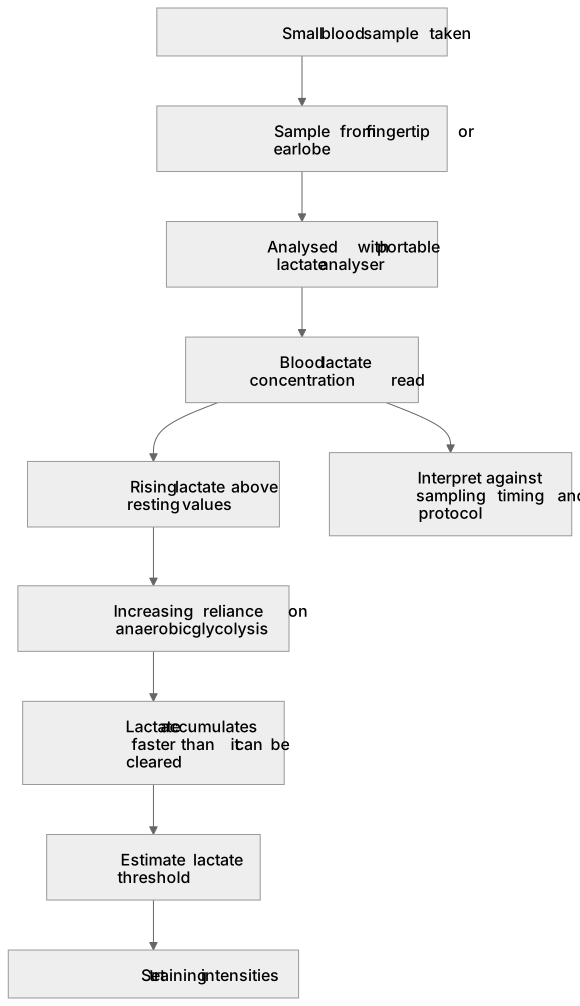
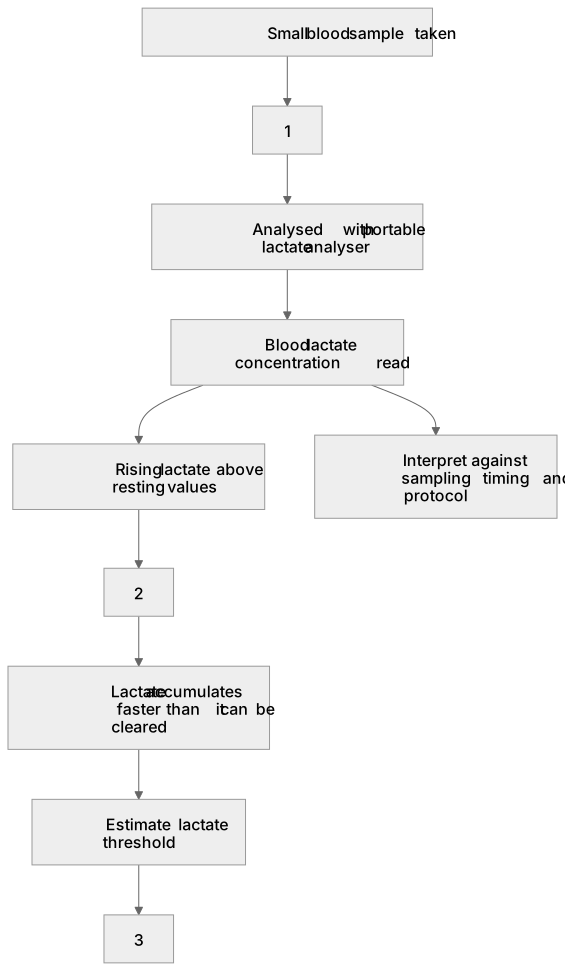
Lactate sampling measures blood lactate concentration to indicate how much the anaerobic glycolytic (lactate) energy system has contributed during exercise. A small blood sample is taken, typically from a fingertip or earlobe, at rest and at set intervals during or after exercise, then analysed with a portable lactate analyser. Rising lactate above resting values shows increasing reliance on anaerobic glycolysis; the point where lactate begins to accumulate faster than it can be cleared is often used to estimate the lactate threshold and to set training intensities. Sampling timing matters: readings taken immediately after a bout differ from those taken during recovery, so results must be interpreted against the protocol used.
What earns the marks
- Lactate sampling measures blood lactate concentration, usually from a fingertip or earlobe blood sample.
- A portable lactate analyser is used to read the concentration, often in mmol·dm⁻³.
- Lactate rises when the anaerobic glycolytic (lactate) system contributes more to ATP resynthesis than lactate can be cleared.
- The lactate threshold is the exercise intensity at which blood lactate begins to accumulate above resting levels.
- Sampling timing (during exercise versus recovery) affects the reading, so results are interpreted against the protocol used.
- Lactate sampling can be used to monitor training intensity and to estimate the lactate threshold.
Common mistakes and how to put them right
Thinking lactate is the direct cause of the burning sensation and of delayed onset muscle soreness.
Put it right: Lactate is a metabolic by-product that is cleared and reused, and the burning sensation relates to other factors such as hydrogen ion accumulation.
Believing lactate only appears when the body has run out of oxygen.
Put it right: Lactate is produced continuously, and it accumulates when production exceeds clearance, which can occur even when oxygen is available.
Assuming a single lactate reading gives a complete picture of fitness.
Put it right: Lactate must be interpreted against the exercise intensity and the sampling time, and often several samples across intensities are needed.
Confusing lactate with lactic acid as if they were identical in the blood.
Put it right: At blood pH, lactate exists largely as the lactate ion, and lactate sampling measures lactate concentration.
Exam tips
- Link each lactate value to the exercise intensity and timing at which it was taken, rather than quoting a number in isolation.
- Use the term lactate threshold precisely: the intensity at which lactate accumulation begins to exceed clearance.
- When comparing two performers, compare their lactate responses at the same relative intensity to make the comparison valid.
Try the lesson
The start of the Energy systems: Lactate sampling. lesson, made from checked teaching notes for this specification point.
Have a go first
What is the primary physiological purpose of taking regular blood lactate samples from an athlete during an incremental exercise test?
Listen
Lactate sampling measures blood lactate concentration to indicate how much the anaerobic glycolytic (lactate) energy system has contributed during exercise. A small blood sample is taken, typically from a fingertip or earlobe, at rest and at set intervals during or after exercise, then analysed with a portable lactate analyser. Rising lactate above resting values shows increasing reliance on anaerobic glycolysis; the point where lactate begins to accumulate faster than it can be cleared is often used to estimate the lactate threshold and to set training intensities. Sampling timing matters: readings taken immediately after a bout differ from those taken during recovery, so results must be interpreted against the protocol used. A strong answer earns marks for these points. Lactate sampling measures blood lactate concentration, usually from a fingertip or earlobe blood sample. A portable lactate analyser is used to read the concentration, often in mmol·dm⁻³. Lactate rises when the anaerobic glycolytic (lactate) system contributes more to ATP resynthesis than lactate can be cleared. The lactate threshold is the exercise intensity at which blood lactate begins to accumulate above resting levels. A common slip: Thinking lactate is the direct cause of the burning sensation and of delayed onset muscle soreness. Instead, lactate is a metabolic by-product that is cleared and reused, and the burning sensation relates to other factors such as hydrogen ion accumulation. Exam tip: Link each lactate value to the exercise intensity and timing at which it was taken, rather than quoting a number in isolation.
See it
Key words
Say what each word means before you turn the card.
Lactate sampling
Try answering aloud or in your head before turning the card.
Lactate threshold
Try answering aloud or in your head before turning the card.
Anaerobic glycolytic energy system contribution
Try answering aloud or in your head before turning the card.
Monitoring and prescribing training intensity
Try answering aloud or in your head before turning the card.
See every definition
- Lactate sampling
- Measures blood lactate concentration to indicate how much the anaerobic glycolytic (lactate) energy system has contributed during exercise.
- Lactate threshold
- The exercise intensity at which blood lactate begins to accumulate above resting levels.
- Anaerobic glycolytic energy system contribution
- Shown by rising lactate above resting values, indicating increasing reliance on anaerobic glycolysis.
- Monitoring and prescribing training intensity
- Lactate sampling can be used to monitor training intensity and to estimate the lactate threshold.
Label the diagram
Some boxes have lost their names. Pick the right name for each number.
1Box 1
2Box 2
3Box 3
There is more to this lesson
The full lesson goes on to check your understanding and help you earn the marks. Create a free account to carry on, with your progress saved.
A week of Premium from your first lesson · Then the free plan continues · No card, no charge
Test your understanding of Energy systems: Lactate sampling.
Active recall beats re-reading. Take an instant quiz now to test what you’ve learned and lock it into long-term memory.
A week of Premium from your first lesson · Then the free plan continues · No card, no charge