AQA · A-Level · Physical Education
Course version: 7582 · Version from Sept 2016
General information processing model, to include:: Output.
Output is the observable response produced after information has been sensed, attended to, encoded, stored and retrieved.
Checked against the AQA 7582 specification (opens in a new tab) on .
- Point 12 of 13
- 4 key terms
Study notes
From the checked teaching notes for this specification point.
The idea
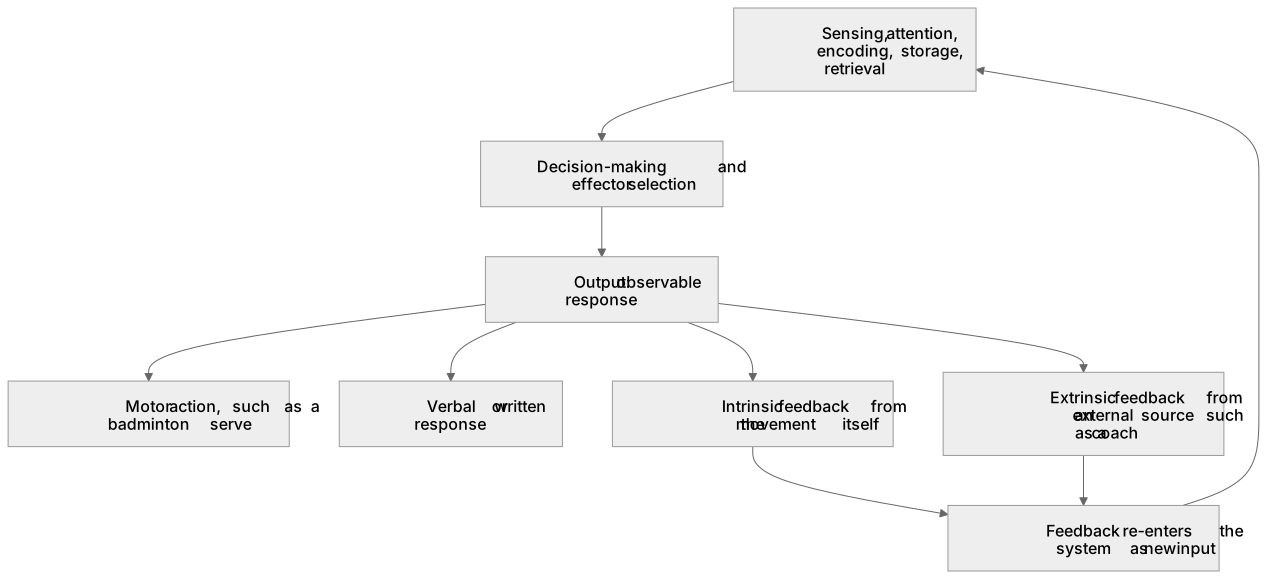
Output is the observable response produced after information has been sensed, attended to, encoded, stored and retrieved. In a general information processing model, output follows decision-making and effector selection. It can be a motor action, such as a badminton serve, or a verbal or written response. Output provides feedback: intrinsic feedback arises from the movement itself, while extrinsic feedback comes from an external source such as a coach. This feedback can re-enter the system as new input, allowing error correction and learning. Output is therefore both the end of one processing cycle and the start of the next.
What earns the marks
- Output is the observable response produced after sensing, attention, encoding, storage, retrieval and decision-making.
- Output can be a motor action, such as a badminton serve, or a verbal or written response.
- Output provides intrinsic feedback from the movement itself and extrinsic feedback from an external source such as a coach.
- Feedback from output can re-enter the system as new input, allowing error correction and learning.
- Output is both the end of one processing cycle and the start of the next.
Common mistakes and how to put them right
Confusing output with input.
Put it right: Input is information detected by the senses, while output is the response produced after processing.
Thinking output is only a motor action.
Put it right: It can also be a verbal or written response.
Believing feedback is separate from output.
Put it right: Output generates intrinsic and extrinsic feedback that can re-enter the system as new input.
Exam tips
- Trace the sequence input, decision-making, output, feedback before selecting an option.
- Check whether an option describes a response produced after processing rather than information detected by the senses.
- Use a concrete example such as a badminton serve to test whether an option is output.
Try the lesson
The start of the General information processing model, to include:: Output. lesson, made from checked teaching notes for this specification point.
Have a go first
In an information processing model of a performer, what does the term output refer to?
Listen
Output is the observable response produced after information has been sensed, attended to, encoded, stored and retrieved. In a general information processing model, output follows decision-making and effector selection. It can be a motor action, such as a badminton serve, or a verbal or written response. Output provides feedback: intrinsic feedback arises from the movement itself, while extrinsic feedback comes from an external source such as a coach. This feedback can re-enter the system as new input, allowing error correction and learning. Output is therefore both the end of one processing cycle and the start of the next. A strong answer earns marks for these points. Output is the observable response produced after sensing, attention, encoding, storage, retrieval and decision-making. Output can be a motor action, such as a badminton serve, or a verbal or written response. Output provides intrinsic feedback from the movement itself and extrinsic feedback from an external source such as a coach. Feedback from output can re-enter the system as new input, allowing error correction and learning. A common slip: Confusing output with input. Instead, input is information detected by the senses, while output is the response produced after processing. Exam tip: Trace the sequence input, decision-making, output, feedback before selecting an option.
See it
Key words
Say what each word means before you turn the card.
Output
Try answering aloud or in your head before turning the card.
Motor, verbal and written forms of output
Try answering aloud or in your head before turning the card.
Intrinsic and extrinsic feedback from output
Try answering aloud or in your head before turning the card.
Feedback as new input for error correction and learning
Try answering aloud or in your head before turning the card.
See every definition
- Output
- The observable response produced after information has been sensed, attended to, encoded, stored and retrieved.
- Motor, verbal and written forms of output
- A motor action, such as a badminton serve, or a verbal or written response.
- Intrinsic and extrinsic feedback from output
- Intrinsic feedback arises from the movement itself, while extrinsic feedback comes from an external source such as a coach.
- Feedback as new input for error correction and learning
- Feedback can re-enter the system as new input, allowing error correction and learning.
Label the diagram
Some boxes have lost their names. Pick the right name for each number.
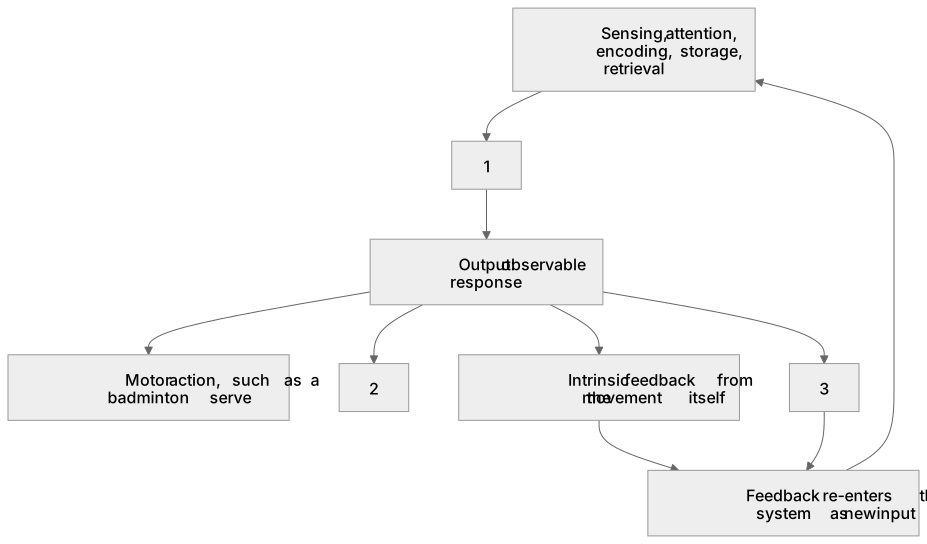
1Box 1
2Box 2
3Box 3
There is more to this lesson
The full lesson goes on to check your understanding and help you earn the marks. Create a free account to carry on, with your progress saved.
A week of Premium from your first lesson · Then the free plan continues · No card, no charge
Test your understanding of General information processing model, to include:: Output.
Active recall beats re-reading. Take an instant quiz now to test what you’ve learned and lock it into long-term memory.
A week of Premium from your first lesson · Then the free plan continues · No card, no charge