AQA · A-Level · Physical Education
Course version: 7582 · Version from Sept 2016
Massed.
Full specification wording
Impact of skill classification on structure of practice for learning: Massed.
Massed practice is a practice structure in which a performer rehearses one skill continuously, with rest intervals kept very short or omitted altogether, so that work dominates the session.
Checked against the AQA 7582 specification (opens in a new tab) on .
- Point 6 of 10
- 4 key terms
Study notes
From the checked teaching notes for this specification point.
The idea
Massed practice is a practice structure in which a performer rehearses one skill continuously, with rest intervals kept very short or omitted altogether, so that work dominates the session. It suits simple, discrete or closed skills that are already reasonably well learned, because the performer can repeat the action many times and build consistency and stamina. For example, a badminton player might rehearse twenty consecutive serves before pausing, or a swimmer might complete a long set of turns without extended recovery. The coach chooses massed practice when the skill is low in complexity, the performer is motivated, and fatigue will not damage technique. It is contrasted with distributed practice, where rest periods are longer and more frequent.
What earns the marks
- Defines massed practice as continuous rehearsal of a skill with very short or no rest intervals.
- Explains that massed practice suits simple, discrete or closed skills that are already well learned.
- Identifies benefits such as repetition, consistency, stamina and efficient use of session time.
- Recognises limitations such as fatigue, reduced concentration and possible technique breakdown.
- Applies the structure to a sporting example, for example repeated serves or turns in a single block.
Common mistakes and how to put them right
Thinking massed practice means practising many different skills in one session.
Put it right: It actually means rehearsing one skill with minimal rest.
Assuming massed practice is always best for beginners.
Put it right: It is usually more suitable for simple skills that are already reasonably well learned.
Confusing massed practice with the whole method.
Put it right: Massed describes the timing of rest, while whole describes whether the skill is broken down.
Believing massed practice removes all rest.
Put it right: Short rest intervals may still occur, but they are kept to a minimum.
Exam tips
- Link the choice of massed practice to the classification of the skill, such as simple, discrete or closed.
- Use a named sporting example to show how the structure would look in a session.
- When evaluating, balance the benefits of repetition against the risk of fatigue and poor technique.
- Use correct terminology, contrasting massed with distributed practice rather than with part practice.
Try the lesson
The start of the Impact of skill classification on structure of practice for learning: Massed. lesson, made from checked teaching notes for this specification point.
Have a go first
In a massed practice session, how is the practice time structured?
Listen
Massed practice is a practice structure in which a performer rehearses one skill continuously, with rest intervals kept very short or omitted altogether, so that work dominates the session. It suits simple, discrete or closed skills that are already reasonably well learned, because the performer can repeat the action many times and build consistency and stamina. For example, a badminton player might rehearse twenty consecutive serves before pausing, or a swimmer might complete a long set of turns without extended recovery. The coach chooses massed practice when the skill is low in complexity, the performer is motivated, and fatigue will not damage technique. It is contrasted with distributed practice, where rest periods are longer and more frequent. A strong answer earns marks for these points. Defines massed practice as continuous rehearsal of a skill with very short or no rest intervals. Explains that massed practice suits simple, discrete or closed skills that are already well learned. Identifies benefits such as repetition, consistency, stamina and efficient use of session time. Recognises limitations such as fatigue, reduced concentration and possible technique breakdown. Exam tip: Link the choice of massed practice to the classification of the skill, such as simple, discrete or closed.
See it

Key words
Say what each word means before you turn the card.
Massed practice
Try answering aloud or in your head before turning the card.
Rest intervals
Try answering aloud or in your head before turning the card.
Distributed practice
Try answering aloud or in your head before turning the card.
Skill classification
Try answering aloud or in your head before turning the card.
See every definition
- Massed practice
- A practice structure in which a performer rehearses one skill continuously, with rest intervals kept very short or omitted altogether, so that work dominates the session.
- Rest intervals
- The pauses in a practice structure, which in massed practice are kept very short or omitted altogether.
- Distributed practice
- A practice structure contrasted with massed practice, where rest periods are longer and more frequent.
- Skill classification
- The classification of a skill, such as simple, discrete or closed, which is linked to the choice of massed practice.
Label the diagram
Some boxes have lost their names. Pick the right name for each number.
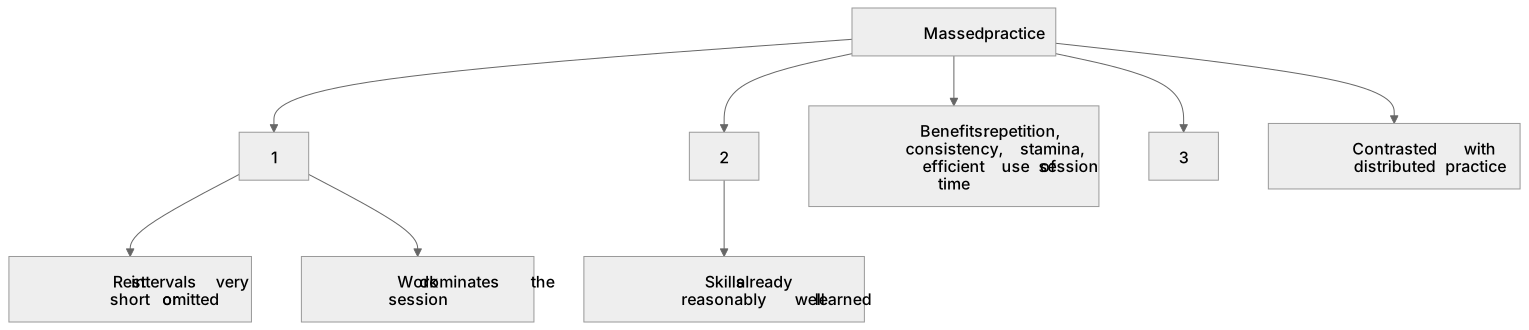
1Box 1
2Box 2
3Box 3
There is more to this lesson
The full lesson goes on to check your understanding and help you earn the marks. Create a free account to carry on, with your progress saved.
A week of Premium from your first lesson · Then the free plan continues · No card, no charge
Test your understanding of Impact of skill classification on structure of practice for learning: Massed.
Active recall beats re-reading. Take an instant quiz now to test what you’ve learned and lock it into long-term memory.
A week of Premium from your first lesson · Then the free plan continues · No card, no charge