AQA · A-Level · Physical Education
Course version: 7582 · Version from Sept 2016
Types of practice.
Full specification wording
Impact of skill classification on structure of practice for learning: Types of practice.
Types of practice describe how training sessions are structured and scheduled.
Checked against the AQA 7582 specification (opens in a new tab) on .
- Point 5 of 10
- 4 key terms
Study notes
From the checked teaching notes for this specification point.
The idea
Types of practice describe how training sessions are structured and scheduled. Massed practice involves continuous practice with little or no rest between trials, suiting highly motivated learners and discrete skills. Distributed practice includes regular rest intervals, which is ideal for beginners, fatiguing tasks or complex skills. Variable practice changes the environmental conditions or task parameters, developing schema and adaptability for open skills like passing in football. Mental practice involves the cognitive rehearsal of a skill without physical movement, helping to build mental imagery, reduce anxiety and reinforce learning, especially for closed skills or during injury recovery.
What earns the marks
- Describes massed practice as continuous trials with little or no rest, suited to discrete skills and fit learners.
- Describes distributed practice as incorporating rest intervals between trials, ideal for beginners or fatiguing tasks.
- Describes variable practice as changing conditions or parameters to develop adaptability, suited to open skills.
- Describes mental practice as cognitive rehearsal without physical movement, used to build imagery and reduce anxiety.
- Links the choice of practice type to skill classification, such as variable practice for open skills.
Common mistakes and how to put them right
Confusing massed practice with overtraining.
Put it right: Massed practice simply means little or no rest between trials; it is a structure, not automatically harmful.
Mixing up variable practice with random practice.
Put it right: Variable practice focuses on changing conditions to build schema, often for open skills.
Assuming mental practice is only for elite athletes.
Put it right: Mental practice benefits all stages of learning by reinforcing cognitive models and reducing anxiety.
Exam tips
- Match the type of practice to the skill classification given in the question, for example open, closed, continuous or discrete.
- Justify your choice by referring to the learner's fitness, motivation and stage of learning.
- Use precise terminology such as massed, distributed, variable and mental practice rather than vague phrases like 'lots of practice'.
Try the lesson
The start of the Impact of skill classification on structure of practice for learning: Types of practice. lesson, made from checked teaching notes for this specification point.
Have a go first
A coach is working with a group of beginners who are learning a physically demanding and complex skill. To prevent fatigue and allow time for feedback, the coach structures the session with short bursts of activity followed by frequent rest intervals. Which type of practice is being used?
Listen
Types of practice describe how training sessions are structured and scheduled. Massed practice involves continuous practice with little or no rest between trials, suiting highly motivated learners and discrete skills. Distributed practice includes regular rest intervals, which is ideal for beginners, fatiguing tasks or complex skills. Variable practice changes the environmental conditions or task parameters, developing schema and adaptability for open skills like passing in football. Mental practice involves the cognitive rehearsal of a skill without physical movement, helping to build mental imagery, reduce anxiety and reinforce learning, especially for closed skills or during injury recovery. A strong answer earns marks for these points. Describes massed practice as continuous trials with little or no rest, suited to discrete skills and fit learners. Describes distributed practice as incorporating rest intervals between trials, ideal for beginners or fatiguing tasks. Describes variable practice as changing conditions or parameters to develop adaptability, suited to open skills. Describes mental practice as cognitive rehearsal without physical movement, used to build imagery and reduce anxiety. A common slip: Confusing massed practice with overtraining. Instead, massed practice simply means little or no rest between trials; it is a structure, not automatically harmful. Exam tip: Match the type of practice to the skill classification given in the question, for example open, closed, continuous or discrete.
See it
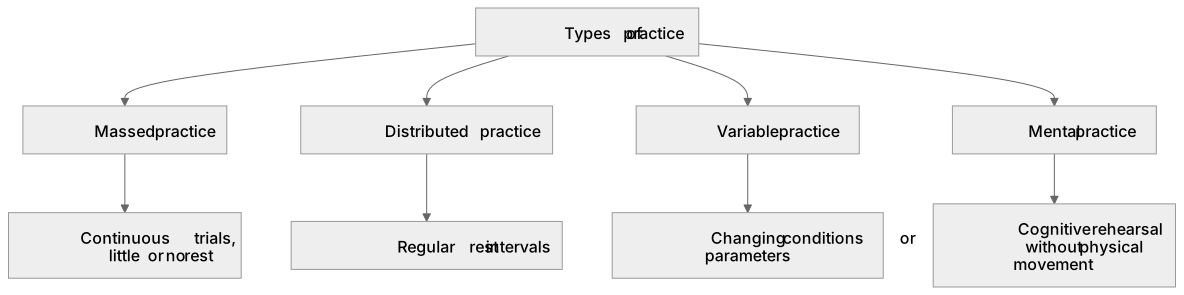
Key words
Say what each word means before you turn the card.
Massed practice
Try answering aloud or in your head before turning the card.
Distributed practice
Try answering aloud or in your head before turning the card.
Variable practice
Try answering aloud or in your head before turning the card.
Mental practice
Try answering aloud or in your head before turning the card.
See every definition
- Massed practice
- Continuous practice with little or no rest between trials, suiting highly motivated learners and discrete skills.
- Distributed practice
- Practice that includes regular rest intervals, which is ideal for beginners, fatiguing tasks or complex skills.
- Variable practice
- Practice that changes the environmental conditions or task parameters, developing schema and adaptability for open skills.
- Mental practice
- Cognitive rehearsal of a skill without physical movement, helping to build mental imagery, reduce anxiety and reinforce learning.
Label the diagram
Some boxes have lost their names. Pick the right name for each number.
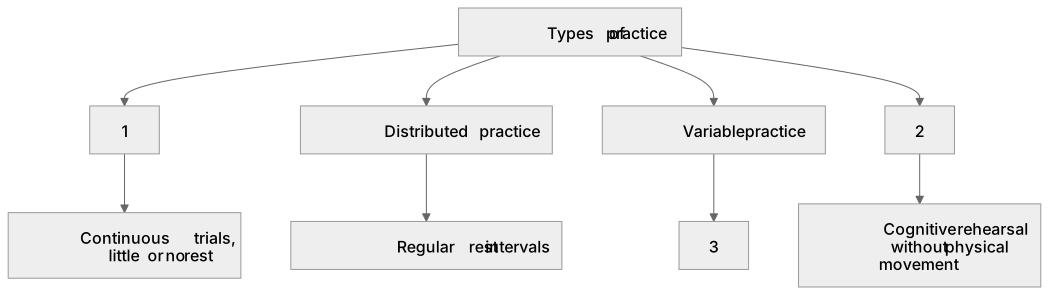
1Box 1
2Box 2
3Box 3
There is more to this lesson
The full lesson goes on to check your understanding and help you earn the marks. Create a free account to carry on, with your progress saved.
A week of Premium from your first lesson · Then the free plan continues · No card, no charge
Test your understanding of Impact of skill classification on structure of practice for learning: Types of practice.
Active recall beats re-reading. Take an instant quiz now to test what you’ve learned and lock it into long-term memory.
A week of Premium from your first lesson · Then the free plan continues · No card, no charge