AQA · A-Level · Physical Education
Course version: 7582 · Version from Sept 2016
Impact of skill classification on structure of practice for learning: Whole.
Whole practice means rehearsing a skill in its complete, uninterrupted form from the first attempt, rather than splitting it into parts.
Checked against the AQA 7582 specification (opens in a new tab) on .
- Point 2 of 10
- 3 key terms
Study notes
From the checked teaching notes for this specification point.
The idea
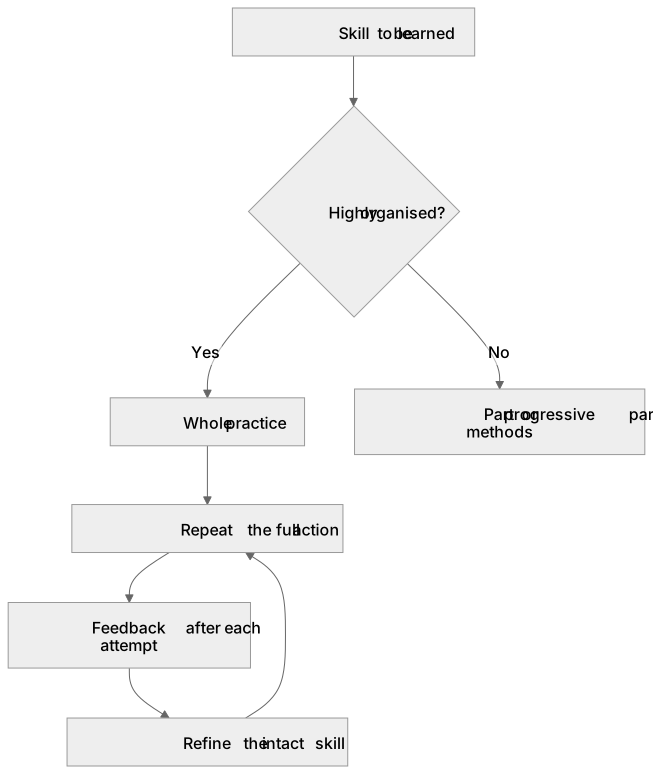
Whole practice means rehearsing a skill in its complete, uninterrupted form from the first attempt, rather than splitting it into parts. It suits skills that are highly organised, fast, discrete or serial, where the parts are so tightly linked that separating them would destroy the timing and flow. A coach teaching a tennis serve or a golf swing would typically use whole practice because the subroutines must run together smoothly. The learner repeats the full action, receiving feedback after each attempt, and gradually refines it. Whole practice is assessed by asking you to identify when it is appropriate, to justify the choice using classification features such as organisation and pacing, and to contrast it with part methods. It is not simply 'doing the whole thing once'; it requires repeated, deliberate rehearsal of the intact skill.
What earns the marks
- Defines whole practice as rehearsal of the skill in its complete form without breaking it into separate parts.
- Links whole practice to skills that are highly organised, so the subroutines are difficult to separate without losing fluency.
- Links whole practice to fast, discrete or serial skills where timing and sequencing are critical.
- Explains that the learner repeats the full action and uses feedback to refine it over trials.
- Contrasts whole practice with part or progressive part methods, which break the skill down.
- Applies the concept to a concrete example such as a tennis serve, golf swing or sprint start.
Common mistakes and how to put them right
Misunderstanding: whole practice means performing the skill only once.
Put it right: It means repeated rehearsal of the complete skill, with feedback between attempts.
Misunderstanding: whole practice is always best because it is realistic.
Put it right: It is appropriate only when the skill is highly organised and the parts cannot be meaningfully separated.
Misunderstanding: whole practice and part practice can be used interchangeably for any skill.
Put it right: The choice depends on the classification of the skill, especially its organisation and pacing.
Misunderstanding: whole practice ignores feedback.
Put it right: Feedback after each complete attempt is central to refining the intact skill.
Exam tips
- When a question asks which practice structure suits a skill, first identify the classification features such as organisation, pacing and continuity, then match them to whole practice.
- Use a named sporting example and explain why splitting it would harm timing or flow.
- Avoid saying 'whole practice is easier'; justify it in terms of the skill's structure, not difficulty.
Try the lesson
The start of the Impact of skill classification on structure of practice for learning: Whole. lesson, made from checked teaching notes for this specification point.
Have a go first
A coach teaches a gymnast a short vault routine by having her rehearse the complete routine from the starting salute to the landing, without breaking it into sections. Which structure of practice is being used?
Listen
Whole practice means rehearsing a skill in its complete, uninterrupted form from the first attempt, rather than splitting it into parts. It suits skills that are highly organised, fast, discrete or serial, where the parts are so tightly linked that separating them would destroy the timing and flow. A coach teaching a tennis serve or a golf swing would typically use whole practice because the subroutines must run together smoothly. The learner repeats the full action, receiving feedback after each attempt, and gradually refines it. Whole practice is assessed by asking you to identify when it is appropriate, to justify the choice using classification features such as organisation and pacing, and to contrast it with part methods. It is not simply 'doing the whole thing once'; it requires repeated, deliberate rehearsal of the intact skill. A strong answer earns marks for these points. Defines whole practice as rehearsal of the skill in its complete form without breaking it into separate parts. Links whole practice to skills that are highly organised, so the subroutines are difficult to separate without losing fluency. Links whole practice to fast, discrete or serial skills where timing and sequencing are critical. Explains that the learner repeats the full action and uses feedback to refine it over trials. A common slip: Misunderstanding: whole practice means performing the skill only once. Instead, it means repeated rehearsal of the complete skill, with feedback between attempts. Exam tip: When a question asks which practice structure suits a skill, first identify the classification features such as organisation, pacing and continuity, then match them to whole practice.
See it
Key words
Say what each word means before you turn the card.
Whole practice
Try answering aloud or in your head before turning the card.
Organisation of skill
Try answering aloud or in your head before turning the card.
Pacing and timing
Try answering aloud or in your head before turning the card.
See every definition
- Whole practice
- Rehearsing a skill in its complete, uninterrupted form from the first attempt, rather than splitting it into parts.
- Organisation of skill
- How tightly linked the parts of a skill are, so that separating them would destroy the timing and flow.
- Pacing and timing
- Features of fast, discrete or serial skills where timing and sequencing are critical to the action.
There is more to this lesson
The full lesson goes on to check your understanding and help you earn the marks. Create a free account to carry on, with your progress saved.
A week of Premium from your first lesson · Then the free plan continues · No card, no charge
Test your understanding of Impact of skill classification on structure of practice for learning: Whole.
Active recall beats re-reading. Take an instant quiz now to test what you’ve learned and lock it into long-term memory.
A week of Premium from your first lesson · Then the free plan continues · No card, no charge