AQA · A-Level · Physical Education
Course version: 7582 · Version from Sept 2016
Progressive part.
Full specification wording
Impact of skill classification on structure of practice for learning: Progressive part.
Progressive part practice, sometimes called chaining, teaches a skill by breaking it into parts that are practised separately and then linked together in sequence.
Checked against the AQA 7582 specification (opens in a new tab) on .
- Point 3 of 10
- 4 key terms
Study notes
From the checked teaching notes for this specification point.
The idea
Progressive part practice, sometimes called chaining, teaches a skill by breaking it into parts that are practised separately and then linked together in sequence. The learner masters part one, then practises part one linked to part two, then adds part three, and so on until the whole skill is performed. It suits serial skills with clear, separable subroutines, such as a gymnastics floor routine or a swimming stroke with distinct phases. The method allows focused attention on each component before integrating it, which can build confidence and reduce overload. It is assessed by asking you to identify when progressive part practice is appropriate, to describe the chaining process accurately, and to contrast it with whole practice and pure part practice. The key feature is the gradual addition and linking of parts, not practising parts in isolation forever.
What earns the marks
- Defines progressive part practice as breaking a skill into parts, practising them separately, then linking them in sequence.
- Describes the chaining process: part one, then part one plus part two, then adding further parts until the whole skill is performed.
- Links progressive part practice to serial skills with separable subroutines and clear phases.
- Explains that it allows focused attention on each component before integration, which can reduce overload and build confidence.
- Contrasts progressive part practice with whole practice, where the skill is rehearsed intact from the start.
- Contrasts progressive part practice with pure part practice, where parts may be practised without necessarily being chained back together.
- Applies the concept to a concrete example such as a gymnastics routine or a multi-phase swimming stroke.
Common mistakes and how to put them right
Misunderstanding: progressive part practice means practising each part in isolation and never joining them.
Put it right: The defining feature is the progressive linking of parts until the whole skill is performed.
Misunderstanding: progressive part practice is the same as whole practice.
Put it right: Whole practice rehearses the intact skill from the start, whereas progressive part practice builds it up through chaining.
Misunderstanding: progressive part practice suits highly organised, fast discrete skills.
Put it right: It suits serial skills with separable subroutines; highly organised fast skills are better suited to whole practice.
Misunderstanding: the order of parts does not matter.
Put it right: Parts are linked in the sequence they occur in the skill, so the order is essential.
Exam tips
- When describing progressive part practice, use the word 'link' or 'chain' to show you understand the gradual integration of parts.
- Name a serial skill and outline the sequence of parts to demonstrate accurate application.
- Compare it explicitly with whole practice and pure part practice to show precise understanding of the distinctions.
Try the lesson
The start of the Impact of skill classification on structure of practice for learning: Progressive part. lesson, made from checked teaching notes for this specification point.
Have a go first
A swimming coach teaches a learner the front crawl by first practising the arm action, then adding the leg kick, and finally linking in the breathing to perform the full stroke. Which structure of practice is being used?
Listen
Progressive part practice, sometimes called chaining, teaches a skill by breaking it into parts that are practised separately and then linked together in sequence. The learner masters part one, then practises part one linked to part two, then adds part three, and so on until the whole skill is performed. It suits serial skills with clear, separable subroutines, such as a gymnastics floor routine or a swimming stroke with distinct phases. The method allows focused attention on each component before integrating it, which can build confidence and reduce overload. It is assessed by asking you to identify when progressive part practice is appropriate, to describe the chaining process accurately, and to contrast it with whole practice and pure part practice. The key feature is the gradual addition and linking of parts, not practising parts in isolation forever. A strong answer earns marks for these points. Defines progressive part practice as breaking a skill into parts, practising them separately, then linking them in sequence. Describes the chaining process: part one, then part one plus part two, then adding further parts until the whole skill is performed. Links progressive part practice to serial skills with separable subroutines and clear phases. Explains that it allows focused attention on each component before integration, which can reduce overload and build confidence. A common slip: Misunderstanding: progressive part practice means practising each part in isolation and never joining them. Instead, the defining feature is the progressive linking of parts until the whole skill is performed. Exam tip: When describing progressive part practice, use the word 'link' or 'chain' to show you understand the gradual integration of parts.
See it
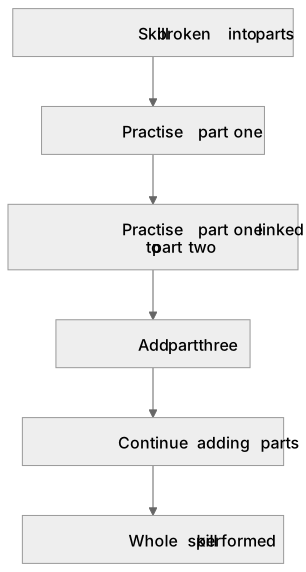
Put it in order
Put these steps in the order they happen.
- 1. Practise part one linked to part two
- 2. Practise part one
- 3. Skill broken into parts
- 4. Whole skill performed
- 5. Continue adding parts
- 6. Add part three
Key words
Say what each word means before you turn the card.
Progressive part practice
Try answering aloud or in your head before turning the card.
Chaining
Try answering aloud or in your head before turning the card.
Serial skills
Try answering aloud or in your head before turning the card.
Whole practice
Try answering aloud or in your head before turning the card.
See every definition
- Progressive part practice
- Breaking a skill into parts that are practised separately and then linked together in sequence until the whole skill is performed.
- Chaining
- The gradual addition and linking of parts, where the learner masters part one, then practises part one linked to part two, then adds part three, and so on.
- Serial skills
- Skills with clear, separable subroutines, such as a gymnastics floor routine or a swimming stroke with distinct phases.
- Whole practice
- Rehearsing the skill intact from the start, contrasted with progressive part practice, which builds it up through chaining.
Label the diagram
Some boxes have lost their names. Pick the right name for each number.
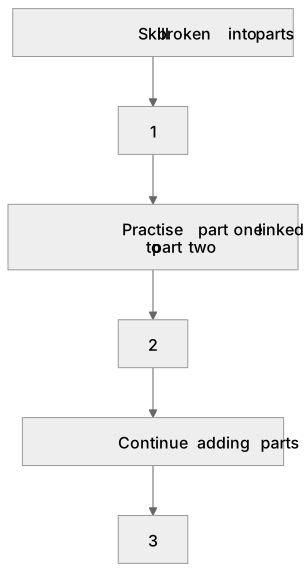
1Box 1
2Box 2
3Box 3
There is more to this lesson
The full lesson goes on to check your understanding and help you earn the marks. Create a free account to carry on, with your progress saved.
A week of Premium from your first lesson · Then the free plan continues · No card, no charge
Test your understanding of Impact of skill classification on structure of practice for learning: Progressive part.
Active recall beats re-reading. Take an instant quiz now to test what you’ve learned and lock it into long-term memory.
A week of Premium from your first lesson · Then the free plan continues · No card, no charge