AQA · A-Level · Physical Education
Course version: 7582 · Version from Sept 2016
SMARTER (specific, measurable, achievable, realistic, time bound,…
Full specification wording
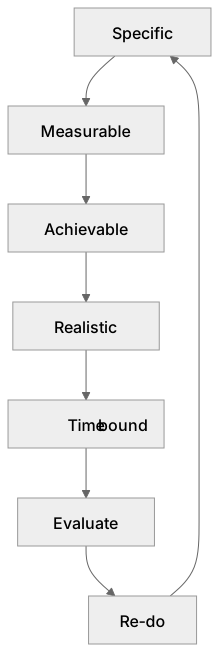
Importance of goal setting: SMARTER (specific, measurable, achievable, realistic, time bound, evaluate, re-do).
SMARTER is a checklist for writing and reviewing goals.
Checked against the AQA 7582 specification (opens in a new tab) on .
- Point 4 of 4
- 4 key terms
Study notes
From the checked teaching notes for this specification point.
The idea
SMARTER is a checklist for writing and reviewing goals. Specific means the goal names the exact behaviour, component or outcome to be changed. Measurable means progress can be recorded, for example a time, distance, repetition maximum or success count. Achievable means the performer has the capacity to reach it with the training available. Realistic means it fits the performer's role, stage of development and wider commitments. Time bound means a deadline is set. Evaluate means the performer reviews whether the goal was met and why. Re-do means the goal is revised in light of that evaluation, so the cycle continues. A swimmer might target reducing 50 m freestyle time by 0.5 s in six weeks, record split times, review at the deadline and then set a new target.
What earns the marks
- Specific: the goal identifies the precise behaviour, component or outcome to be improved.
- Measurable: progress can be quantified using a time, distance, load, count or similar record.
- Achievable: the performer has the capacity and opportunity to reach the target with the training available.
- Realistic: the goal fits the performer's role, stage of development and wider commitments.
- Time bound: a deadline is set so progress can be judged against a fixed point.
- Evaluate: the performer reviews whether the goal was met and identifies reasons for the outcome.
- Re-do: the goal is revised after evaluation so the process continues rather than stopping.
Common mistakes and how to put them right
Confusing achievable with realistic.
Put it right: Achievable concerns whether the performer can physically reach the target, while realistic concerns whether it fits their role, stage and wider commitments.
Treating evaluate and re-do as the same stage.
Put it right: Evaluate is the review of whether and why the goal was met, while re-do is the revision of the goal that follows.
Writing a goal that is measurable but not specific, such as improving fitness.
Put it right: The goal must name the exact component or outcome to be changed.
Exam tips
- Learn each letter as a distinct criterion and be ready to match a described goal to the letter it satisfies or fails.
- When a stem describes a goal, check it against every letter in turn rather than stopping at the first match.
- Remember that evaluate and re-do extend the basic SMART checklist, so a question about reviewing and revising a goal points to those two letters.
Try the lesson
The start of the Importance of goal setting: SMARTER (specific, measurable, achievable, realistic, time bound, evaluate, re-do). lesson, made from checked teaching notes for this specification point.
Have a go first
A netball player writes the target "to improve my shooting accuracy from 62% to 75% within eight weeks". Which SMARTER element does the phrase "from 62% to 75%" satisfy?
Listen
SMARTER is a checklist for writing and reviewing goals. Specific means the goal names the exact behaviour, component or outcome to be changed. Measurable means progress can be recorded, for example a time, distance, repetition maximum or success count. Achievable means the performer has the capacity to reach it with the training available. Realistic means it fits the performer's role, stage of development and wider commitments. Time bound means a deadline is set. Evaluate means the performer reviews whether the goal was met and why. Re-do means the goal is revised in light of that evaluation, so the cycle continues. A swimmer might target reducing 50 m freestyle time by 0.5 s in six weeks, record split times, review at the deadline and then set a new target. A strong answer earns marks for these points. Specific: the goal identifies the precise behaviour, component or outcome to be improved. Measurable: progress can be quantified using a time, distance, load, count or similar record. Achievable: the performer has the capacity and opportunity to reach the target with the training available. Realistic: the goal fits the performer's role, stage of development and wider commitments. A common slip: Confusing achievable with realistic. Instead, achievable concerns whether the performer can physically reach the target, while realistic concerns whether it fits their role, stage and wider commitments. Exam tip: Learn each letter as a distinct criterion and be ready to match a described goal to the letter it satisfies or fails.
See it
Key words
Say what each word means before you turn the card.
Specific
Try answering aloud or in your head before turning the card.
Measurable
Try answering aloud or in your head before turning the card.
Achievable
Try answering aloud or in your head before turning the card.
Realistic
Try answering aloud or in your head before turning the card.
See every definition
- Specific
- The goal names the exact behaviour, component or outcome to be changed.
- Measurable
- Progress can be recorded, for example a time, distance, repetition maximum or success count.
- Achievable
- The performer has the capacity to reach it with the training available.
- Realistic
- It fits the performer's role, stage of development and wider commitments.
Label the diagram
Some boxes have lost their names. Pick the right name for each number.
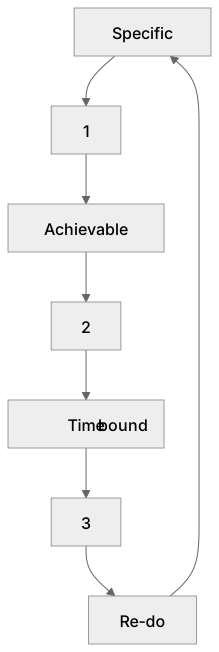
1Box 1
2Box 2
3Box 3
There is more to this lesson
The full lesson goes on to check your understanding and help you earn the marks. Create a free account to carry on, with your progress saved.
A week of Premium from your first lesson · Then the free plan continues · No card, no charge
Test your understanding of Importance of goal setting: SMARTER (specific, measurable, achievable, realistic, time bound, evaluate, re-do).
Active recall beats re-reading. Take an instant quiz now to test what you’ve learned and lock it into long-term memory.
A week of Premium from your first lesson · Then the free plan continues · No card, no charge