AQA · A-Level · Physical Education
Course version: 7582 · Version from Sept 2016
Industrial and post-industrial (1780–1900): Industrial Revolution.
The Industrial Revolution (1780–1900) transformed British society through factory production, urbanisation, railway expansion and changing working conditions.
Checked against the AQA 7582 specification (opens in a new tab) on .
- Point 2 of 12
- 4 key terms
Study notes
From the checked teaching notes for this specification point.
The idea
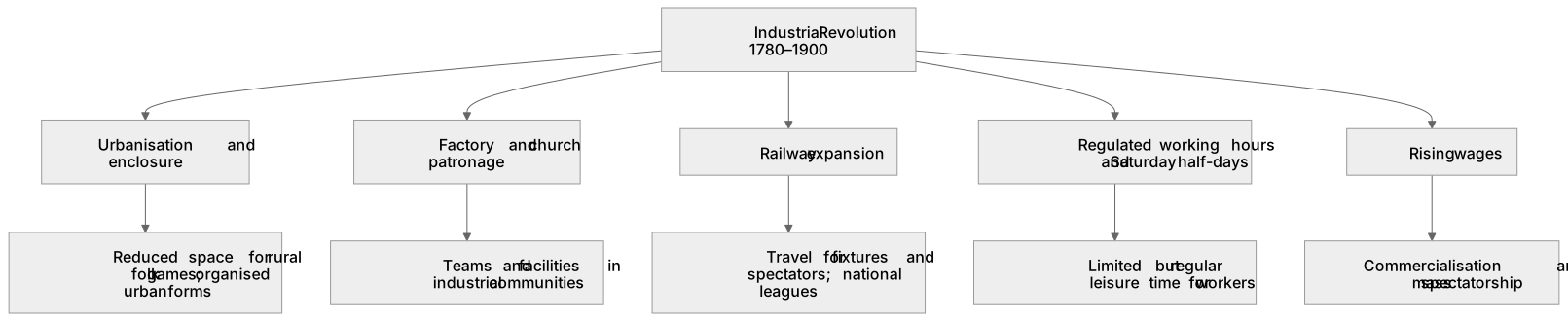
The Industrial Revolution (1780–1900) transformed British society through factory production, urbanisation, railway expansion and changing working conditions. These changes reshaped sport: rural folk games declined as open land was enclosed and working hours became regulated, while factory owners and churches sometimes promoted organised teams. Railways allowed teams and spectators to travel, supporting national leagues and competitions. Rising wages and Saturday half-days gave workers limited leisure time, encouraging mass participation and spectatorship. You need to connect industrial changes to specific sporting developments, such as the growth of association football and the rationalisation of track and field events, and explain how urbanisation, transport and employment patterns affected who played, who watched and how sport was organised.
What earns the marks
- Urbanisation and enclosure reduced space for traditional rural games, pushing sport towards organised urban forms.
- Factory and church patronage created teams and facilities, linking sport to industrial communities.
- Railway expansion enabled travel for fixtures and spectators, supporting national leagues and competitions.
- Regulated working hours and Saturday half-days created limited but regular leisure time for workers.
- Rising wages and improved transport contributed to commercialisation and mass spectatorship.
Common mistakes and how to put them right
Treating the Industrial Revolution as only technological.
Put it right by explaining its social effects on leisure, work and space.
Assuming all workers gained leisure time equally.
Put it right by noting that hours and wages varied by industry and region.
Ignoring the role of transport.
Put it right by explaining railways enabled national fixtures and away spectators.
Confusing cause and effect.
Put it right by linking each industrial change to a specific sporting outcome.
Exam tips
- Use the chain: industrial change → social effect → sporting consequence, for example urbanisation → less open space → organised urban teams.
- Refer to specific groups such as factory workers, factory owners and church organisations to show who drove change.
- For multiple-choice questions, reject options that describe pre-industrial rural sport or post-1900 professional sport.
Try the lesson
The start of the Industrial and post-industrial (1780–1900): Industrial Revolution. lesson, made from checked teaching notes for this specification point.
Have a go first
During the first half of the Industrial Revolution (approximately 1780–1850), how did the shift to factory-based work initially affect the sporting participation of the working classes?
Listen
The Industrial Revolution (1780–1900) transformed British society through factory production, urbanisation, railway expansion and changing working conditions. These changes reshaped sport: rural folk games declined as open land was enclosed and working hours became regulated, while factory owners and churches sometimes promoted organised teams. Railways allowed teams and spectators to travel, supporting national leagues and competitions. Rising wages and Saturday half-days gave workers limited leisure time, encouraging mass participation and spectatorship. You need to connect industrial changes to specific sporting developments, such as the growth of association football and the rationalisation of track and field events, and explain how urbanisation, transport and employment patterns affected who played, who watched and how sport was organised. A strong answer earns marks for these points. Urbanisation and enclosure reduced space for traditional rural games, pushing sport towards organised urban forms. Factory and church patronage created teams and facilities, linking sport to industrial communities. Railway expansion enabled travel for fixtures and spectators, supporting national leagues and competitions. Regulated working hours and Saturday half-days created limited but regular leisure time for workers. A common slip: Treating the Industrial Revolution as only technological. Instead, explaining its social effects on leisure, work and space. Exam tip: Use the chain: industrial change → social effect → sporting consequence, for example urbanisation → less open space → organised urban teams.
See it
Key words
Say what each word means before you turn the card.
Industrialisation and urbanisation
Try answering aloud or in your head before turning the card.
Transport and communication
Try answering aloud or in your head before turning the card.
Social class and leisure time
Try answering aloud or in your head before turning the card.
Commercialisation of sport
Try answering aloud or in your head before turning the card.
See every definition
- Industrialisation and urbanisation
- Factory production and the growth of towns reshaped society, and enclosure of open land reduced space for traditional rural games, pushing sport towards organised urban forms.
- Transport and communication
- Railway expansion enabled teams and spectators to travel for fixtures, supporting national leagues and competitions.
- Social class and leisure time
- Regulated working hours and Saturday half-days gave workers limited but regular leisure time, while hours and wages varied by industry and region.
- Commercialisation of sport
- Rising wages and improved transport contributed to commercialisation and mass spectatorship.
Label the diagram
Some boxes have lost their names. Pick the right name for each number.
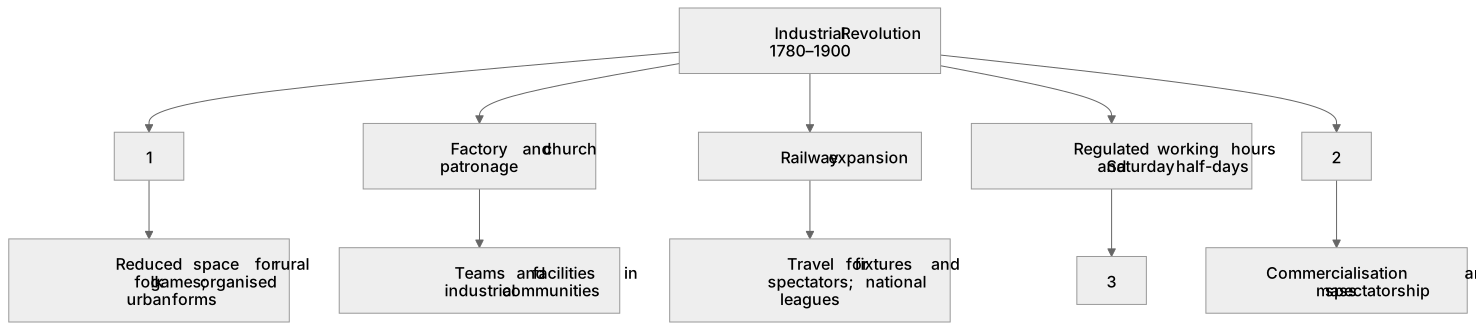
1Box 1
2Box 2
3Box 3
There is more to this lesson
The full lesson goes on to check your understanding and help you earn the marks. Create a free account to carry on, with your progress saved.
A week of Premium from your first lesson · Then the free plan continues · No card, no charge
Test your understanding of Industrial and post-industrial (1780–1900): Industrial Revolution.
Active recall beats re-reading. Take an instant quiz now to test what you’ve learned and lock it into long-term memory.
A week of Premium from your first lesson · Then the free plan continues · No card, no charge