AQA · A-Level · Physical Education
Course version: 7582 · Version from Sept 2016
Industrial and post-industrial (1780–1900): Urbanisation.
Urbanisation means the growth of towns and cities as people move from rural areas to urban ones.
Checked against the AQA 7582 specification (opens in a new tab) on .
- Point 3 of 12
- 4 key terms
Study notes
From the checked teaching notes for this specification point.
The idea
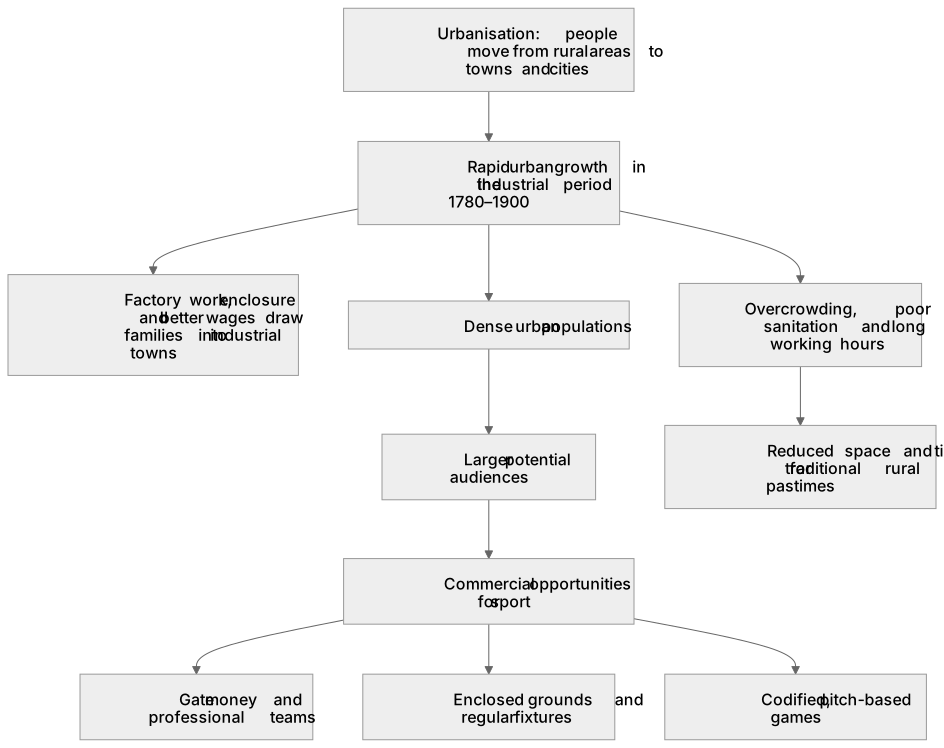
Urbanisation means the growth of towns and cities as people move from rural areas to urban ones. In the industrial period 1780–1900, Britain's population shifted sharply: factory work, enclosure and better wages drew families into rapidly expanding industrial towns such as Manchester, Birmingham and Leeds. Overcrowding, poor sanitation and long working hours shaped the health and recreation of these new urban populations. For sport, urbanisation created dense audiences, enclosed grounds, regular fixtures and commercial spectatorship, while also reducing space for traditional rural pastimes. A useful method is to link each urban change to a sporting consequence: more people in one place means larger crowds, gate money and professional teams; less open land means codified, pitch-based games. This makes urbanisation a cause, not just a setting, of modern sport.
What earns the marks
- Defines urbanisation as the movement of population from rural areas into towns and cities, producing rapid urban growth.
- Places urbanisation within the industrial period 1780–1900 and links it to factory employment and migration.
- Explains that dense urban populations created larger potential audiences and commercial opportunities for sport.
- Explains that loss of rural space and long working hours changed the nature and availability of recreation.
- Links urbanisation to the development of enclosed grounds, codified rules and regular fixtures.
- Uses a specific industrial town or city as an example of urban growth and its sporting consequences.
Common mistakes and how to put them right
Treating urbanisation as simply 'more people' rather than the movement of population from rural to urban areas.
Put it right by defining it as rural-to-urban migration and urban growth.
Assuming urbanisation automatically improved health.
Put it right by noting overcrowding, poor sanitation and disease in industrial towns.
Ignoring the effect on sport.
Put it right by linking urban density to crowds, commercialism and enclosed grounds.
Placing urbanisation outside 1780–1900.
Put it right by keeping examples within the industrial period.
Exam tips
- Read the question stem carefully: if it asks for a consequence of urbanisation, choose the option that links urban growth to sport, not a general social effect.
- Eliminate options that describe rural pastimes as unaffected by urbanisation, because loss of space and time changed them.
- Check the date range in the question; options referring to pre-industrial or post-1900 developments are outside this section.
Try the lesson
The start of the Industrial and post-industrial (1780–1900): Urbanisation. lesson, made from checked teaching notes for this specification point.
Have a go first
What does the term urbanisation describe in the context of Britain between 1780 and 1900?
Listen
Urbanisation means the growth of towns and cities as people move from rural areas to urban ones. In the industrial period 1780–1900, Britain's population shifted sharply: factory work, enclosure and better wages drew families into rapidly expanding industrial towns such as Manchester, Birmingham and Leeds. Overcrowding, poor sanitation and long working hours shaped the health and recreation of these new urban populations. For sport, urbanisation created dense audiences, enclosed grounds, regular fixtures and commercial spectatorship, while also reducing space for traditional rural pastimes. A useful method is to link each urban change to a sporting consequence: more people in one place means larger crowds, gate money and professional teams; less open land means codified, pitch-based games. This makes urbanisation a cause, not just a setting, of modern sport. A strong answer earns marks for these points. Defines urbanisation as the movement of population from rural areas into towns and cities, producing rapid urban growth. Places urbanisation within the industrial period 1780–1900 and links it to factory employment and migration. Explains that dense urban populations created larger potential audiences and commercial opportunities for sport. Explains that loss of rural space and long working hours changed the nature and availability of recreation. A common slip: Treating urbanisation as simply 'more people' rather than the movement of population from rural to urban areas. Instead, defining it as rural-to-urban migration and urban growth. Exam tip: Read the question stem carefully: if it asks for a consequence of urbanisation, choose the option that links urban growth to sport, not a general social effect.
See it
Key words
Say what each word means before you turn the card.
Rural-to-urban migration
Try answering aloud or in your head before turning the card.
Industrial town growth
Try answering aloud or in your head before turning the card.
Commercial spectatorship
Try answering aloud or in your head before turning the card.
Loss of rural recreation space
Try answering aloud or in your head before turning the card.
See every definition
- Rural-to-urban migration
- The movement of population from rural areas into towns and cities, producing rapid urban growth.
- Industrial town growth
- The rapid expansion of industrial towns as factory work, enclosure and better wages drew families into them.
- Commercial spectatorship
- Dense audiences, enclosed grounds and regular fixtures creating commercial opportunities for sport.
- Loss of rural recreation space
- Reduced space for traditional rural pastimes as urbanisation changed the nature and availability of recreation.
Label the diagram
Some boxes have lost their names. Pick the right name for each number.
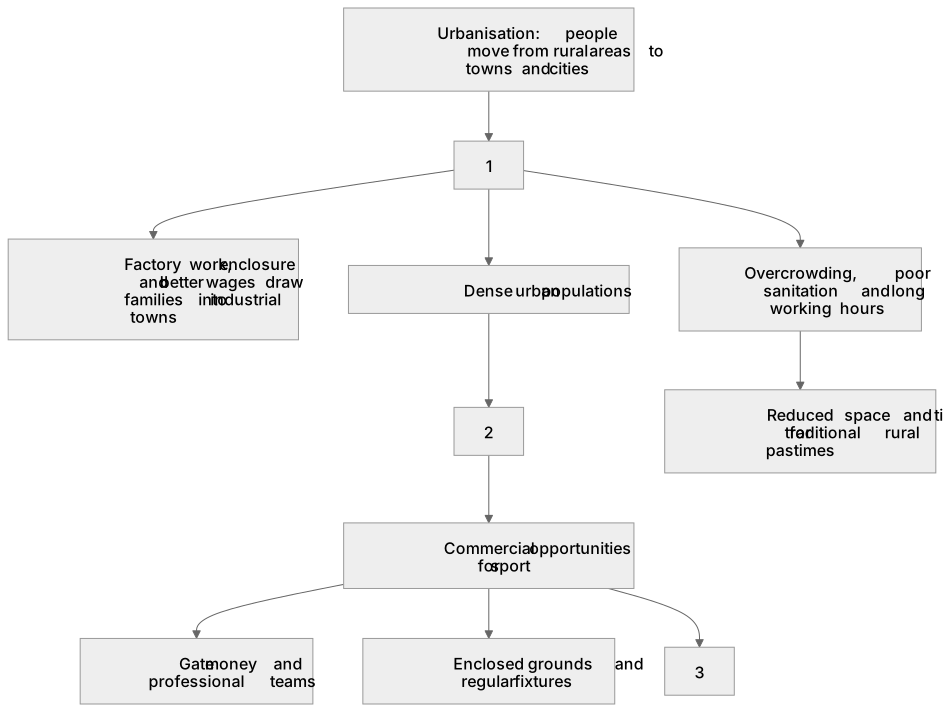
1Box 1
2Box 2
3Box 3
There is more to this lesson
The full lesson goes on to check your understanding and help you earn the marks. Create a free account to carry on, with your progress saved.
A week of Premium from your first lesson · Then the free plan continues · No card, no charge
Test your understanding of Industrial and post-industrial (1780–1900): Urbanisation.
Active recall beats re-reading. Take an instant quiz now to test what you’ve learned and lock it into long-term memory.
A week of Premium from your first lesson · Then the free plan continues · No card, no charge