AQA · A-Level · Physical Education
Course version: 7582 · Version from Sept 2016
Industrial and post-industrial (1780–1900): Provision through factories.
Provision through factories refers to the ways industrial employers in 1780–1900 shaped workers’ leisure and physical activity.
Checked against the AQA 7582 specification (opens in a new tab) on .
- Point 6 of 12
- 4 key terms
Study notes
From the checked teaching notes for this specification point.
The idea
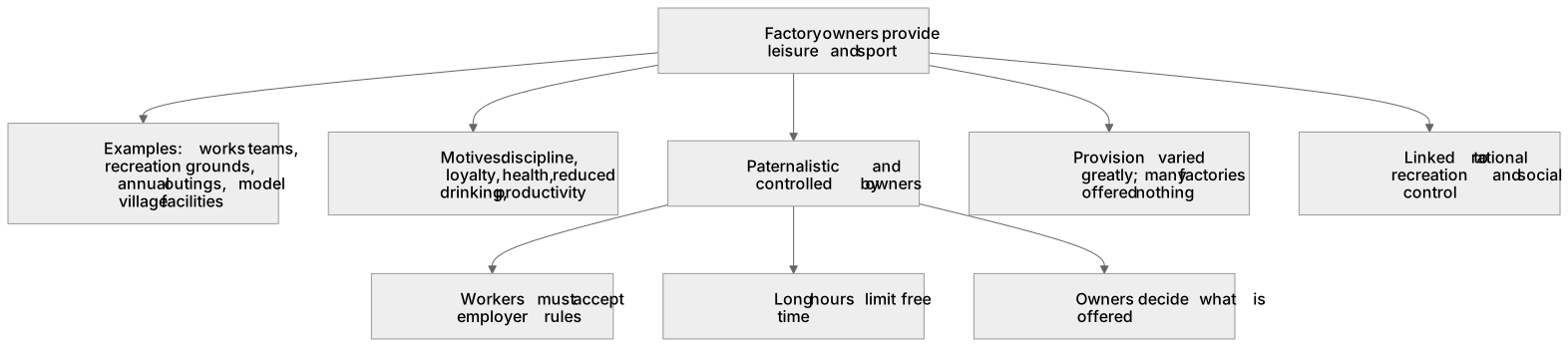
Provision through factories refers to the ways industrial employers in 1780–1900 shaped workers’ leisure and physical activity. Factory owners sometimes provided sports facilities, teams or annual outings to promote discipline, loyalty and health. Some built model villages with recreation grounds, while others used sport to reduce drinking and absenteeism. However, provision was often paternalistic and controlled: workers had to accept employer rules, and long hours limited free time. Factory provision also reflected class inequality, because owners decided what was offered. For MCQ, distinguish factory provision from public school or municipal provision. Link it to rational recreation, the cult of athleticism and social control. Do not assume all factories provided sport; many offered nothing.
What earns the marks
- Defines provision through factories as employer-led leisure and sporting opportunities for workers during 1780–1900.
- Gives examples such as works teams, recreation grounds, annual outings or model village facilities.
- Explains motives: discipline, loyalty, health, reduced drinking and improved productivity.
- Recognises that provision was paternalistic and controlled by owners, limiting worker autonomy.
- Links factory provision to rational recreation and social control.
- Acknowledges that provision varied greatly and many factories offered no sport at all.
Common mistakes and how to put them right
Misunderstanding: all factory owners provided sport for workers.
Put it right: Provision was uneven, and many factories offered nothing.
Misunderstanding: factory sport was purely generous.
Put it right: It often served employers’ interests in discipline, loyalty and productivity.
Misunderstanding: factory provision gave workers full freedom in sport.
Put it right: Owners usually set rules and controlled facilities, so worker autonomy was limited.
Misunderstanding: factory provision was the same as public school athleticism.
Put it right: Public school sport aimed at character and leadership, while factory provision aimed at workforce control and welfare.
Exam tips
- Identify the key phrase in the MCQ stem: provision, factories, 1780–1900, or workers’ leisure.
- Reject options that describe public school or municipal provision when the stem asks about factories.
- Look for options that mention employer control or paternalism, because these are central to factory provision.
- Check that examples fit the period, such as works teams or model village grounds, not modern corporate sponsorship.
Try the lesson
The start of the Industrial and post-industrial (1780–1900): Provision through factories. lesson, made from checked teaching notes for this specification point.
Have a go first
During the industrial period in Britain (1780–1900), some factory owners provided sporting facilities for their workers. What was the main reason factory owners gave this provision?
Listen
Provision through factories refers to the ways industrial employers in 1780–1900 shaped workers’ leisure and physical activity. Factory owners sometimes provided sports facilities, teams or annual outings to promote discipline, loyalty and health. Some built model villages with recreation grounds, while others used sport to reduce drinking and absenteeism. However, provision was often paternalistic and controlled: workers had to accept employer rules, and long hours limited free time. Factory provision also reflected class inequality, because owners decided what was offered. For MCQ, distinguish factory provision from public school or municipal provision. Link it to rational recreation, the cult of athleticism and social control. Do not assume all factories provided sport; many offered nothing. A strong answer earns marks for these points. Defines provision through factories as employer-led leisure and sporting opportunities for workers during 1780–1900. Gives examples such as works teams, recreation grounds, annual outings or model village facilities. Explains motives: discipline, loyalty, health, reduced drinking and improved productivity. Recognises that provision was paternalistic and controlled by owners, limiting worker autonomy. A common slip: Misunderstanding: all factory owners provided sport for workers. Instead, provision was uneven, and many factories offered nothing. Exam tip: Identify the key phrase in the MCQ stem: provision, factories, 1780–1900, or workers’ leisure.
See it
Key words
Say what each word means before you turn the card.
Industrial paternalism
Try answering aloud or in your head before turning the card.
Rational recreation and social control
Try answering aloud or in your head before turning the card.
Class inequality in leisure
Try answering aloud or in your head before turning the card.
Workplace welfare and discipline
Try answering aloud or in your head before turning the card.
See every definition
- Industrial paternalism
- Employers controlled provision, so workers had to accept employer rules and owners decided what was offered.
- Rational recreation and social control
- Factory provision is linked to rational recreation and social control, with owners using sport to reduce drinking and absenteeism.
- Class inequality in leisure
- Provision reflected class inequality, because owners decided what was offered to workers.
- Workplace welfare and discipline
- Factory owners sometimes provided sports facilities, teams or annual outings to promote discipline, loyalty and health.
Label the diagram
Some boxes have lost their names. Pick the right name for each number.
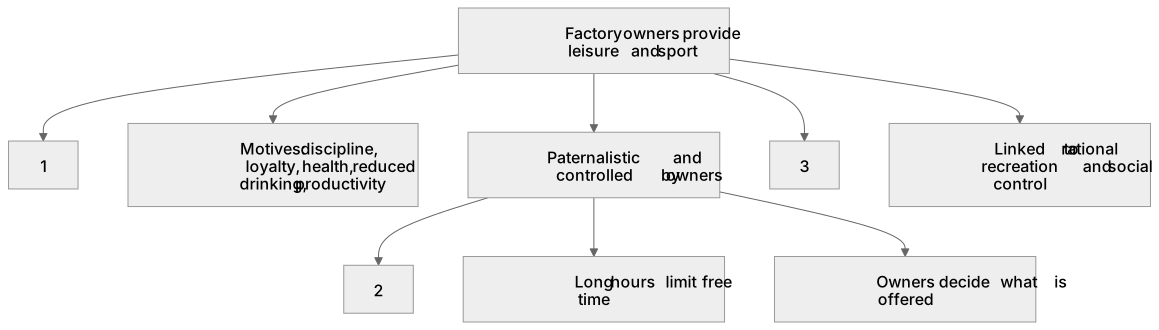
1Box 1
2Box 2
3Box 3
There is more to this lesson
The full lesson goes on to check your understanding and help you earn the marks. Create a free account to carry on, with your progress saved.
A week of Premium from your first lesson · Then the free plan continues · No card, no charge
Test your understanding of Industrial and post-industrial (1780–1900): Provision through factories.
Active recall beats re-reading. Take an instant quiz now to test what you’ve learned and lock it into long-term memory.
A week of Premium from your first lesson · Then the free plan continues · No card, no charge