AQA · A-Level · Physical Education
Course version: 7582 · Version from Sept 2016
Industrial and post-industrial (1780–1900): The British Empire.
The British Empire was a global network of territories, trade routes and political control centred on Britain.
Checked against the AQA 7582 specification (opens in a new tab) on .
- Point 5 of 12
- 4 key terms
Study notes
From the checked teaching notes for this specification point.
The idea
The British Empire was a global network of territories, trade routes and political control centred on Britain. In the industrial and post-industrial period 1780–1900, it expanded across India, Africa, the Caribbean, Canada, Australia and New Zealand. This mattered for physical education because empire created wealth, urbanisation and global sport contact. Public schools and muscular Christians exported team games to colonies, while colonised peoples sometimes adapted them. Factory owners and missionaries used sport for discipline and moral training. The empire also shaped access: working-class Britons had limited leisure, while colonial subjects faced racial and cultural exclusion. For MCQ, link empire to the growth of rational recreation, the spread of codified games and the amateur ideal. Do not treat empire as a single cause; it interacted with industrialisation and class.
What earns the marks
- Identifies the British Empire as a global system of territories, trade and political control centred on Britain during 1780–1900.
- Explains that empire generated wealth and urbanisation that affected leisure and recreation in Britain.
- Describes how public schools and muscular Christians exported team games and athletic ideals across the empire.
- Recognises that colonised peoples adapted and sometimes resisted British sporting practices.
- Links empire to the spread of codified sport, the amateur ideal and rational recreation.
- Acknowledges limits: working-class Britons and colonial subjects often faced restricted access to sport.
Common mistakes and how to put them right
Misunderstanding: the British Empire only affected politics and economics, not sport.
Put it right: Empire also shaped the global spread of codified games, amateur ideals and rational recreation.
Misunderstanding: all British people benefited equally from imperial sport.
Put it right: Class and race restricted access, so working-class Britons and colonised peoples often had fewer opportunities.
Misunderstanding: empire alone caused modern sport.
Put it right: Industrialisation, urbanisation and class conflict also drove changes in leisure and physical activity.
Misunderstanding: colonised peoples passively accepted British sport.
Put it right: They adapted, reinterpreted and sometimes resisted imported games.
Exam tips
- Read the MCQ stem carefully to identify whether it asks about cause, consequence or characteristic of empire in 1780–1900.
- Eliminate options that ignore class or race, because empire’s sporting impact was unequal.
- Link empire to specific developments such as the export of team games or the amateur ideal, not vague generalisations.
- Check that your chosen option stays within 1780–1900 and does not import later globalisation debates.
Try the lesson
The start of the Industrial and post-industrial (1780–1900): The British Empire. lesson, made from checked teaching notes for this specification point.
Have a go first
During the 19th century, how did the expansion of the British Empire most significantly influence the global development of sport?
Listen
The British Empire was a global network of territories, trade routes and political control centred on Britain. In the industrial and post-industrial period 1780–1900, it expanded across India, Africa, the Caribbean, Canada, Australia and New Zealand. This mattered for physical education because empire created wealth, urbanisation and global sport contact. Public schools and muscular Christians exported team games to colonies, while colonised peoples sometimes adapted them. Factory owners and missionaries used sport for discipline and moral training. The empire also shaped access: working-class Britons had limited leisure, while colonial subjects faced racial and cultural exclusion. For MCQ, link empire to the growth of rational recreation, the spread of codified games and the amateur ideal. Do not treat empire as a single cause; it interacted with industrialisation and class. A strong answer earns marks for these points. Identifies the British Empire as a global system of territories, trade and political control centred on Britain during 1780–1900. Explains that empire generated wealth and urbanisation that affected leisure and recreation in Britain. Describes how public schools and muscular Christians exported team games and athletic ideals across the empire. Recognises that colonised peoples adapted and sometimes resisted British sporting practices. A common slip: Misunderstanding: the British Empire only affected politics and economics, not sport. Instead, empire also shaped the global spread of codified games, amateur ideals and rational recreation. Exam tip: Read the MCQ stem carefully to identify whether it asks about cause, consequence or characteristic of empire in 1780–1900.
See it

Key words
Say what each word means before you turn the card.
Imperial expansion and global trade
Try answering aloud or in your head before turning the card.
Export of public school games and muscular Christianity
Try answering aloud or in your head before turning the card.
Class and racial inequality in sport access
Try answering aloud or in your head before turning the card.
Codification and rational recreation
Try answering aloud or in your head before turning the card.
See every definition
- Imperial expansion and global trade
- A global network of territories, trade routes and political control centred on Britain that expanded across India, Africa, the Caribbean, Canada, Australia and New Zealand.
- Export of public school games and muscular Christianity
- The process by which public schools and muscular Christians exported team games and athletic ideals across the empire.
- Class and racial inequality in sport access
- Restricted access to sport, as working-class Britons had limited leisure while colonial subjects faced racial and cultural exclusion.
- Codification and rational recreation
- Developments in sport linked to empire, alongside the spread of codified games and the amateur ideal.
Label the diagram
Some boxes have lost their names. Pick the right name for each number.
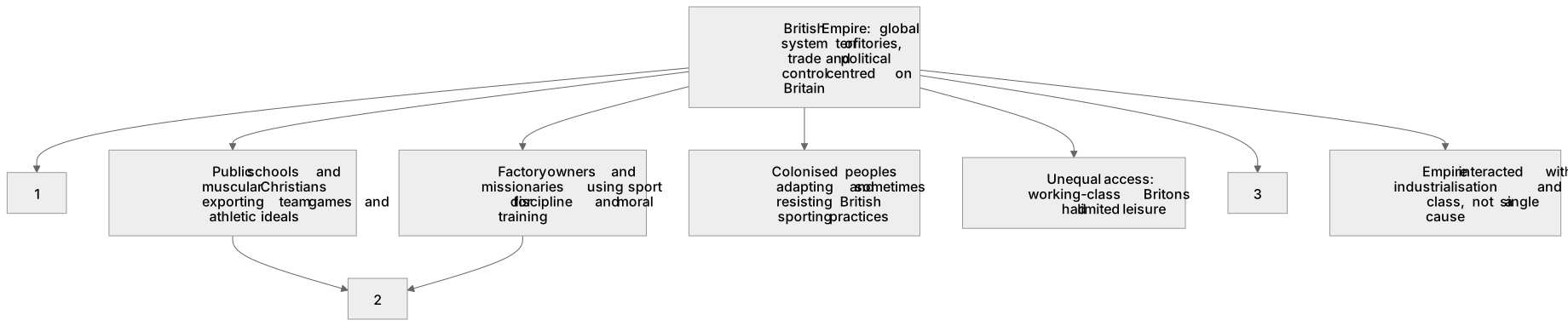
1Box 1
2Box 2
3Box 3
There is more to this lesson
The full lesson goes on to check your understanding and help you earn the marks. Create a free account to carry on, with your progress saved.
A week of Premium from your first lesson · Then the free plan continues · No card, no charge
Test your understanding of Industrial and post-industrial (1780–1900): The British Empire.
Active recall beats re-reading. Take an instant quiz now to test what you’ve learned and lock it into long-term memory.
A week of Premium from your first lesson · Then the free plan continues · No card, no charge