AQA · A-Level · Physical Education
Course version: 7582 · Version from Sept 2016
An understanding of the forces acting on a performer during linear motion.
Full specification wording
Linear motion: An understanding of the forces acting on a performer during linear motion.
Linear motion means movement along a straight or curved path where the body travels in one direction at a time, such as a sprinter accelerating down a straight lane or a swimmer pushing off the wall.
Checked against the AQA 7582 specification (opens in a new tab) on .
- Point 1 of 7
- 4 key terms
Study notes
From the checked teaching notes for this specification point.
The idea
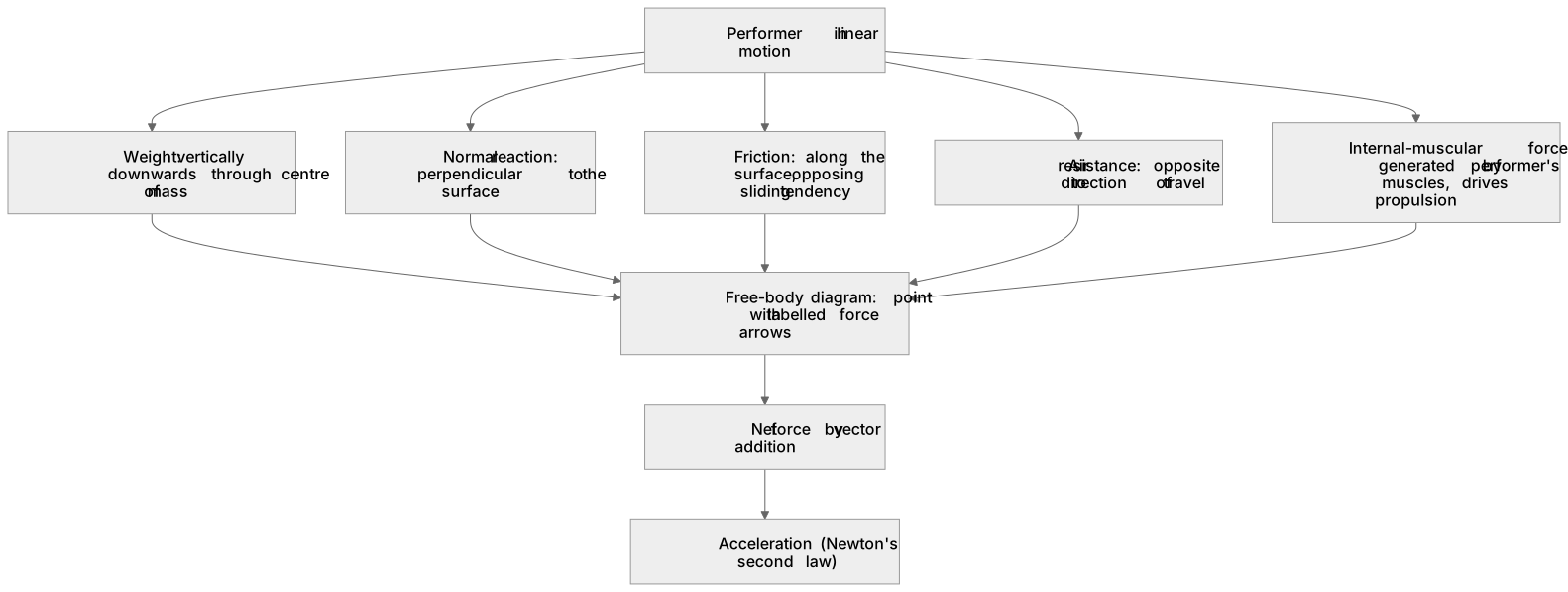
Linear motion means movement along a straight or curved path where the body travels in one direction at a time, such as a sprinter accelerating down a straight lane or a swimmer pushing off the wall. Several forces act simultaneously on that performer. Weight acts vertically downwards through the centre of mass. The normal reaction from the ground acts perpendicular to the surface. Frictional force acts along the surface, opposing the sliding tendency between shoe and track. Air resistance acts opposite to the direction of travel. Internal-muscular force is generated by the performer's own muscles and drives propulsion. To analyse motion you draw a free-body diagram: a dot for the performer, arrows for each external force, labelled with direction and relative size. Net force is then found by vector addition, and it determines acceleration in line with Newton's second law.
What earns the marks
- Weight is the gravitational force on the performer, acting vertically downwards through the centre of mass.
- Frictional force acts along the contact surface and opposes the relative sliding tendency between shoe and ground.
- Air resistance (drag) acts in the direction opposite to the performer's motion through the air.
- Internal-muscular force is produced by the performer's own muscles and provides propulsion; it is internal to the body but still drives the motion.
- A free-body diagram represents the performer as a point with labelled force arrows, allowing net force to be found by vector addition.
- Net force determines acceleration, so identifying the direction and relative size of each force explains speeding up, slowing down or steady speed.
Common mistakes and how to put them right
Treating weight and normal reaction as an equal-and-opposite pair in every situation.
Put it right: They are only equal in magnitude when the surface is horizontal and there is no vertical acceleration, so on a slope the normal reaction is smaller than weight.
Drawing internal-muscular force as an external arrow acting on the performer from outside.
Put it right: It is generated within the body, so it is shown as the force the performer exerts on the ground, with the ground's reaction propelling the body forward.
Assuming air resistance is negligible at all speeds.
Put it right: It grows with speed and frontal area, so it becomes significant in sprinting, cycling and downhill running.
Confusing mass with weight.
Put it right: Mass is measured in kilograms and is constant, whereas weight is a force measured in newtons and equals mass multiplied by gravitational field strength.
Exam tips
- Read the stem carefully to identify which single force the question targets, then eliminate options that describe a different force or the wrong direction.
- Check the direction wording in each option: weight is always vertically downwards, friction opposes sliding along the surface, and drag opposes motion through the air.
- Where a diagram is given, confirm the arrow's point of application and direction before choosing, because a correct force drawn in the wrong direction is still wrong.
Try the lesson
The start of the Linear motion: An understanding of the forces acting on a performer during linear motion. lesson, made from checked teaching notes for this specification point.
Have a go first
A sprinter runs at a constant velocity along a straight track. Which statement describes the horizontal forces acting on the sprinter?
Listen
Linear motion means movement along a straight or curved path where the body travels in one direction at a time, such as a sprinter accelerating down a straight lane or a swimmer pushing off the wall. Several forces act simultaneously on that performer. Weight acts vertically downwards through the centre of mass. The normal reaction from the ground acts perpendicular to the surface. Frictional force acts along the surface, opposing the sliding tendency between shoe and track. Air resistance acts opposite to the direction of travel. Internal-muscular force is generated by the performer's own muscles and drives propulsion. To analyse motion you draw a free-body diagram: a dot for the performer, arrows for each external force, labelled with direction and relative size. Net force is then found by vector addition, and it determines acceleration in line with Newton's second law. A strong answer earns marks for these points. Weight is the gravitational force on the performer, acting vertically downwards through the centre of mass. Frictional force acts along the contact surface and opposes the relative sliding tendency between shoe and ground. Air resistance (drag) acts in the direction opposite to the performer's motion through the air. Internal-muscular force is produced by the performer's own muscles and provides propulsion; it is internal to the body but still drives the motion. Exam tip: Read the stem carefully to identify which single force the question targets, then eliminate options that describe a different force or the wrong direction.
See it
Key words
Say what each word means before you turn the card.
Free-body diagram
Try answering aloud or in your head before turning the card.
Net force
Try answering aloud or in your head before turning the card.
Weight
Try answering aloud or in your head before turning the card.
Internal-muscular force
Try answering aloud or in your head before turning the card.
See every definition
- Free-body diagram
- A dot for the performer with arrows for each external force, labelled with direction and relative size.
- Net force
- Found by vector addition of the forces, and it determines acceleration in line with Newton's second law.
- Weight
- The gravitational force on the performer, acting vertically downwards through the centre of mass.
- Internal-muscular force
- Generated by the performer's own muscles and drives propulsion.
Label the diagram
Some boxes have lost their names. Pick the right name for each number.
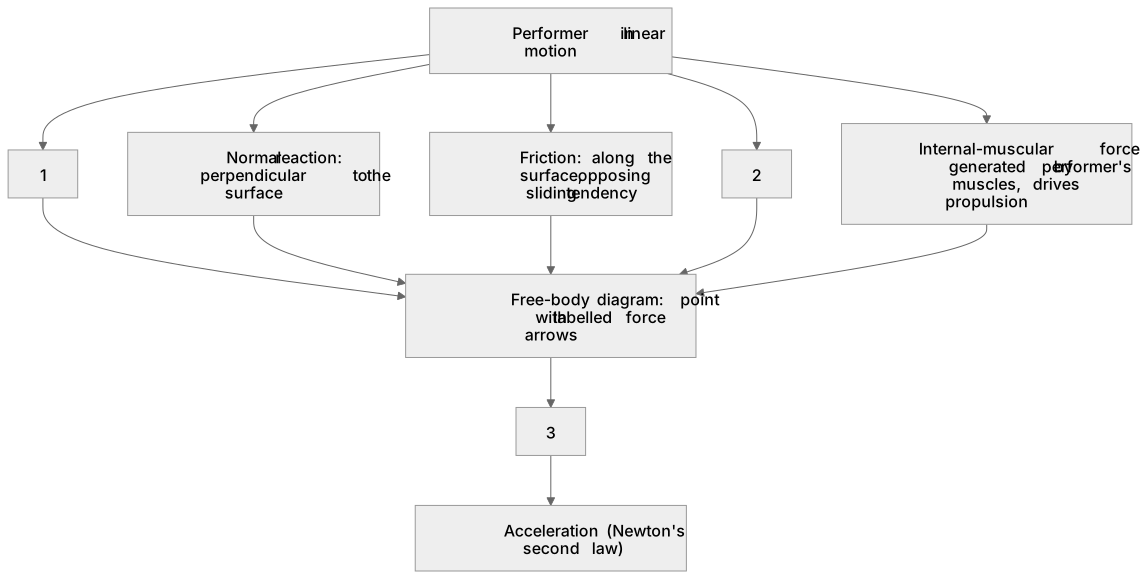
1Box 1
2Box 2
3Box 3
There is more to this lesson
The full lesson goes on to check your understanding and help you earn the marks. Create a free account to carry on, with your progress saved.
A week of Premium from your first lesson · Then the free plan continues · No card, no charge
Test your understanding of Linear motion: An understanding of the forces acting on a performer during linear motion.
Active recall beats re-reading. Take an instant quiz now to test what you’ve learned and lock it into long-term memory.
A week of Premium from your first lesson · Then the free plan continues · No card, no charge