AQA · A-Level · Physical Education
Course version: 7582 · Version from Sept 2016
Gravity, frictional force, air resistance, internal-muscular force, weight.
Full specification wording
Linear motion: Gravity, frictional force, air resistance, internal-muscular force, weight.
Each named force has a distinct origin and direction.
Checked against the AQA 7582 specification (opens in a new tab) on .
- Point 2 of 7
- 4 key terms
Study notes
From the checked teaching notes for this specification point.
The idea
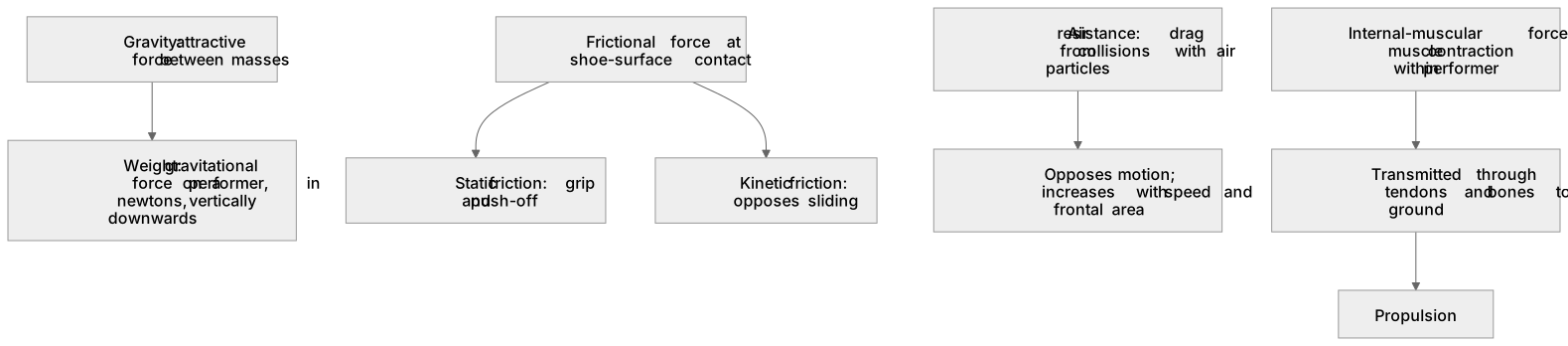
Each named force has a distinct origin and direction. Gravity is the attractive force between masses; on Earth it gives a gravitational field strength of about 9.81 N kg⁻¹, so a 70 kg performer has a weight of about 687 N acting vertically downwards. Weight is therefore the gravitational force on that performer, measured in newtons. Frictional force arises at the contact between shoe and surface and opposes sliding; it can be static, gripping the foot to allow push-off, or kinetic, opposing sliding. Air resistance is a drag force from collisions with air particles, acting opposite to motion and increasing with speed and frontal area. Internal-muscular force is generated by muscle contraction within the performer and is transmitted through tendons and bones to the ground, producing propulsion.
What earns the marks
- Gravity is the attractive force between masses and produces a gravitational field strength of about 9.81 N kg⁻¹ near the Earth's surface.
- Weight is the gravitational force acting on a performer, calculated as mass multiplied by gravitational field strength, and acts vertically downwards through the centre of mass.
- Frictional force acts at the contact surface between shoe and ground, opposing the relative sliding tendency; static friction enables grip and push-off.
- Air resistance is a drag force opposing motion through the air, increasing with speed and frontal area.
- Internal-muscular force is generated by muscle contraction inside the performer and drives propulsion when transmitted to the ground.
- Weight and gravity are related but not identical terms: gravity is the interaction, weight is the force experienced by a particular mass.
Common mistakes and how to put them right
Using weight and gravity as exact synonyms.
Put it right: Gravity is the interaction between masses, while weight is the force that interaction produces on a specific mass.
Giving weight in kilograms.
Put it right: Weight is a force measured in newtons, so a 70 kg performer has a weight of about 687 N, not 70 N.
Describing friction as always opposing motion.
Put it right: Static friction at the shoe can act forwards, in the direction of travel, to propel the performer.
Treating air resistance as constant.
Put it right: It rises with speed and frontal area, so it matters far more in cycling or sprinting than in a slow walk.
Exam tips
- Match each option to the force definition before choosing, because distractors often swap the origin or direction of two forces.
- Check units in any numerical option: weight must be in newtons, mass in kilograms, and gravitational field strength in N kg⁻¹.
- For friction questions, decide first whether the contact is sliding or gripping, since that determines whether friction opposes motion or enables it.
Try the lesson
The start of the Linear motion: Gravity, frictional force, air resistance, internal-muscular force, weight. lesson, made from checked teaching notes for this specification point.
Have a go first
A sprinter pushes backwards against the starting blocks during the drive phase. Which of the following is the internal-muscular force acting on the sprinter?
Listen
Each named force has a distinct origin and direction. Gravity is the attractive force between masses; on Earth it gives a gravitational field strength of about 9.81 N kg⁻¹, so a 70 kg performer has a weight of about 687 N acting vertically downwards. Weight is therefore the gravitational force on that performer, measured in newtons. Frictional force arises at the contact between shoe and surface and opposes sliding; it can be static, gripping the foot to allow push-off, or kinetic, opposing sliding. Air resistance is a drag force from collisions with air particles, acting opposite to motion and increasing with speed and frontal area. Internal-muscular force is generated by muscle contraction within the performer and is transmitted through tendons and bones to the ground, producing propulsion. A strong answer earns marks for these points. Gravity is the attractive force between masses and produces a gravitational field strength of about 9.81 N kg⁻¹ near the Earth's surface. Weight is the gravitational force acting on a performer, calculated as mass multiplied by gravitational field strength, and acts vertically downwards through the centre of mass. Frictional force acts at the contact surface between shoe and ground, opposing the relative sliding tendency; static friction enables grip and push-off. Air resistance is a drag force opposing motion through the air, increasing with speed and frontal area. Exam tip: Match each option to the force definition before choosing, because distractors often swap the origin or direction of two forces.
See it
Key words
Say what each word means before you turn the card.
Gravity
Try answering aloud or in your head before turning the card.
Weight
Try answering aloud or in your head before turning the card.
Frictional force
Try answering aloud or in your head before turning the card.
Air resistance
Try answering aloud or in your head before turning the card.
See every definition
- Gravity
- The attractive force between masses, giving a gravitational field strength of about 9.81 N kg⁻¹ on Earth.
- Weight
- The gravitational force acting on a performer, measured in newtons and acting vertically downwards.
- Frictional force
- Arises at the contact between shoe and surface and opposes sliding, being static to grip the foot for push-off or kinetic when opposing sliding.
- Air resistance
- A drag force from collisions with air particles, acting opposite to motion and increasing with speed and frontal area.
Label the diagram
Some boxes have lost their names. Pick the right name for each number.
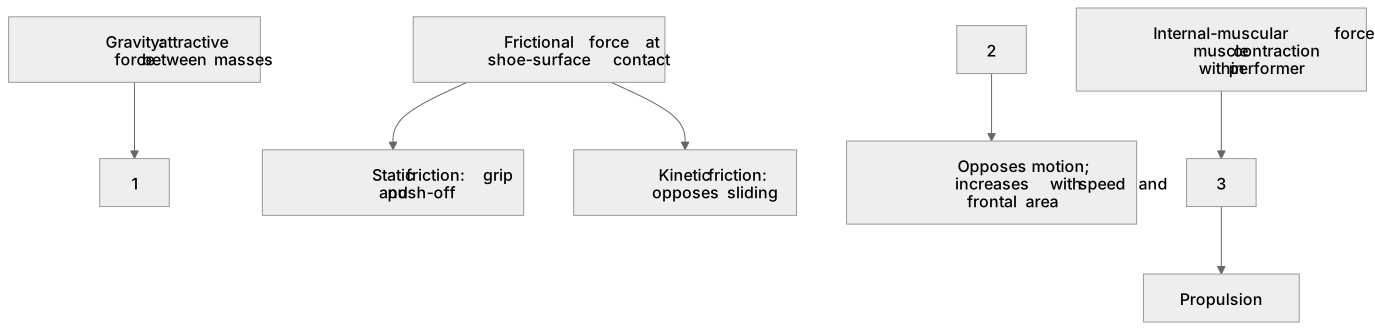
1Box 1
2Box 2
3Box 3
There is more to this lesson
The full lesson goes on to check your understanding and help you earn the marks. Create a free account to carry on, with your progress saved.
A week of Premium from your first lesson · Then the free plan continues · No card, no charge
Test your understanding of Linear motion: Gravity, frictional force, air resistance, internal-muscular force, weight.
Active recall beats re-reading. Take an instant quiz now to test what you’ve learned and lock it into long-term memory.
A week of Premium from your first lesson · Then the free plan continues · No card, no charge