AQA · A-Level · Physical Education
Course version: 7582 · Version from Sept 2016
Characteristics and functions of different muscle fibre types for a…
Full specification wording
Neuromuscular system: Characteristics and functions of different muscle fibre types for a variety of sporting activities.
Skeletal muscle contains fibres with different contractile and metabolic characteristics.
Checked against the AQA 7582 specification (opens in a new tab) on .
- Point 2 of 16
- 4 key terms
Study notes
From the checked teaching notes for this specification point.
The idea
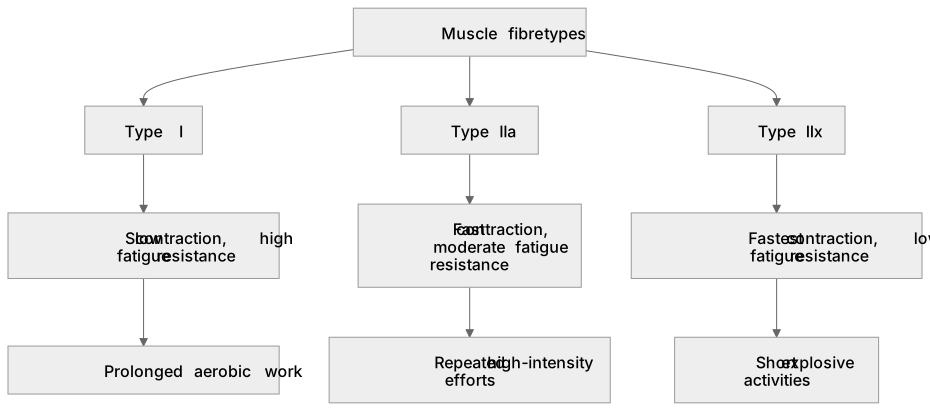
Skeletal muscle contains fibres with different contractile and metabolic characteristics. Type I fibres contract slowly, resist fatigue and suit prolonged aerobic work such as distance running or cycling. Type IIa fibres contract quickly, have moderate fatigue resistance and support repeated high-intensity efforts such as 400 m or 200 m swimming. Type IIx fibres contract fastest, generate high force but fatigue rapidly, suiting short explosive events such as 100 m sprint or a single jump. Function follows structure: more mitochondria, myoglobin and capillaries support aerobic ATP resynthesis in type I, while larger motor units and rapid ATP-PCr use support power in type IIx.
What earns the marks
- Type I fibres have a slow contraction speed and high fatigue resistance, supporting prolonged aerobic activities such as marathon running.
- Type IIa fibres have a fast contraction speed with moderate fatigue resistance, supporting repeated high-intensity efforts such as 400 m running.
- Type IIx fibres have the fastest contraction speed and low fatigue resistance, supporting short explosive activities such as 100 m sprinting.
- Type I fibres have a high density of mitochondria, myoglobin and capillaries, which supports aerobic ATP resynthesis.
- Type IIx fibres rely more on ATP-PCr and glycolytic ATP resynthesis, which supports rapid force production but limits duration.
- Motor unit recruitment determines which fibre types are active: low-force aerobic work recruits mainly type I, while high-force explosive work recruits type II.
- The dominant fibre type used in an activity depends on the intensity and duration of the effort, not on the sport alone.
Common mistakes and how to put them right
Misunderstanding: all fibres in a muscle are the same type.
Put it right: A muscle contains a mixture of type I, IIa and IIx fibres, and the proportion recruited changes with the demand of the activity.
Misunderstanding: type IIx fibres are best for endurance because they are powerful.
Put it right: Type IIx fibres fatigue rapidly and are suited to short explosive efforts, whereas type I fibres resist fatigue and suit prolonged aerobic work.
Misunderstanding: a sport uses only one fibre type.
Put it right: Most sports recruit a range of fibre types; for example, a football match uses type I for jogging and type IIa/IIx for sprints and jumps.
Misunderstanding: fibre type alone determines performance.
Put it right: Training, technique, tactics and motivation also affect performance, and fibre type contributes to, but does not solely determine, success.
Exam tips
- Read the activity in the question and identify its dominant intensity and duration before selecting a fibre type.
- Link each fibre characteristic to its function: slow and fatigue-resistant for endurance, fast and fatigable for power.
- Eliminate options that describe a fibre type with the wrong fatigue profile for the activity given.
- Check whether the question asks about characteristics, functions or both, and answer only what is asked.
Try the lesson
The start of the Neuromuscular system: Characteristics and functions of different muscle fibre types for a variety of sporting activities. lesson, made from checked teaching notes for this specification point.
Have a go first
Which muscle fibre type is best suited to a 100 m sprint because it contracts rapidly and generates high force?
Listen
Skeletal muscle contains fibres with different contractile and metabolic characteristics. Type I fibres contract slowly, resist fatigue and suit prolonged aerobic work such as distance running or cycling. Type IIa fibres contract quickly, have moderate fatigue resistance and support repeated high-intensity efforts such as 400 m or 200 m swimming. Type IIx fibres contract fastest, generate high force but fatigue rapidly, suiting short explosive events such as 100 m sprint or a single jump. Function follows structure: more mitochondria, myoglobin and capillaries support aerobic ATP resynthesis in type I, while larger motor units and rapid ATP-PCr use support power in type IIx. A strong answer earns marks for these points. Type I fibres have a slow contraction speed and high fatigue resistance, supporting prolonged aerobic activities such as marathon running. Type IIa fibres have a fast contraction speed with moderate fatigue resistance, supporting repeated high-intensity efforts such as 400 m running. Type IIx fibres have the fastest contraction speed and low fatigue resistance, supporting short explosive activities such as 100 m sprinting. Type I fibres have a high density of mitochondria, myoglobin and capillaries, which supports aerobic ATP resynthesis. A common slip: Misunderstanding: all fibres in a muscle are the same type. Instead, a muscle contains a mixture of type I, IIa and IIx fibres, and the proportion recruited changes with the demand of the activity. Exam tip: Read the activity in the question and identify its dominant intensity and duration before selecting a fibre type.
See it
Key words
Say what each word means before you turn the card.
Structure and function of muscle fibre types
Try answering aloud or in your head before turning the card.
Fatigue resistance and contraction speed
Try answering aloud or in your head before turning the card.
Aerobic and anaerobic ATP resynthesis
Try answering aloud or in your head before turning the card.
Matching fibre type to sporting demand
Try answering aloud or in your head before turning the card.
See every definition
- Structure and function of muscle fibre types
- Skeletal muscle contains fibres with different contractile and metabolic characteristics, and function follows structure.
- Fatigue resistance and contraction speed
- Type I fibres contract slowly and resist fatigue, type IIa fibres contract quickly with moderate fatigue resistance, and type IIx fibres contract fastest but fatigue rapidly.
- Aerobic and anaerobic ATP resynthesis
- More mitochondria, myoglobin and capillaries support aerobic ATP resynthesis in type I, while type IIx relies more on ATP-PCr and glycolytic ATP resynthesis.
- Matching fibre type to sporting demand
- The dominant fibre type used in an activity depends on the intensity and duration of the effort, not on the sport alone.
Label the diagram
Some boxes have lost their names. Pick the right name for each number.
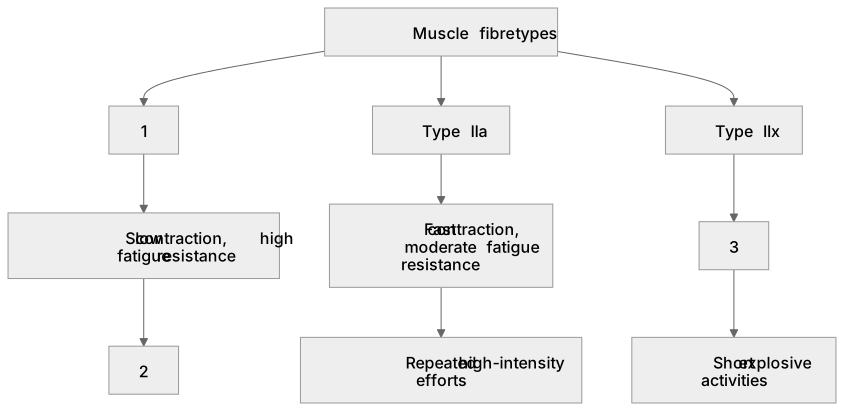
1Box 1
2Box 2
3Box 3
There is more to this lesson
The full lesson goes on to check your understanding and help you earn the marks. Create a free account to carry on, with your progress saved.
A week of Premium from your first lesson · Then the free plan continues · No card, no charge
Test your understanding of Neuromuscular system: Characteristics and functions of different muscle fibre types for a variety of sporting activities.
Active recall beats re-reading. Take an instant quiz now to test what you’ve learned and lock it into long-term memory.
A week of Premium from your first lesson · Then the free plan continues · No card, no charge