AQA · A-Level · Physical Education
Course version: 7582 · Version from Sept 2016
Neuromuscular system: Slow twitch (type I).
Slow twitch (type I) fibres contract slowly and resist fatigue, making them suited to prolonged aerobic activities such as distance running, cycling or cross-country skiing.
Checked against the AQA 7582 specification (opens in a new tab) on .
- Point 3 of 16
- 4 key terms
Study notes
From the checked teaching notes for this specification point.
The idea
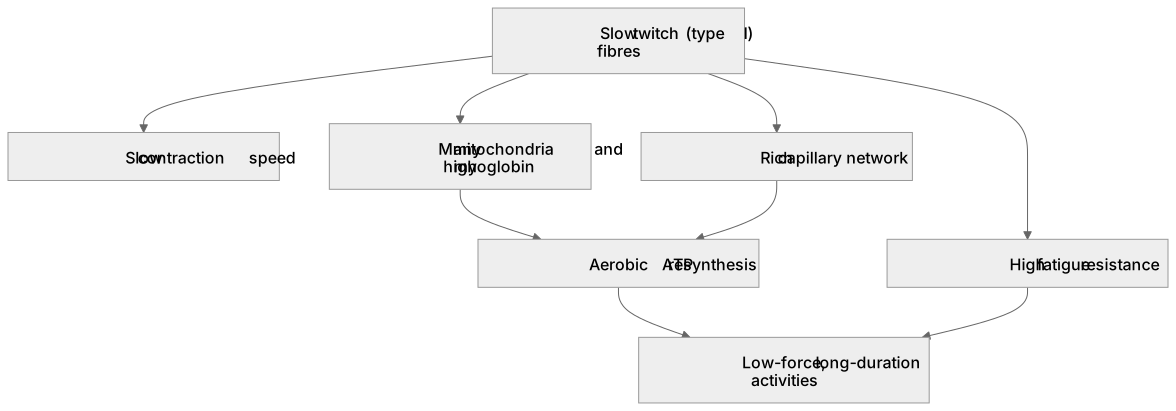
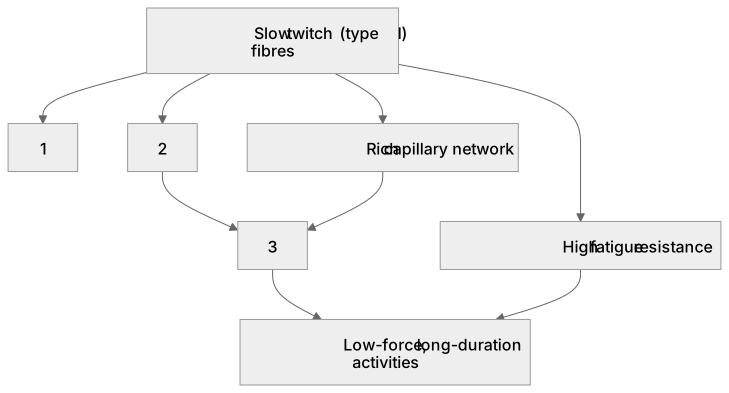
Slow twitch (type I) fibres contract slowly and resist fatigue, making them suited to prolonged aerobic activities such as distance running, cycling or cross-country skiing. They contain many mitochondria, a high concentration of myoglobin and a dense capillary network, which support aerobic ATP resynthesis and efficient oxygen delivery. Their motor units are recruited for low-force, long-duration work. Do not confuse them with type IIa, which are faster but less fatigue-resistant, or type IIx, which are fastest and fatigue most rapidly.
What earns the marks
- Type I fibres have a slow contraction speed.
- Type I fibres have high fatigue resistance.
- Type I fibres have a high density of mitochondria and myoglobin.
- Type I fibres have a rich capillary network supporting oxygen delivery.
- Type I fibres rely mainly on aerobic ATP resynthesis.
- Type I fibres are recruited for low-force, long-duration activities such as distance running.
Common mistakes and how to put them right
Misunderstanding: type I fibres produce the most force.
Put it right: Type I fibres produce relatively low force and are suited to low-intensity, prolonged work; type IIx fibres produce the highest force.
Misunderstanding: type I fibres are used only in slow sports.
Put it right: Type I fibres are recruited in many sports during low-intensity periods, such as jogging between sprints in football.
Misunderstanding: type I fibres fatigue quickly because they contract slowly.
Put it right: Type I fibres are highly fatigue-resistant and can sustain aerobic work for long periods.
Misunderstanding: type I fibres have few mitochondria.
Put it right: Type I fibres have many mitochondria and high myoglobin, which support aerobic metabolism.
Exam tips
- Look for the combination of slow contraction and high fatigue resistance to identify type I fibres.
- Match type I fibres to activities with a long duration and low-to-moderate intensity.
- Reject options that describe fast contraction or rapid fatigue when the question asks about type I fibres.
- Use the presence of mitochondria, myoglobin and capillaries as evidence for aerobic function.
Try the lesson
The start of the Neuromuscular system: Slow twitch (type I). lesson, made from checked teaching notes for this specification point.
Have a go first
Which structural feature is characteristic of a slow twitch (type I) muscle fibre?
Listen
Slow twitch (type I) fibres contract slowly and resist fatigue, making them suited to prolonged aerobic activities such as distance running, cycling or cross-country skiing. They contain many mitochondria, a high concentration of myoglobin and a dense capillary network, which support aerobic ATP resynthesis and efficient oxygen delivery. Their motor units are recruited for low-force, long-duration work. Do not confuse them with type IIa, which are faster but less fatigue-resistant, or type IIx, which are fastest and fatigue most rapidly. A strong answer earns marks for these points. Type I fibres have a slow contraction speed. Type I fibres have high fatigue resistance. Type I fibres have a high density of mitochondria and myoglobin. Type I fibres have a rich capillary network supporting oxygen delivery. A common slip: Misunderstanding: type I fibres produce the most force. Instead, type I fibres produce relatively low force and are suited to low-intensity, prolonged work; type IIx fibres produce the highest force. Exam tip: Look for the combination of slow contraction and high fatigue resistance to identify type I fibres.
See it
Key words
Say what each word means before you turn the card.
Slow contraction speed
Try answering aloud or in your head before turning the card.
High fatigue resistance
Try answering aloud or in your head before turning the card.
Aerobic ATP resynthesis
Try answering aloud or in your head before turning the card.
Endurance activity performance
Try answering aloud or in your head before turning the card.
See every definition
- Slow contraction speed
- A defining characteristic of type I fibres, which contract slowly and are identified by this alongside high fatigue resistance.
- High fatigue resistance
- The ability of type I fibres to resist fatigue, allowing them to sustain aerobic work for long periods.
- Aerobic ATP resynthesis
- The main way type I fibres produce ATP, supported by many mitochondria, a high concentration of myoglobin and a dense capillary network.
- Endurance activity performance
- Type I fibres are suited to prolonged aerobic activities such as distance running, cycling or cross-country skiing, being recruited for low-force, long-duration work.
Label the diagram
Some boxes have lost their names. Pick the right name for each number.
1Box 1
2Box 2
3Box 3
There is more to this lesson
The full lesson goes on to check your understanding and help you earn the marks. Create a free account to carry on, with your progress saved.
A week of Premium from your first lesson · Then the free plan continues · No card, no charge
Test your understanding of Neuromuscular system: Slow twitch (type I).
Active recall beats re-reading. Take an instant quiz now to test what you’ve learned and lock it into long-term memory.
A week of Premium from your first lesson · Then the free plan continues · No card, no charge