AQA · A-Level · Physical Education
Course version: 7582 · Version from Sept 2016
Neuromuscular system: Spatial summation.
In A-Level Physical Education, spatial summation refers to the recruitment of additional or larger motor units to increase the overall force of a muscle contraction.
Checked against the AQA 7582 specification (opens in a new tab) on .
- Point 13 of 16
- 4 key terms
Study notes
From the checked teaching notes for this specification point.
The idea
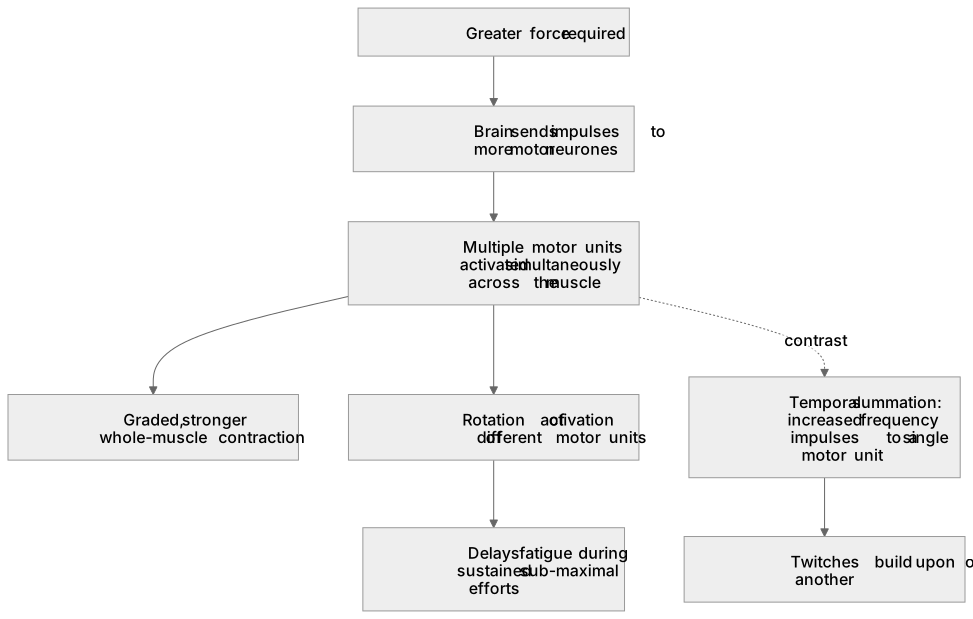
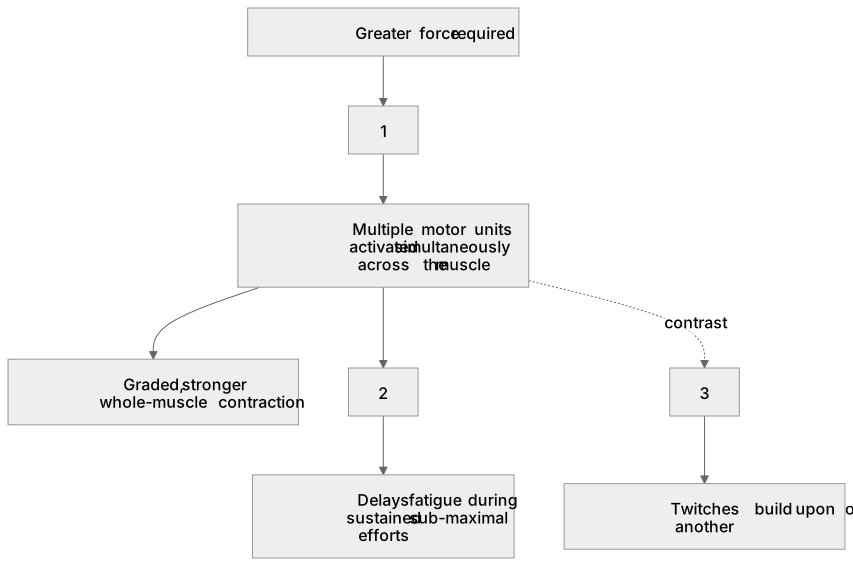
In A-Level Physical Education, spatial summation refers to the recruitment of additional or larger motor units to increase the overall force of a muscle contraction. When greater force is required, the brain sends impulses to more motor neurones, activating multiple motor units simultaneously across the muscle. This spatial distribution of activated units allows the muscle to produce a graded, stronger contraction. It can also involve rotating the activation of different motor units to delay fatigue during sustained sub-maximal efforts. Spatial summation differs from temporal summation (wave summation), which increases force by raising the frequency of nerve impulses to a single motor unit, causing twitches to build upon one another.
What earns the marks
- Defines spatial summation as the recruitment of multiple motor units to increase the force of muscle contraction.
- Explains that activating larger or more motor units simultaneously produces a stronger whole-muscle contraction.
- Notes that spatial summation allows for graded force production depending on the demands of the activity.
- Identifies that rotating the activation of different motor units can help delay fatigue during sustained efforts.
- Distinguishes spatial summation (recruiting more units) from temporal summation (increasing the frequency of impulses to a unit).
Common mistakes and how to put them right
Confusing spatial summation with temporal summation.
Put it right: Spatial involves recruiting more motor units, while temporal involves increasing the frequency of impulses to existing active units.
Defining spatial summation purely in neurobiological terms (synapses) rather than its A-Level PE application to motor unit recruitment and whole-muscle force.
Assuming spatial summation only applies to maximal contractions.
Put it right: It also allows for graded force and delaying fatigue through motor unit rotation during sub-maximal work.
Exam tips
- Clearly define spatial summation as the recruitment of additional motor units to increase force.
- Contrast spatial summation with temporal summation (wave summation) to demonstrate precise understanding of how muscle force is graded.
- Mention the rotation of motor units as a mechanism of spatial summation to delay fatigue in endurance events.
Try the lesson
The start of the Neuromuscular system: Spatial summation. lesson, made from checked teaching notes for this specification point.
Have a go first
What describes the process of spatial summation at the cell body of a motor neurone?
Listen
In A-Level Physical Education, spatial summation refers to the recruitment of additional or larger motor units to increase the overall force of a muscle contraction. When greater force is required, the brain sends impulses to more motor neurones, activating multiple motor units simultaneously across the muscle. This spatial distribution of activated units allows the muscle to produce a graded, stronger contraction. It can also involve rotating the activation of different motor units to delay fatigue during sustained sub-maximal efforts. Spatial summation differs from temporal summation (wave summation), which increases force by raising the frequency of nerve impulses to a single motor unit, causing twitches to build upon one another. A strong answer earns marks for these points. Defines spatial summation as the recruitment of multiple motor units to increase the force of muscle contraction. Explains that activating larger or more motor units simultaneously produces a stronger whole-muscle contraction. Notes that spatial summation allows for graded force production depending on the demands of the activity. Identifies that rotating the activation of different motor units can help delay fatigue during sustained efforts. Exam tip: Clearly define spatial summation as the recruitment of additional motor units to increase force.
See it
Key words
Say what each word means before you turn the card.
Spatial summation
Try answering aloud or in your head before turning the card.
Graded force production
Try answering aloud or in your head before turning the card.
Temporal summation
Try answering aloud or in your head before turning the card.
Fatigue management
Try answering aloud or in your head before turning the card.
See every definition
- Spatial summation
- The recruitment of additional or larger motor units to increase the overall force of a muscle contraction.
- Graded force production
- A stronger whole-muscle contraction produced by activating more motor units simultaneously, depending on the demands of the activity.
- Temporal summation
- Increasing force by raising the frequency of nerve impulses to a single motor unit, causing twitches to build upon one another.
- Fatigue management
- Rotating the activation of different motor units to delay fatigue during sustained sub-maximal efforts.
Label the diagram
Some boxes have lost their names. Pick the right name for each number.
1Box 1
2Box 2
3Box 3
There is more to this lesson
The full lesson goes on to check your understanding and help you earn the marks. Create a free account to carry on, with your progress saved.
A week of Premium from your first lesson · Then the free plan continues · No card, no charge
Test your understanding of Neuromuscular system: Spatial summation.
Active recall beats re-reading. Take an instant quiz now to test what you’ve learned and lock it into long-term memory.
A week of Premium from your first lesson · Then the free plan continues · No card, no charge