AQA · A-Level · Physical Education
Course version: 7582 · Version from Sept 2016
Neuromuscular system: Wave summation.
Wave summation occurs when a motor neurone delivers a second stimulus to a muscle fibre before the previous contraction has fully relaxed, so the mechanical responses overlap and force builds.
Checked against the AQA 7582 specification (opens in a new tab) on .
- Point 14 of 16
- 4 key terms
Study notes
From the checked teaching notes for this specification point.
The idea
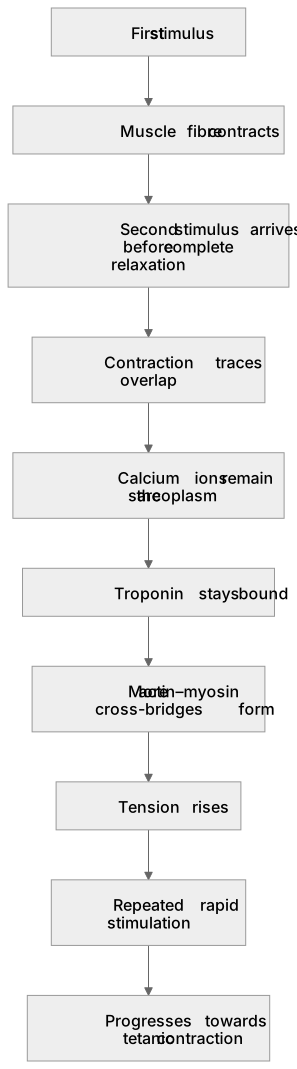
Wave summation occurs when a motor neurone delivers a second stimulus to a muscle fibre before the previous contraction has fully relaxed, so the mechanical responses overlap and force builds. The muscle fibre cannot relax between impulses, so calcium ions remain in the sarcoplasm, troponin stays bound and more actin–myosin cross-bridges form, raising tension. If stimuli arrive rapidly and repeatedly, summation progresses towards a smooth, sustained tetanic contraction. Summation depends on impulse frequency, not on recruiting extra fibres, so it differs from spatial summation through motor unit recruitment. A concrete method: stimulate a frog gastrocnemius at increasing frequencies and record the trace; the peaks rise and merge as the interval shortens.
What earns the marks
- Wave summation is the additive effect of a second stimulus arriving before the muscle fibre has fully relaxed from the first.
- The interval between stimuli is shorter than the relaxation time, so the contraction traces overlap.
- Calcium ions remain in the sarcoplasm, sustaining troponin binding and cross-bridge cycling.
- Repeated rapid stimulation produces a progressively greater force, leading towards tetanus.
- Summation is a temporal effect of impulse frequency on one fibre, distinct from spatial summation by recruiting more motor units.
Common mistakes and how to put them right
Thinking summation means more muscle fibres are recruited.
Put it right: It is a temporal effect on the same fibre, whereas recruitment is spatial summation.
Believing the second stimulus must be stronger.
Put it right: Summation depends on timing, not stimulus strength above threshold.
Assuming summation requires complete relaxation between stimuli.
Put it right: It specifically requires the second stimulus before relaxation is complete.
Confusing summation with the all or none law.
Put it right: The law concerns whether a single fibre contracts at all, while summation concerns the force produced by overlapping twitches.
Exam tips
- Define summation in terms of stimulus timing relative to relaxation, then explain the calcium and cross-bridge mechanism.
- Use the phrase 'before complete relaxation' to show precise understanding of the temporal condition.
- Contrast summation with motor unit recruitment in one sentence to demonstrate secure conceptual boundaries.
Try the lesson
The start of the Neuromuscular system: Wave summation. lesson, made from checked teaching notes for this specification point.
Have a go first
What causes wave summation in a skeletal muscle fibre?
Listen
Wave summation occurs when a motor neurone delivers a second stimulus to a muscle fibre before the previous contraction has fully relaxed, so the mechanical responses overlap and force builds. The muscle fibre cannot relax between impulses, so calcium ions remain in the sarcoplasm, troponin stays bound and more actin–myosin cross-bridges form, raising tension. If stimuli arrive rapidly and repeatedly, summation progresses towards a smooth, sustained tetanic contraction. Summation depends on impulse frequency, not on recruiting extra fibres, so it differs from spatial summation through motor unit recruitment. A concrete method: stimulate a frog gastrocnemius at increasing frequencies and record the trace; the peaks rise and merge as the interval shortens. A strong answer earns marks for these points. Wave summation is the additive effect of a second stimulus arriving before the muscle fibre has fully relaxed from the first. The interval between stimuli is shorter than the relaxation time, so the contraction traces overlap. Calcium ions remain in the sarcoplasm, sustaining troponin binding and cross-bridge cycling. Repeated rapid stimulation produces a progressively greater force, leading towards tetanus. A common slip: Thinking summation means more muscle fibres are recruited. Instead, it is a temporal effect on the same fibre, whereas recruitment is spatial summation. Exam tip: Define summation in terms of stimulus timing relative to relaxation, then explain the calcium and cross-bridge mechanism.
See it
Key words
Say what each word means before you turn the card.
Wave summation
Try answering aloud or in your head before turning the card.
Tetanic contraction
Try answering aloud or in your head before turning the card.
Spatial summation
Try answering aloud or in your head before turning the card.
Calcium ions
Try answering aloud or in your head before turning the card.
See every definition
- Wave summation
- The additive effect of a second stimulus arriving before the muscle fibre has fully relaxed from the first, so the mechanical responses overlap and force builds.
- Tetanic contraction
- A smooth, sustained contraction towards which summation progresses when stimuli arrive rapidly and repeatedly.
- Spatial summation
- Summation through motor unit recruitment, which differs from summation that depends on impulse frequency on one fibre.
- Calcium ions
- These remain in the sarcoplasm when the muscle fibre cannot relax between impulses, sustaining troponin binding and cross-bridge cycling.
Label the diagram
Some boxes have lost their names. Pick the right name for each number.
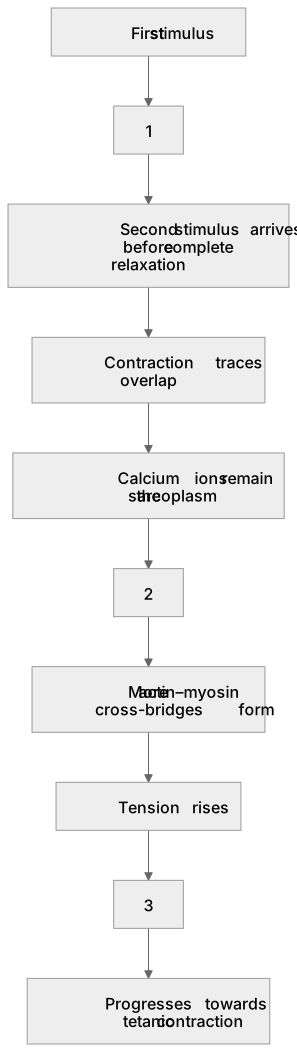
1Box 1
2Box 2
3Box 3
There is more to this lesson
The full lesson goes on to check your understanding and help you earn the marks. Create a free account to carry on, with your progress saved.
A week of Premium from your first lesson · Then the free plan continues · No card, no charge
Test your understanding of Neuromuscular system: Wave summation.
Active recall beats re-reading. Take an instant quiz now to test what you’ve learned and lock it into long-term memory.
A week of Premium from your first lesson · Then the free plan continues · No card, no charge