AQA · A-Level · Physical Education
Course version: 7582 · Version from Sept 2016
Neuromuscular system: Tetanic.
Tetanic contraction is the sustained, maximal contraction a muscle produces when it is stimulated by a rapid series of nerve impulses before it can relax.
Checked against the AQA 7582 specification (opens in a new tab) on .
- Point 16 of 16
- 4 key terms
Study notes
From the checked teaching notes for this specification point.
The idea
Tetanic contraction is the sustained, maximal contraction a muscle produces when it is stimulated by a rapid series of nerve impulses before it can relax. Each impulse arrives during the relaxation phase of the previous twitch, so the individual twitches fuse into one smooth, powerful contraction. This happens because the motor neurone fires repeatedly and calcium ions remain in the sarcoplasm, keeping troponin and tropomyosin displaced so actin and myosin can keep forming cross-bridges. A practical example is holding a heavy barbell at the top of a bicep curl: the biceps brachii stays shortened and firm rather than pulsing. Tetanic contraction is graded by impulse frequency, not by the size of a single stimulus, and it underpins most forceful sporting movements.
What earns the marks
- Tetanic contraction is a sustained contraction produced by a rapid series of impulses arriving before the muscle can fully relax.
- Individual twitches summate because each new impulse arrives during the relaxation phase of the previous twitch.
- High-frequency stimulation keeps calcium ions in the sarcoplasm so cross-bridge cycling continues without relaxation.
- Tetanic contraction produces greater force than a single twitch and is the normal pattern in forceful sporting actions.
Common mistakes and how to put them right
Thinking tetanic contraction is a single twitch repeated slowly.
Put it right: It requires impulses arriving so rapidly that relaxation phases fuse.
Confusing tetanic contraction with tetanus disease.
Put it right: Tetanic contraction is a normal physiological response of muscle to high-frequency stimulation.
Believing the muscle lengthens during tetanic contraction.
Put it right: The muscle maintains tension and may shorten, hold length or lengthen under load depending on the movement.
Exam tips
- Link the definition to impulse frequency and the absence of relaxation between twitches.
- Use a named sporting action, such as a gymnast holding a crucifix position, to show sustained force.
- Check that your answer distinguishes tetanic contraction from a single muscle twitch.
Try the lesson
The start of the Neuromuscular system: Tetanic. lesson, made from checked teaching notes for this specification point.
Have a go first
What is meant by a tetanic contraction of a muscle?
Listen
Tetanic contraction is the sustained, maximal contraction a muscle produces when it is stimulated by a rapid series of nerve impulses before it can relax. Each impulse arrives during the relaxation phase of the previous twitch, so the individual twitches fuse into one smooth, powerful contraction. This happens because the motor neurone fires repeatedly and calcium ions remain in the sarcoplasm, keeping troponin and tropomyosin displaced so actin and myosin can keep forming cross-bridges. A practical example is holding a heavy barbell at the top of a bicep curl: the biceps brachii stays shortened and firm rather than pulsing. Tetanic contraction is graded by impulse frequency, not by the size of a single stimulus, and it underpins most forceful sporting movements. A strong answer earns marks for these points. Tetanic contraction is a sustained contraction produced by a rapid series of impulses arriving before the muscle can fully relax. Individual twitches summate because each new impulse arrives during the relaxation phase of the previous twitch. High-frequency stimulation keeps calcium ions in the sarcoplasm so cross-bridge cycling continues without relaxation. Tetanic contraction produces greater force than a single twitch and is the normal pattern in forceful sporting actions. A common slip: Thinking tetanic contraction is a single twitch repeated slowly. Instead, it requires impulses arriving so rapidly that relaxation phases fuse. Exam tip: Link the definition to impulse frequency and the absence of relaxation between twitches.
See it
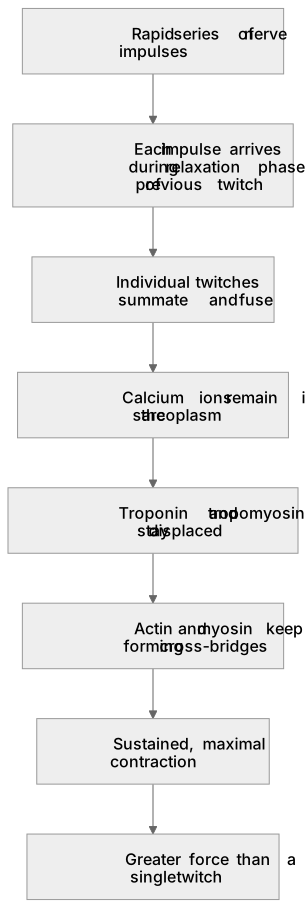
Put it in order
Put these steps in the order they happen.
- 1. Troponin and tropomyosin stay displaced
- 2. Greater force than a single twitch
- 3. Actin and myosin keep forming cross-bridges
- 4. Rapid series of nerve impulses
- 5. Each impulse arrives during relaxation phase of previous twitch
- 6. Sustained, maximal contraction
- 7. Individual twitches summate and fuse
- 8. Calcium ions remain in the sarcoplasm
Key words
Say what each word means before you turn the card.
Tetanic contraction
Try answering aloud or in your head before turning the card.
Summation of twitches
Try answering aloud or in your head before turning the card.
Calcium ion retention
Try answering aloud or in your head before turning the card.
Force production in sport
Try answering aloud or in your head before turning the card.
See every definition
- Tetanic contraction
- A sustained, maximal contraction a muscle produces when stimulated by a rapid series of nerve impulses before it can relax.
- Summation of twitches
- Individual twitches fuse into one smooth, powerful contraction because each impulse arrives during the relaxation phase of the previous twitch.
- Calcium ion retention
- Calcium ions remain in the sarcoplasm, keeping troponin and tropomyosin displaced so actin and myosin can keep forming cross-bridges.
- Force production in sport
- Tetanic contraction produces greater force than a single twitch and underpins most forceful sporting movements.
Label the diagram
Some boxes have lost their names. Pick the right name for each number.
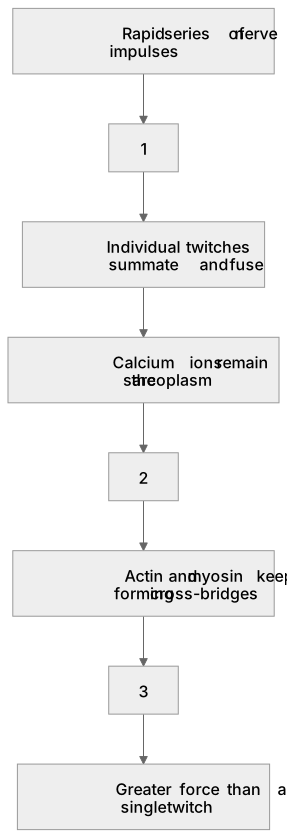
1Box 1
2Box 2
3Box 3
There is more to this lesson
The full lesson goes on to check your understanding and help you earn the marks. Create a free account to carry on, with your progress saved.
A week of Premium from your first lesson · Then the free plan continues · No card, no charge
Test your understanding of Neuromuscular system: Tetanic.
Active recall beats re-reading. Take an instant quiz now to test what you’ve learned and lock it into long-term memory.
A week of Premium from your first lesson · Then the free plan continues · No card, no charge