AQA · A-Level · Physical Education
Course version: 7582 · Version from Sept 2016
Neuromuscular system: All or none law.
The all or none law states that once a stimulus reaches threshold at a muscle fibre, that fibre contracts to its maximum possible extent for its current condition; a sub-threshold stimulus…
Checked against the AQA 7582 specification (opens in a new tab) on .
- Point 15 of 16
- 4 key terms
Study notes
From the checked teaching notes for this specification point.
The idea
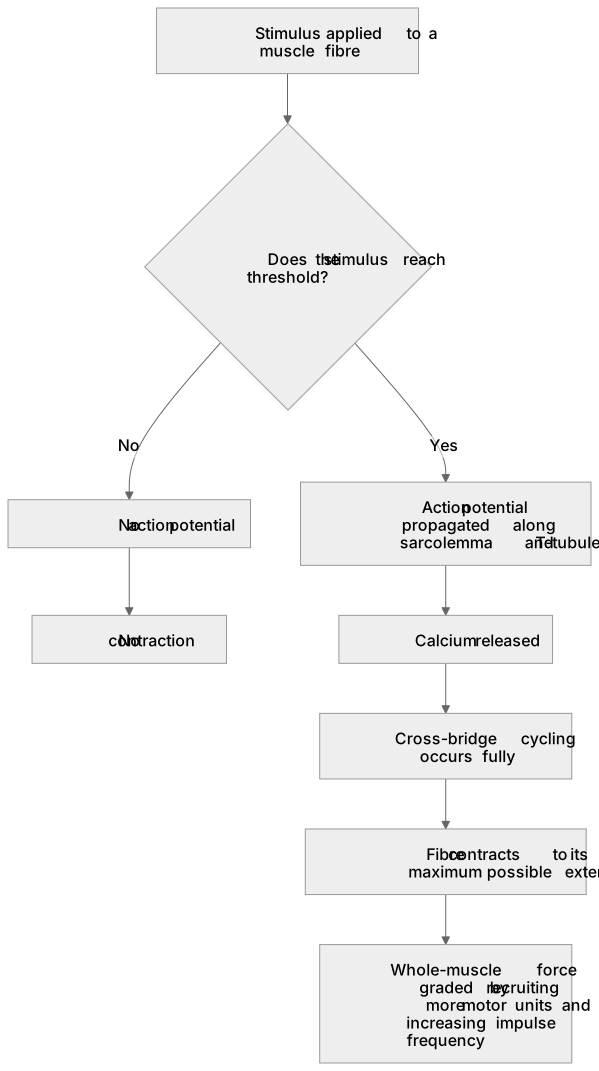
The all or none law states that once a stimulus reaches threshold at a muscle fibre, that fibre contracts to its maximum possible extent for its current condition; a sub-threshold stimulus produces no contraction. The action potential is propagated along the sarcolemma and T-tubules, releasing calcium so that cross-bridge cycling occurs fully. Gradation of whole-muscle force therefore comes from recruiting more motor units and from increasing impulse frequency, not from a single fibre contracting partially. A concrete method: apply increasing voltages to an isolated muscle preparation and note that the twitch appears suddenly at threshold and does not grow further with stronger single stimuli.
What earns the marks
- A muscle fibre either contracts maximally or not at all once threshold is reached.
- A stimulus below threshold produces no action potential and no contraction.
- Above threshold, a single fibre's twitch force is not graded by stimulus strength.
- Whole-muscle force is graded by recruiting additional motor units and by increasing impulse frequency.
- The law applies to individual muscle fibres, not to the whole muscle as a single unit.
Common mistakes and how to put them right
Applying the law to a whole muscle.
Put it right: It applies to individual fibres, while whole-muscle force varies with recruitment and frequency.
Thinking a stronger stimulus makes one fibre contract harder.
Put it right: Above threshold the single-fibre response is maximal.
Believing sub-threshold stimuli cause weak contractions.
Put it right: They produce no contraction at all.
Confusing the all or none law with wave summation.
Put it right: The law concerns whether a fibre contracts, while summation concerns overlapping twitches increasing force.
Exam tips
- State clearly that the law refers to individual muscle fibres, then explain how whole-muscle force is graded.
- Use threshold as the key term and explain what happens below and above it.
- Link the law to recruitment and frequency to show how the neuromuscular system controls force.
Try the lesson
The start of the Neuromuscular system: All or none law. lesson, made from checked teaching notes for this specification point.
Have a go first
According to the all or none law, what happens when a motor neurone is stimulated at a strength above the threshold needed to trigger a response?
Listen
The all or none law states that once a stimulus reaches threshold at a muscle fibre, that fibre contracts to its maximum possible extent for its current condition; a sub-threshold stimulus produces no contraction. The action potential is propagated along the sarcolemma and T-tubules, releasing calcium so that cross-bridge cycling occurs fully. Gradation of whole-muscle force therefore comes from recruiting more motor units and from increasing impulse frequency, not from a single fibre contracting partially. A concrete method: apply increasing voltages to an isolated muscle preparation and note that the twitch appears suddenly at threshold and does not grow further with stronger single stimuli. A strong answer earns marks for these points. A muscle fibre either contracts maximally or not at all once threshold is reached. A stimulus below threshold produces no action potential and no contraction. Above threshold, a single fibre's twitch force is not graded by stimulus strength. Whole-muscle force is graded by recruiting additional motor units and by increasing impulse frequency. A common slip: Applying the law to a whole muscle. Instead, it applies to individual fibres, while whole-muscle force varies with recruitment and frequency. Exam tip: State clearly that the law refers to individual muscle fibres, then explain how whole-muscle force is graded.
See it
Key words
Say what each word means before you turn the card.
Threshold
Try answering aloud or in your head before turning the card.
All or none law
Try answering aloud or in your head before turning the card.
Gradation of whole-muscle force
Try answering aloud or in your head before turning the card.
Motor unit recruitment and frequency
Try answering aloud or in your head before turning the card.
See every definition
- Threshold
- The stimulus level at which a muscle fibre contracts to its maximum possible extent for its current condition.
- All or none law
- Once a stimulus reaches threshold at a muscle fibre, that fibre contracts to its maximum possible extent for its current condition.
- Gradation of whole-muscle force
- Comes from recruiting more motor units and from increasing impulse frequency, not from a single fibre contracting partially.
- Motor unit recruitment and frequency
- The means by which whole-muscle force is graded, through recruiting additional motor units and increasing impulse frequency.
There is more to this lesson
The full lesson goes on to check your understanding and help you earn the marks. Create a free account to carry on, with your progress saved.
A week of Premium from your first lesson · Then the free plan continues · No card, no charge
Test your understanding of Neuromuscular system: All or none law.
Active recall beats re-reading. Take an instant quiz now to test what you’ve learned and lock it into long-term memory.
A week of Premium from your first lesson · Then the free plan continues · No card, no charge