AQA · A-Level · Physical Education
Course version: 7582 · Version from Sept 2016
Neuromuscular system: The recruitment of muscle fibres.
Recruitment of muscle fibres is the process by which the nervous system increases the number of motor units activated to produce more force.
Checked against the AQA 7582 specification (opens in a new tab) on .
- Point 11 of 16
- 4 key terms
Study notes
From the checked teaching notes for this specification point.
The idea
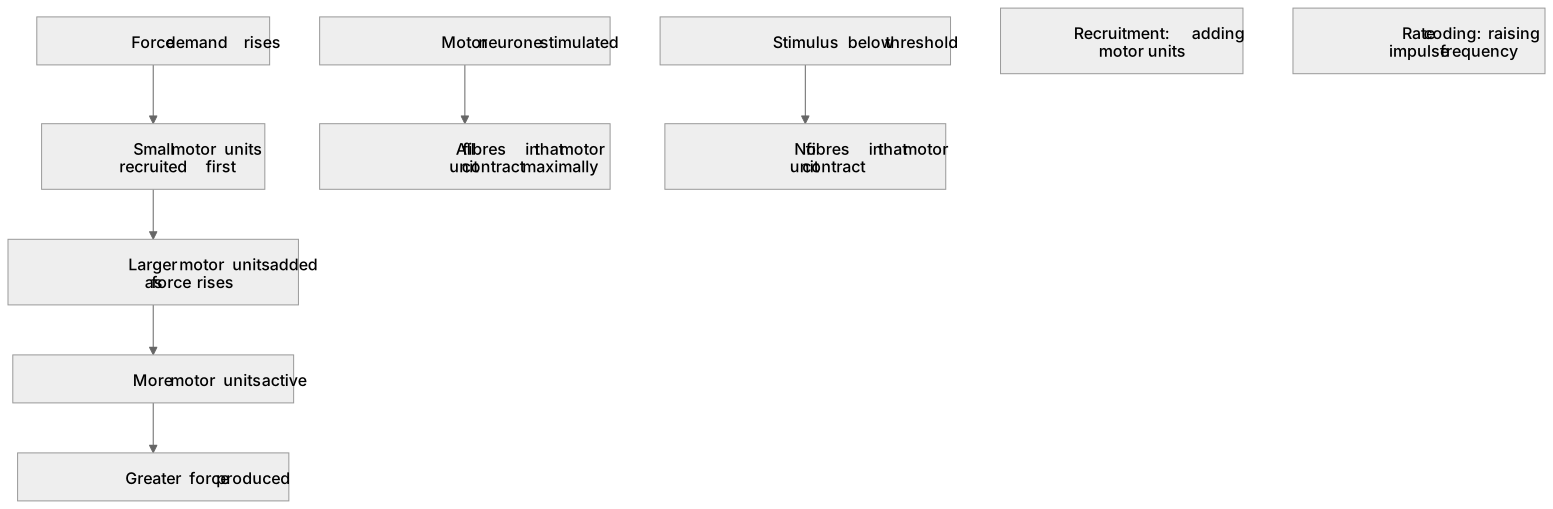
Recruitment of muscle fibres is the process by which the nervous system increases the number of motor units activated to produce more force. A motor unit consists of one motor neurone and all the muscle fibres it innervates. Small motor units are typically recruited first for fine or low-force tasks, while larger motor units are added as the required force rises (the size principle). The all-or-none law states that when a motor neurone is stimulated, all the muscle fibres within that specific motor unit contract maximally; if the stimulus is below the threshold, none of the fibres contract. In multiple-choice assessment, you must separate recruitment (adding active motor units) from rate coding (raising impulse frequency).
What earns the marks
- Defines recruitment as the activation of additional motor units to increase force production.
- States that a motor unit comprises one motor neurone and the muscle fibres it supplies.
- Explains the size principle, in which smaller motor units are recruited before larger ones as force demand increases.
- Distinguishes recruitment from rate coding, where increased impulse frequency raises force.
- Applies the all-or-none law to the motor unit, stating that all fibres in the unit contract maximally if the threshold is reached, or none do.
Common mistakes and how to put them right
Believing that a whole muscle contracts in an all-or-none manner.
Put it right: The all-or-none law applies to the motor unit, while whole-muscle force varies with recruitment and frequency.
Confusing recruitment with rate coding.
Put it right: Recruitment adds motor units, whereas rate coding increases the frequency of stimulation.
Thinking that large motor units are always recruited first.
Put it right: The size principle means smaller units are generally activated before larger ones.
Exam tips
- Check whether an option describes adding motor units or changing impulse frequency, because only the former is recruitment.
- Use the size principle to predict the order of activation when force demand increases.
- Keep the all-or-none law attached to the motor unit so that distractors about whole-muscle responses can be rejected.
Try the lesson
The start of the Neuromuscular system: The recruitment of muscle fibres. lesson, made from checked teaching notes for this specification point.
Have a go first
Which statement describes the order in which motor units are recruited as the force required from a muscle increases?
Listen
Recruitment of muscle fibres is the process by which the nervous system increases the number of motor units activated to produce more force. A motor unit consists of one motor neurone and all the muscle fibres it innervates. Small motor units are typically recruited first for fine or low-force tasks, while larger motor units are added as the required force rises (the size principle). The all-or-none law states that when a motor neurone is stimulated, all the muscle fibres within that specific motor unit contract maximally; if the stimulus is below the threshold, none of the fibres contract. In multiple-choice assessment, you must separate recruitment (adding active motor units) from rate coding (raising impulse frequency). A strong answer earns marks for these points. Defines recruitment as the activation of additional motor units to increase force production. States that a motor unit comprises one motor neurone and the muscle fibres it supplies. Explains the size principle, in which smaller motor units are recruited before larger ones as force demand increases. Distinguishes recruitment from rate coding, where increased impulse frequency raises force. Exam tip: Check whether an option describes adding motor units or changing impulse frequency, because only the former is recruitment.
See it
Key words
Say what each word means before you turn the card.
Recruitment
Try answering aloud or in your head before turning the card.
Motor unit
Try answering aloud or in your head before turning the card.
Size principle
Try answering aloud or in your head before turning the card.
All-or-none law
Try answering aloud or in your head before turning the card.
See every definition
- Recruitment
- The process by which the nervous system increases the number of motor units activated to produce more force.
- Motor unit
- One motor neurone and all the muscle fibres it innervates.
- Size principle
- Smaller motor units are recruited before larger ones as the required force rises.
- All-or-none law
- When a motor neurone is stimulated, all the muscle fibres within that specific motor unit contract maximally; if the stimulus is below the threshold, none of the fibres contract.
Label the diagram
Some boxes have lost their names. Pick the right name for each number.
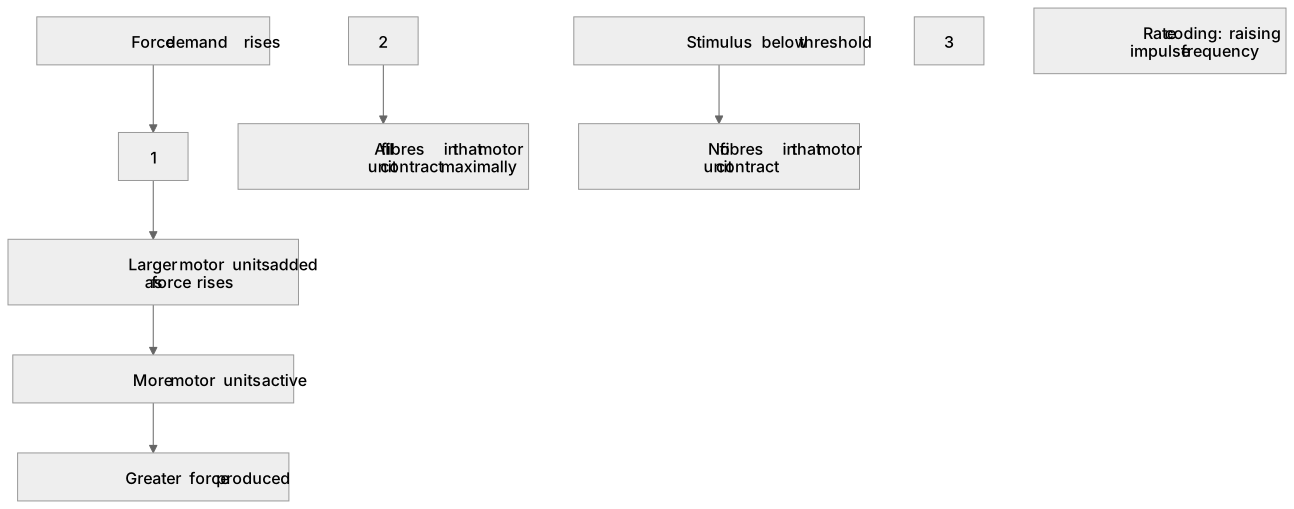
1Box 1
2Box 2
3Box 3
There is more to this lesson
The full lesson goes on to check your understanding and help you earn the marks. Create a free account to carry on, with your progress saved.
A week of Premium from your first lesson · Then the free plan continues · No card, no charge
Test your understanding of Neuromuscular system: The recruitment of muscle fibres.
Active recall beats re-reading. Take an instant quiz now to test what you’ve learned and lock it into long-term memory.
A week of Premium from your first lesson · Then the free plan continues · No card, no charge