AQA · A-Level · Physical Education
Course version: 7582 · Version from Sept 2016
Neuromuscular system: Golgi tendon organ.
The Golgi tendon organ is a proprioceptor lying within the tendon close to where it joins the muscle.
Checked against the AQA 7582 specification (opens in a new tab) on .
- Point 10 of 16
- 4 key terms
Study notes
From the checked teaching notes for this specification point.
The idea
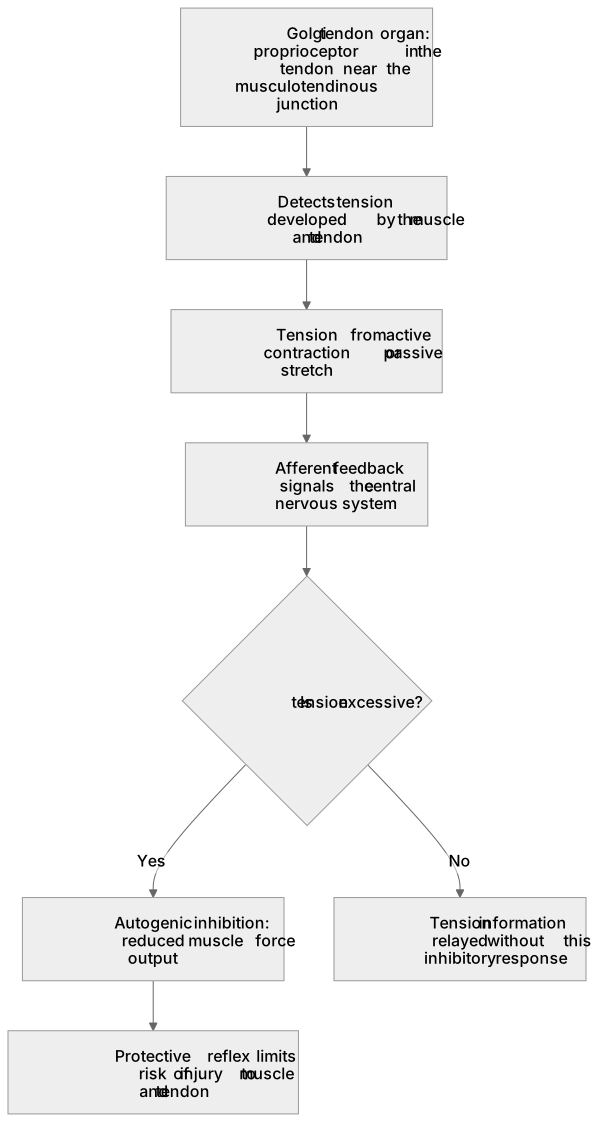
The Golgi tendon organ is a proprioceptor lying within the tendon close to where it joins the muscle. It detects the tension developed by the muscle, whether that tension arises from active contraction or from passive stretch, and it signals this information to the central nervous system. When tension becomes excessive, the resulting afferent feedback triggers an inhibitory response that reduces the force produced by the muscle, which is described as autogenic inhibition. This protective reflex helps to limit the risk of injury to the muscle and its tendon. In multiple-choice assessment you must distinguish the Golgi tendon organ, which monitors tension, from the muscle spindle, which monitors the rate and extent of muscle length change.
What earns the marks
- Identifies the Golgi tendon organ as a proprioceptor located in the tendon near the musculotendinous junction.
- States that it detects tension generated within the muscle and tendon rather than muscle length.
- Explains that afferent signals travel to the central nervous system to inform it about the level of tension.
- Describes autogenic inhibition, in which excessive tension leads to reduced muscle force output as a protective response.
- Distinguishes the Golgi tendon organ from the muscle spindle, which detects changes in muscle length and the rate of that change.
Common mistakes and how to put them right
Confusing the Golgi tendon organ with the muscle spindle.
Put it right: The Golgi tendon organ monitors tension in the tendon, whereas the muscle spindle monitors length and rate of change of length.
Believing the Golgi tendon organ directly causes the muscle to contract.
Put it right: It provides sensory feedback that can inhibit contraction when tension is excessive.
Thinking the receptor is located in the muscle belly.
Put it right: It lies in the tendon close to the musculotendinous junction.
Assuming the response always increases force.
Put it right: The protective response reduces force output when tension is judged to be too high.
Exam tips
- Read each option carefully and eliminate any that describe detection of muscle length, because that is the role of the muscle spindle.
- Link the receptor to its protective function so that tension detection and autogenic inhibition are recalled together.
- Use precise terminology such as proprioceptor, tension and afferent feedback rather than vague phrases like 'senses movement'.
Try the lesson
The start of the Neuromuscular system: Golgi tendon organ. lesson, made from checked teaching notes for this specification point.
Have a go first
Which receptor detects the level of tension in a tendon?
Listen
The Golgi tendon organ is a proprioceptor lying within the tendon close to where it joins the muscle. It detects the tension developed by the muscle, whether that tension arises from active contraction or from passive stretch, and it signals this information to the central nervous system. When tension becomes excessive, the resulting afferent feedback triggers an inhibitory response that reduces the force produced by the muscle, which is described as autogenic inhibition. This protective reflex helps to limit the risk of injury to the muscle and its tendon. In multiple-choice assessment you must distinguish the Golgi tendon organ, which monitors tension, from the muscle spindle, which monitors the rate and extent of muscle length change. A strong answer earns marks for these points. Identifies the Golgi tendon organ as a proprioceptor located in the tendon near the musculotendinous junction. States that it detects tension generated within the muscle and tendon rather than muscle length. Explains that afferent signals travel to the central nervous system to inform it about the level of tension. Describes autogenic inhibition, in which excessive tension leads to reduced muscle force output as a protective response. Exam tip: Read each option carefully and eliminate any that describe detection of muscle length, because that is the role of the muscle spindle.
See it
Key words
Say what each word means before you turn the card.
Proprioception and sensory feedback
Try answering aloud or in your head before turning the card.
Muscle tension detection
Try answering aloud or in your head before turning the card.
Protective reflex mechanisms
Try answering aloud or in your head before turning the card.
Neuromuscular control and coordination
Try answering aloud or in your head before turning the card.
See every definition
- Proprioception and sensory feedback
- The Golgi tendon organ is a proprioceptor lying within the tendon close to where it joins the muscle, and it signals information to the central nervous system.
- Muscle tension detection
- It detects the tension developed by the muscle, whether that tension arises from active contraction or from passive stretch.
- Protective reflex mechanisms
- When tension becomes excessive, the resulting afferent feedback triggers an inhibitory response that reduces the force produced by the muscle, limiting the risk of injury to the muscle and its tendon.
- Neuromuscular control and coordination
- Autogenic inhibition is the inhibitory response in which excessive tension leads to reduced muscle force output as a protective response.
There is more to this lesson
The full lesson goes on to check your understanding and help you earn the marks. Create a free account to carry on, with your progress saved.
A week of Premium from your first lesson · Then the free plan continues · No card, no charge
Test your understanding of Neuromuscular system: Golgi tendon organ.
Active recall beats re-reading. Take an instant quiz now to test what you’ve learned and lock it into long-term memory.
A week of Premium from your first lesson · Then the free plan continues · No card, no charge