AQA · A-Level · Physical Education
Course version: 7582 · Version from Sept 2016
Characteristics of sporting recreation (limited to mob football and real…
Full specification wording
Pre-industrial (pre-1780): Characteristics of sporting recreation (limited to mob football and real tennis.
Pre-industrial sporting recreation before 1780 is studied through two activities only: mob football and real tennis.
Checked against the AQA 7582 specification (opens in a new tab) on .
- Point 6 of 6
- 4 key terms
Study notes
From the checked teaching notes for this specification point.
The idea
Pre-industrial sporting recreation before 1780 is studied through two activities only: mob football and real tennis. Mob football was a rough, violent, mass game played by large numbers of working men, often between villages on holy days and festivals. It had few rules, used a pig's bladder or similar ball, and took place in open land or streets, so it was local, occasional and largely uncivilised. Real tennis was different: it was played by royalty and the wealthy upper class on enclosed courts, with written rules, specialist equipment and skilled technique. Comparing the two shows how social class shaped recreation: mob football reflected the harsh, communal life of the lower classes, while real tennis reflected the wealth, leisure and refinement of the upper class.
What earns the marks
- Identifies mob football as a rough, violent, mass-participation game of the lower classes.
- Notes that mob football had few rules, basic equipment and was played on open land or streets.
- States that mob football was occasional, linked to holy days and festivals, and often contested between villages.
- Identifies real tennis as an upper-class activity played by royalty and the wealthy.
- Notes that real tennis took place on enclosed courts with written rules and specialist equipment.
- Explains that social class was the key difference between the two activities in terms of participants, setting and rules.
Common mistakes and how to put them right
Confusing the two activities.
Put it right: Mob football was the rough mass game of the lower classes, while real tennis was the refined upper-class game on enclosed courts.
Describing mob football as having many written rules and referees.
Put it right: It had few rules, no proper officials and often caused injury.
Placing real tennis in the streets or open fields.
Put it right: It was played on purpose-built enclosed courts by the wealthy.
Assuming both activities were played regularly by all classes.
Put it right: Mob football was occasional and tied to festivals, and real tennis was restricted to the upper class.
Exam tips
- Learn the two named activities as a contrasting pair and be ready to compare participants, setting, rules and equipment.
- Use social class as the organising idea when explaining differences between mob football and real tennis.
- In multiple-choice questions, reject options that mix features of the two activities, such as 'real tennis was played in the streets by villagers'.
Try the lesson
The start of the Pre-industrial (pre-1780): Characteristics of sporting recreation (limited to mob football and real tennis. lesson, made from checked teaching notes for this specification point.
Have a go first
In pre-industrial Britain before 1780, mob football was typically played between which groups of people?
Listen
Pre-industrial sporting recreation before 1780 is studied through two activities only: mob football and real tennis. Mob football was a rough, violent, mass game played by large numbers of working men, often between villages on holy days and festivals. It had few rules, used a pig's bladder or similar ball, and took place in open land or streets, so it was local, occasional and largely uncivilised. Real tennis was different: it was played by royalty and the wealthy upper class on enclosed courts, with written rules, specialist equipment and skilled technique. Comparing the two shows how social class shaped recreation: mob football reflected the harsh, communal life of the lower classes, while real tennis reflected the wealth, leisure and refinement of the upper class. A strong answer earns marks for these points. Identifies mob football as a rough, violent, mass-participation game of the lower classes. Notes that mob football had few rules, basic equipment and was played on open land or streets. States that mob football was occasional, linked to holy days and festivals, and often contested between villages. Identifies real tennis as an upper-class activity played by royalty and the wealthy. Exam tip: Learn the two named activities as a contrasting pair and be ready to compare participants, setting, rules and equipment.
See it

Key words
Say what each word means before you turn the card.
Mob football
Try answering aloud or in your head before turning the card.
Real tennis
Try answering aloud or in your head before turning the card.
Social class
Try answering aloud or in your head before turning the card.
Occasional play
Try answering aloud or in your head before turning the card.
See every definition
- Mob football
- A rough, violent, mass game played by large numbers of working men, often between villages on holy days and festivals, with few rules and basic equipment on open land or streets.
- Real tennis
- A game played by royalty and the wealthy upper class on enclosed courts, with written rules, specialist equipment and skilled technique.
- Social class
- The key difference between the two activities in terms of participants, setting and rules, shaping recreation as either harsh and communal or wealthy and refined.
- Occasional play
- Mob football was linked to holy days and festivals and often contested between villages, rather than being played regularly.
Label the diagram
Some boxes have lost their names. Pick the right name for each number.
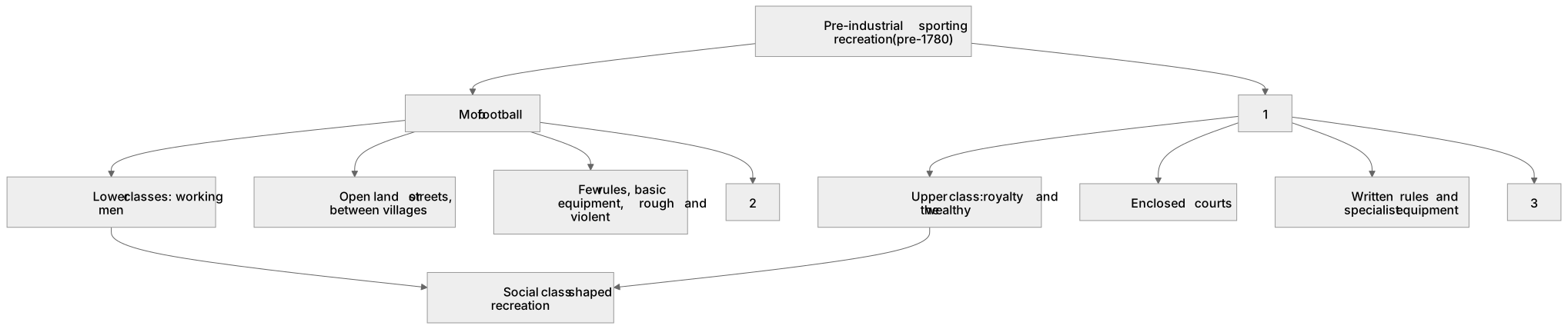
1Box 1
2Box 2
3Box 3
There is more to this lesson
The full lesson goes on to check your understanding and help you earn the marks. Create a free account to carry on, with your progress saved.
A week of Premium from your first lesson · Then the free plan continues · No card, no charge
Test your understanding of Pre-industrial (pre-1780): Characteristics of sporting recreation (limited to mob football and real tennis.
Active recall beats re-reading. Take an instant quiz now to test what you’ve learned and lock it into long-term memory.
A week of Premium from your first lesson · Then the free plan continues · No card, no charge