AQA · A-Level · Physical Education
Course version: 7582 · Version from Sept 2016
Pre-industrial (pre-1780): Harsh lifestyle
In pre-industrial Britain before 1780, the majority of the rural population lived a harsh lifestyle.
Checked against the AQA 7582 specification (opens in a new tab) on .
- Point 5 of 6
- 4 key terms
Study notes
From the checked teaching notes for this specification point.
The idea
In pre-industrial Britain before 1780, the majority of the rural population lived a harsh lifestyle. Work was mainly agricultural, seasonal and physically demanding, with long hours in all weathers and low pay. Housing was basic, often shared and poorly heated, and diet depended on what could be grown or afforded locally, so hunger and illness were common. Life expectancy was short and infant mortality high. Transport was limited, so most people rarely travelled beyond their village. Recreation therefore had to be local, occasional, cheap and vigorous, fitting around the farming calendar and offering brief relief from hardship. Understanding this harshness explains why activities such as mob football were rough, simple and tied to holidays and festivals rather than organised leagues.
What earns the marks
- Identifies that pre-industrial life before 1780 was predominantly rural and agricultural.
- Recognises long working hours, seasonal employment and low wages as features of the harsh lifestyle.
- Notes poor housing, limited heating and an inadequate or uncertain diet.
- Links short life expectancy and high infant mortality to the harshness of everyday life.
- Explains that limited transport kept most people within their local village.
- Connects the harsh lifestyle to recreation that was local, occasional, cheap and vigorous.
Common mistakes and how to put them right
Thinking pre-industrial people had plenty of leisure time.
Put it right: In fact work was long, seasonal and physically demanding, so recreation was occasional and fitted around the farming calendar.
Assuming everyone travelled widely for sport.
Put it right: Transport was limited, so most recreation was local and tied to the village or nearest town.
Believing recreation was expensive and commercial.
Put it right: Most people had little money, so activities were cheap, simple and often used basic or homemade equipment.
Treating the harsh lifestyle as irrelevant background.
Put it right: It directly explains why recreation was rough, occasional and linked to festivals and holidays.
Exam tips
- Link each feature of the harsh lifestyle to a consequence for recreation, for example long working hours leading to occasional rather than regular play.
- Use precise pre-industrial vocabulary such as agricultural, seasonal, rural and local rather than vague words like 'olden times'.
- When answering a multiple-choice question, eliminate options that describe modern conditions such as regular leagues, commercial sponsorship or widespread car travel.
Try the lesson
The start of the Pre-industrial (pre-1780): Harsh lifestyle lesson, made from checked teaching notes for this specification point.
Have a go first
Life for most people in pre-industrial Britain (before 1780) was physically hard and working hours were long. What effect did this have on their recreations?
Listen
In pre-industrial Britain before 1780, the majority of the rural population lived a harsh lifestyle. Work was mainly agricultural, seasonal and physically demanding, with long hours in all weathers and low pay. Housing was basic, often shared and poorly heated, and diet depended on what could be grown or afforded locally, so hunger and illness were common. Life expectancy was short and infant mortality high. Transport was limited, so most people rarely travelled beyond their village. Recreation therefore had to be local, occasional, cheap and vigorous, fitting around the farming calendar and offering brief relief from hardship. Understanding this harshness explains why activities such as mob football were rough, simple and tied to holidays and festivals rather than organised leagues. A strong answer earns marks for these points. Identifies that pre-industrial life before 1780 was predominantly rural and agricultural. Recognises long working hours, seasonal employment and low wages as features of the harsh lifestyle. Notes poor housing, limited heating and an inadequate or uncertain diet. Links short life expectancy and high infant mortality to the harshness of everyday life. Exam tip: Link each feature of the harsh lifestyle to a consequence for recreation, for example long working hours leading to occasional rather than regular play.
See it

Key words
Say what each word means before you turn the card.
Rural agricultural society before 1780
Try answering aloud or in your head before turning the card.
Poverty, poor housing and limited diet
Try answering aloud or in your head before turning the card.
Seasonal and physically demanding work
Try answering aloud or in your head before turning the card.
Local, occasional and vigorous recreation
Try answering aloud or in your head before turning the card.
See every definition
- Rural agricultural society before 1780
- Pre-industrial Britain before 1780 was predominantly rural and agricultural, with the majority of the population living a harsh lifestyle.
- Poverty, poor housing and limited diet
- Housing was basic, often shared and poorly heated, and diet depended on what could be grown or afforded locally, so hunger and illness were common.
- Seasonal and physically demanding work
- Work was mainly agricultural, seasonal and physically demanding, with long hours in all weathers and low pay.
- Local, occasional and vigorous recreation
- Recreation had to be local, occasional, cheap and vigorous, fitting around the farming calendar and offering brief relief from hardship.
Label the diagram
Some boxes have lost their names. Pick the right name for each number.
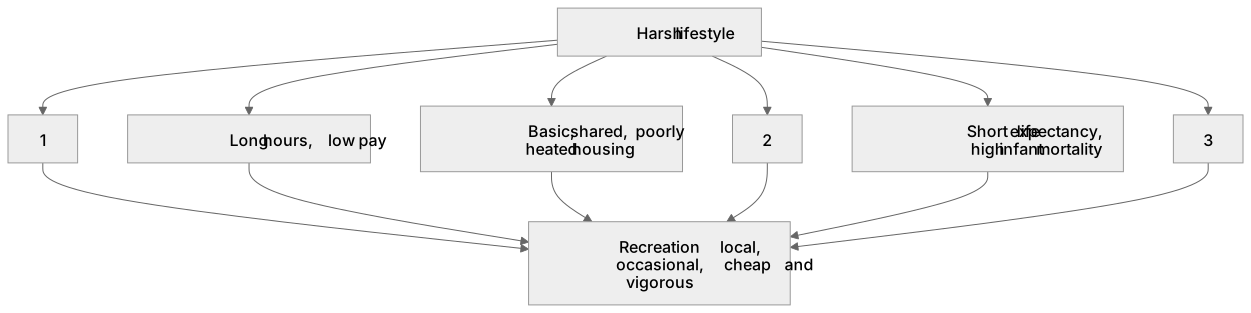
1Box 1
2Box 2
3Box 3
There is more to this lesson
The full lesson goes on to check your understanding and help you earn the marks. Create a free account to carry on, with your progress saved.
A week of Premium from your first lesson · Then the free plan continues · No card, no charge
Test your understanding of Pre-industrial (pre-1780): Harsh lifestyle
Active recall beats re-reading. Take an instant quiz now to test what you’ve learned and lock it into long-term memory.
A week of Premium from your first lesson · Then the free plan continues · No card, no charge