AQA · A-Level · Physical Education
Course version: 7582 · Version from Sept 2016
Circuit training (muscular endurance).
Full specification wording
Preparation and training methods in relation to maintaining physical activity and performance: Circuit training (muscular endurance).
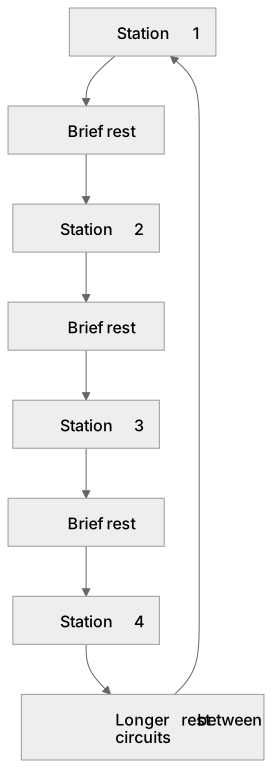
Circuit training arranges a sequence of exercises, called stations, performed one after another for a set time or repetition count, with a short recovery between stations and a longer rest between…
Checked against the AQA 7582 specification (opens in a new tab) on .
- Point 17 of 19
- 4 key terms
Study notes
From the checked teaching notes for this specification point.
The idea
Circuit training arranges a sequence of exercises, called stations, performed one after another for a set time or repetition count, with a short recovery between stations and a longer rest between complete circuits. To develop muscular endurance, the performer chooses moderate loads or body-weight movements, keeps repetitions high, and limits rest so the muscles resist fatigue across repeated contractions. A typical circuit might include press-ups, squats, step-ups and shuttle runs, each worked for around 30 to 60 seconds. The number of circuits, work-to-rest ratio and exercise order are the key variables a coach manipulates, and progression comes from adding circuits, repetitions or resistance rather than from maximal loads.
What earns the marks
- Circuit training is a series of stations completed in sequence, with brief rest between stations and longer rest between circuits.
- Muscular endurance is the ability of a muscle or muscle group to sustain repeated contractions against a submaximal resistance.
- High repetitions, moderate resistance and short recovery intervals are the key variables that target muscular endurance.
- Progression is achieved by increasing the number of circuits, repetitions, work duration or resistance, or by reducing rest.
- Exercise order and work-to-rest ratio influence the training stimulus and the specificity of the circuit.
Common mistakes and how to put them right
Thinking circuit training automatically builds muscular endurance.
Put it right: The outcome depends on high repetitions, moderate load and short rest, so a heavy-load low-repetition circuit trains strength instead.
Confusing muscular endurance with cardiovascular endurance.
Put it right: Muscular endurance concerns repeated contractions of a muscle group, while cardiovascular endurance concerns the heart and lungs supplying oxygen over sustained whole-body work.
Believing rest between stations should be long.
Put it right: Long recovery allows full phosphocreatine resynthesis and reduces the endurance stimulus, so rest should be brief and controlled.
Assuming any exercise order works equally.
Put it right: Ordering stations so the same muscle group is not worked consecutively spreads fatigue and keeps technique safe.
Exam tips
- Read the stem carefully to identify whether the question asks about the training method, the fitness component or the manipulation of variables.
- Link each option back to the defining variables of circuit training: repetitions, resistance, work time, rest time and number of circuits.
- Eliminate options that describe maximal or near-maximal loads, because these target strength rather than muscular endurance.
- Check whether an option confuses muscular endurance with aerobic or cardiovascular endurance before selecting it.
Try the lesson
The start of the Preparation and training methods in relation to maintaining physical activity and performance: Circuit training (muscular endurance). lesson, made from checked teaching notes for this specification point.
Have a go first
A performer wants to improve muscular endurance using circuit training. Which design feature of the circuit is most important for this goal?
Listen
Circuit training arranges a sequence of exercises, called stations, performed one after another for a set time or repetition count, with a short recovery between stations and a longer rest between complete circuits. To develop muscular endurance, the performer chooses moderate loads or body-weight movements, keeps repetitions high, and limits rest so the muscles resist fatigue across repeated contractions. A typical circuit might include press-ups, squats, step-ups and shuttle runs, each worked for around 30 to 60 seconds. The number of circuits, work-to-rest ratio and exercise order are the key variables a coach manipulates, and progression comes from adding circuits, repetitions or resistance rather than from maximal loads. A strong answer earns marks for these points. Circuit training is a series of stations completed in sequence, with brief rest between stations and longer rest between circuits. Muscular endurance is the ability of a muscle or muscle group to sustain repeated contractions against a submaximal resistance. High repetitions, moderate resistance and short recovery intervals are the key variables that target muscular endurance. Progression is achieved by increasing the number of circuits, repetitions, work duration or resistance, or by reducing rest. Exam tip: Read the stem carefully to identify whether the question asks about the training method, the fitness component or the manipulation of variables.
See it
Key words
Say what each word means before you turn the card.
Circuit training
Try answering aloud or in your head before turning the card.
Muscular endurance
Try answering aloud or in your head before turning the card.
Progression
Try answering aloud or in your head before turning the card.
Work-to-rest ratio
Try answering aloud or in your head before turning the card.
See every definition
- Circuit training
- A sequence of exercises, called stations, performed one after another for a set time or repetition count, with a short recovery between stations and a longer rest between complete circuits.
- Muscular endurance
- The ability of a muscle or muscle group to sustain repeated contractions against a submaximal resistance.
- Progression
- Achieved by increasing the number of circuits, repetitions, work duration or resistance, or by reducing rest.
- Work-to-rest ratio
- One of the key variables a coach manipulates, alongside the number of circuits and exercise order, influencing the training stimulus and the specificity of the circuit.
There is more to this lesson
The full lesson goes on to check your understanding and help you earn the marks. Create a free account to carry on, with your progress saved.
A week of Premium from your first lesson · Then the free plan continues · No card, no charge
Test your understanding of Preparation and training methods in relation to maintaining physical activity and performance: Circuit training (muscular endurance).
Active recall beats re-reading. Take an instant quiz now to test what you’ve learned and lock it into long-term memory.
A week of Premium from your first lesson · Then the free plan continues · No card, no charge