AQA · A-Level · Physical Education
Course version: 7582 · Version from Sept 2016
Fartlek (aerobic power).
Full specification wording
Preparation and training methods in relation to maintaining physical activity and performance: Fartlek (aerobic power).
Fartlek, Swedish for speed play, develops aerobic power by mixing continuous running with varied pace and terrain.
Checked against the AQA 7582 specification (opens in a new tab) on .
- Point 16 of 19
- 4 key terms
Study notes
From the checked teaching notes for this specification point.
The idea
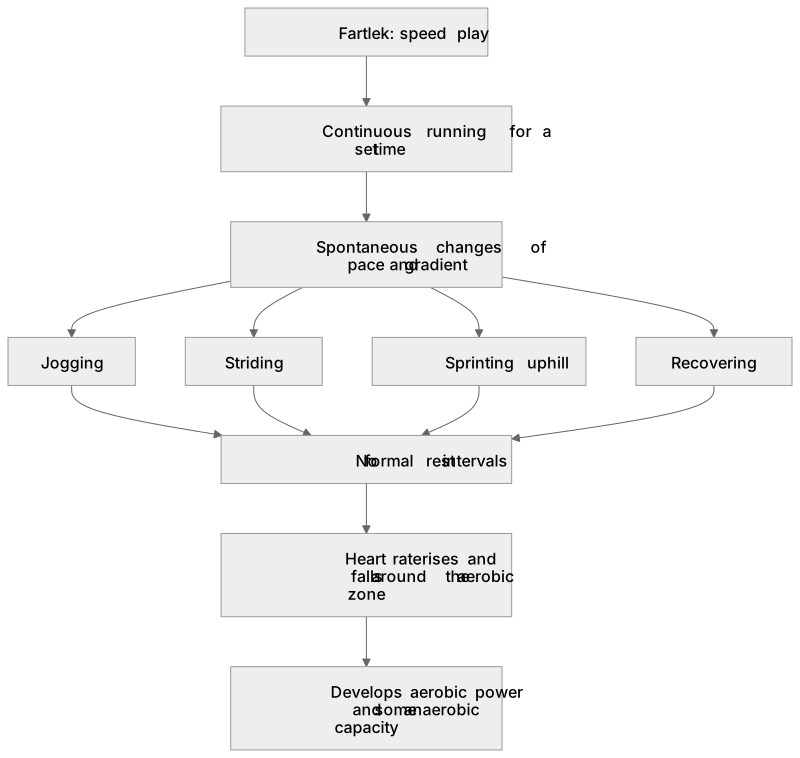
Fartlek, Swedish for speed play, develops aerobic power by mixing continuous running with varied pace and terrain. The performer runs for a set time, changing speed and gradient spontaneously, for example jogging, then striding, then sprinting uphill, then recovering, without formal rest periods. Because intensity fluctuates, heart rate rises and falls around the aerobic zone, so the method trains both aerobic power and some anaerobic capacity. It is flexible, needs no equipment and can be done on roads, trails or hills. Progression comes from longer sessions, more or harder efforts, or tougher terrain. It suits games players and endurance athletes needing varied, sport-relevant conditioning, though the lack of precise control makes exact overload harder to monitor.
What earns the marks
- Fartlek means speed play and combines continuous running with spontaneous changes of pace and terrain.
- The performer varies speed and gradient, for example jogging, striding, sprinting uphill and recovering, without formal rest intervals.
- Fluctuating intensity raises and lowers heart rate around the aerobic zone, developing aerobic power and some anaerobic capacity.
- Progression is achieved through longer sessions, more or harder efforts, or more demanding terrain.
Common mistakes and how to put them right
Thinking fartlek has fixed work and rest intervals.
Put it right: Pace changes are spontaneous and continuous.
Believing fartlek only develops anaerobic capacity.
Put it right: It mainly develops aerobic power with some anaerobic benefit.
Assuming it needs a track or equipment.
Put it right: It can be done on varied natural terrain.
Treating it as identical to continuous training.
Put it right: Intensity fluctuates rather than staying constant.
Exam tips
- Define fartlek as speed play and give a concrete example of changing pace and gradient.
- Explain how fluctuating intensity develops aerobic power and some anaerobic capacity.
- Compare fartlek with continuous training, noting flexibility versus precise control of overload.
Try the lesson
The start of the Preparation and training methods in relation to maintaining physical activity and performance: Fartlek (aerobic power). lesson, made from checked teaching notes for this specification point.
Have a go first
Which description best matches fartlek training as a method for developing aerobic power?
Listen
Fartlek, Swedish for speed play, develops aerobic power by mixing continuous running with varied pace and terrain. The performer runs for a set time, changing speed and gradient spontaneously, for example jogging, then striding, then sprinting uphill, then recovering, without formal rest periods. Because intensity fluctuates, heart rate rises and falls around the aerobic zone, so the method trains both aerobic power and some anaerobic capacity. It is flexible, needs no equipment and can be done on roads, trails or hills. Progression comes from longer sessions, more or harder efforts, or tougher terrain. It suits games players and endurance athletes needing varied, sport-relevant conditioning, though the lack of precise control makes exact overload harder to monitor. A strong answer earns marks for these points. Fartlek means speed play and combines continuous running with spontaneous changes of pace and terrain. The performer varies speed and gradient, for example jogging, striding, sprinting uphill and recovering, without formal rest intervals. Fluctuating intensity raises and lowers heart rate around the aerobic zone, developing aerobic power and some anaerobic capacity. Progression is achieved through longer sessions, more or harder efforts, or more demanding terrain. A common slip: Thinking fartlek has fixed work and rest intervals: the error is confusing it with interval training. Instead, pace changes are spontaneous and continuous. Exam tip: Define fartlek as speed play and give a concrete example of changing pace and gradient.
See it
Key words
Say what each word means before you turn the card.
Fartlek
Try answering aloud or in your head before turning the card.
Varied-pace running
Try answering aloud or in your head before turning the card.
Aerobic power development
Try answering aloud or in your head before turning the card.
Flexible, equipment-free training
Try answering aloud or in your head before turning the card.
See every definition
- Fartlek
- Swedish for speed play, it develops aerobic power by mixing continuous running with varied pace and terrain.
- Varied-pace running
- The performer runs for a set time, changing speed and gradient spontaneously, without formal rest periods.
- Aerobic power development
- Because intensity fluctuates, heart rate rises and falls around the aerobic zone, so both aerobic power and some anaerobic capacity are trained.
- Flexible, equipment-free training
- It needs no equipment and can be done on roads, trails or hills, making it flexible and easy to organise.
Label the diagram
Some boxes have lost their names. Pick the right name for each number.
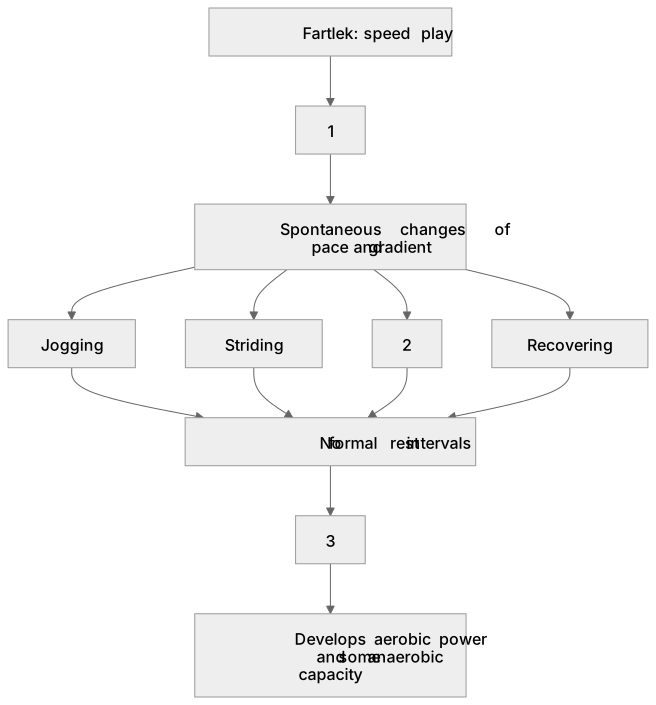
1Box 1
2Box 2
3Box 3
There is more to this lesson
The full lesson goes on to check your understanding and help you earn the marks. Create a free account to carry on, with your progress saved.
A week of Premium from your first lesson · Then the free plan continues · No card, no charge
Test your understanding of Preparation and training methods in relation to maintaining physical activity and performance: Fartlek (aerobic power).
Active recall beats re-reading. Take an instant quiz now to test what you’ve learned and lock it into long-term memory.
A week of Premium from your first lesson · Then the free plan continues · No card, no charge