AQA · A-Level · Physical Education
Course version: 7582 · Version from Sept 2016
Continuous training (aerobic power).
Full specification wording
Preparation and training methods in relation to maintaining physical activity and performance: Continuous training (aerobic power).
Continuous training develops aerobic power by sustaining one steady activity, typically running, cycling, rowing or swimming, without rest intervals.
Checked against the AQA 7582 specification (opens in a new tab) on .
- Point 15 of 19
- 4 key terms
Study notes
From the checked teaching notes for this specification point.
The idea
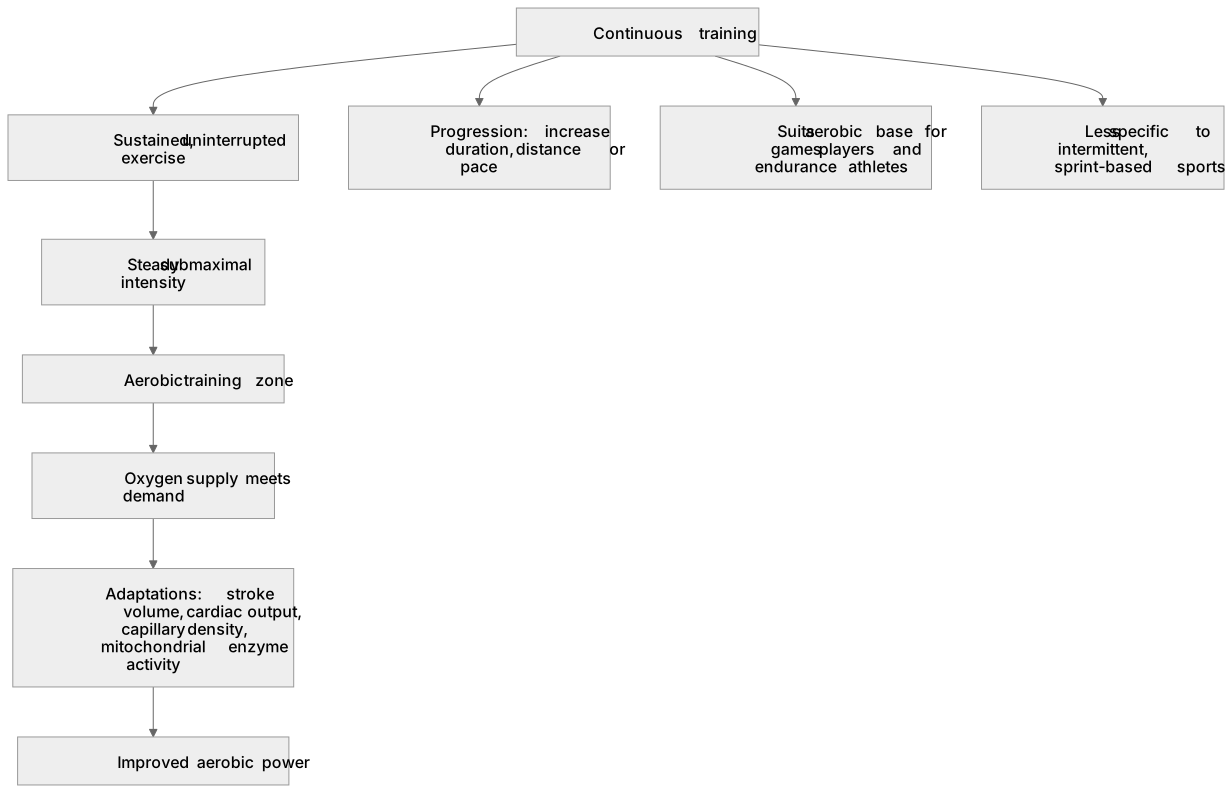
Continuous training develops aerobic power by sustaining one steady activity, typically running, cycling, rowing or swimming, without rest intervals. The performer works continuously for a prolonged period, commonly 20 minutes or more, keeping heart rate in the aerobic training zone, often cited as roughly 60–80% of maximum heart rate, so oxygen supply keeps pace with demand. Intensity is submaximal and constant, so the method is simple to organise and needs little equipment. It overloads the cardiovascular and respiratory systems, raising stroke volume, cardiac output, capillary density and mitochondrial enzyme activity. Progression comes from increasing duration, distance or pace. It suits games players building an aerobic base and endurance athletes in early season, but it is less specific to intermittent, sprint-based sports.
What earns the marks
- Continuous training involves sustained, uninterrupted exercise at a steady submaximal intensity for a prolonged period, typically 20 minutes or more.
- Work is held in the aerobic training zone, commonly around 60–80% of maximum heart rate, so oxygen supply meets demand throughout.
- Typical activities include distance running, cycling, rowing and swimming, requiring minimal equipment and simple organisation.
- Physiological adaptations include increased stroke volume, cardiac output, capillary density and mitochondrial enzyme activity, improving aerobic power.
- Progression is achieved by increasing duration, distance or pace rather than by adding rest intervals.
Common mistakes and how to put them right
Believing continuous training must include rest intervals.
Put it right: Work is sustained without rest.
Thinking any short, hard effort counts.
Put it right: The session is prolonged and submaximal.
Assuming it develops speed or muscular power.
Put it right: It primarily develops aerobic power.
Treating intensity as maximal.
Put it right: Intensity stays in the aerobic zone.
Exam tips
- Link the method to the aerobic training zone and name the physiological adaptations it produces.
- Use a concrete example such as a 30-minute steady run to show duration and constant pace.
- When comparing methods, state why continuous work suits endurance but not intermittent sprint sports.
Try the lesson
The start of the Preparation and training methods in relation to maintaining physical activity and performance: Continuous training (aerobic power). lesson, made from checked teaching notes for this specification point.
Have a go first
Which description best matches continuous training as a method for developing aerobic power?
Listen
Continuous training develops aerobic power by sustaining one steady activity, typically running, cycling, rowing or swimming, without rest intervals. The performer works continuously for a prolonged period, commonly 20 minutes or more, keeping heart rate in the aerobic training zone, often cited as roughly 60–80% of maximum heart rate, so oxygen supply keeps pace with demand. Intensity is submaximal and constant, so the method is simple to organise and needs little equipment. It overloads the cardiovascular and respiratory systems, raising stroke volume, cardiac output, capillary density and mitochondrial enzyme activity. Progression comes from increasing duration, distance or pace. It suits games players building an aerobic base and endurance athletes in early season, but it is less specific to intermittent, sprint-based sports. A strong answer earns marks for these points. Continuous training involves sustained, uninterrupted exercise at a steady submaximal intensity for a prolonged period, typically 20 minutes or more. Work is held in the aerobic training zone, commonly around 60–80% of maximum heart rate, so oxygen supply meets demand throughout. Typical activities include distance running, cycling, rowing and swimming, requiring minimal equipment and simple organisation. Physiological adaptations include increased stroke volume, cardiac output, capillary density and mitochondrial enzyme activity, improving aerobic power. A common slip: Believing continuous training must include rest intervals: the error is confusing it with interval training. Instead, work is sustained without rest. Exam tip: Link the method to the aerobic training zone and name the physiological adaptations it produces.
See it
Key words
Say what each word means before you turn the card.
Aerobic power development
Try answering aloud or in your head before turning the card.
Steady-state submaximal work
Try answering aloud or in your head before turning the card.
Cardiovascular and respiratory adaptation
Try answering aloud or in your head before turning the card.
Training method specificity
Try answering aloud or in your head before turning the card.
See every definition
- Aerobic power development
- Continuous training develops aerobic power by sustaining one steady activity without rest intervals.
- Steady-state submaximal work
- The performer works continuously for a prolonged period, commonly 20 minutes or more, with intensity submaximal and constant.
- Cardiovascular and respiratory adaptation
- The method overloads the cardiovascular and respiratory systems, raising stroke volume, cardiac output, capillary density and mitochondrial enzyme activity.
- Training method specificity
- It suits games players building an aerobic base and endurance athletes in early season, but it is less specific to intermittent, sprint-based sports.
Label the diagram
Some boxes have lost their names. Pick the right name for each number.
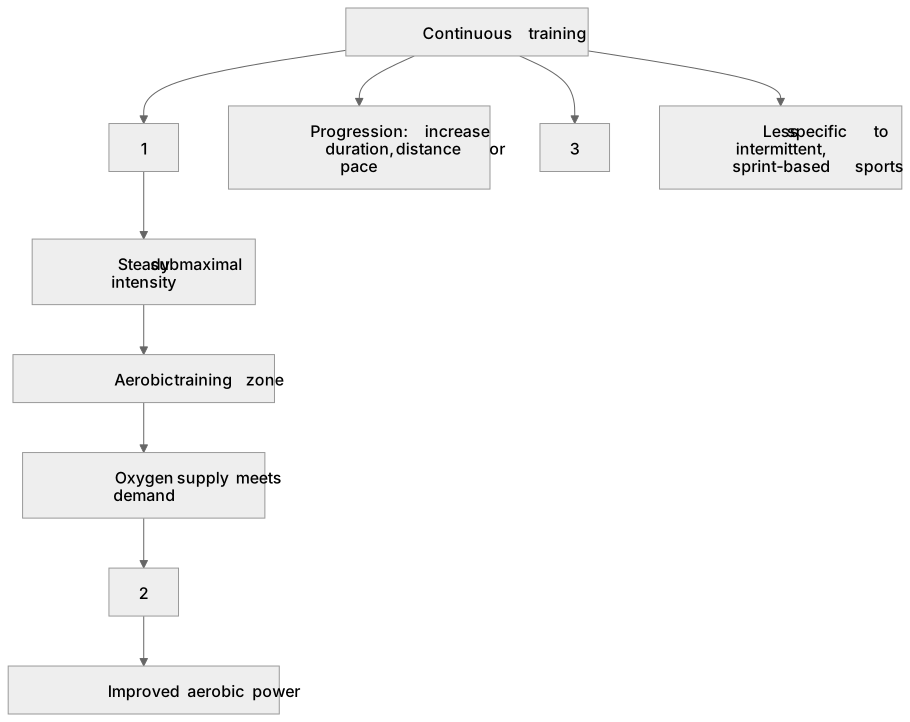
1Box 1
2Box 2
3Box 3
There is more to this lesson
The full lesson goes on to check your understanding and help you earn the marks. Create a free account to carry on, with your progress saved.
A week of Premium from your first lesson · Then the free plan continues · No card, no charge
Test your understanding of Preparation and training methods in relation to maintaining physical activity and performance: Continuous training (aerobic power).
Active recall beats re-reading. Take an instant quiz now to test what you’ve learned and lock it into long-term memory.
A week of Premium from your first lesson · Then the free plan continues · No card, no charge