AQA · A-Level · Physical Education
Course version: 7582 · Version from Sept 2016
Understanding of the key terms relating to laboratory conditions and field…
Full specification wording
Preparation and training methods in relation to maintaining physical activity and performance: Understanding of the key terms relating to laboratory conditions and field tests.
Laboratory conditions and field tests are two broad settings for measuring physical capacities.
Checked against the AQA 7582 specification (opens in a new tab) on .
- Point 1 of 19
- 4 key terms
Study notes
From the checked teaching notes for this specification point.
The idea
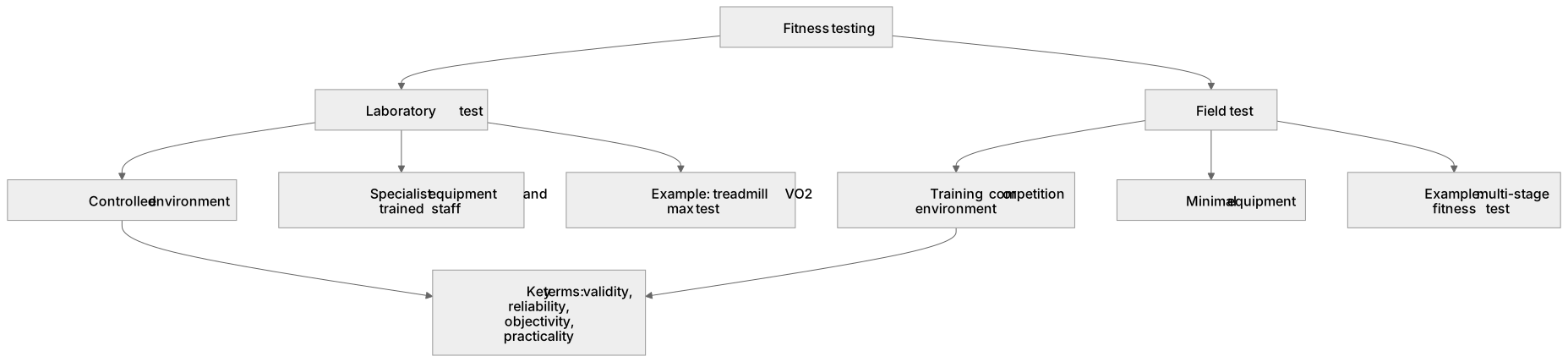
Laboratory conditions and field tests are two broad settings for measuring physical capacities. A laboratory test is conducted in a controlled environment using specialist equipment, such as a treadmill with gas analysis to measure VO₂ max, giving high validity and reliability but requiring trained staff and limited to one participant at a time. A field test is performed in the training or competition environment, often with minimal equipment, such as a multi-stage fitness test or a 30 m sprint, allowing many performers to be tested quickly and cheaply but with less control over extraneous variables. Key terms include validity, reliability, objectivity, and practicality. Understanding these terms helps you select and justify a test for a given purpose.
What earns the marks
- Laboratory test: carried out in a controlled, indoor environment using specialist equipment and trained personnel, for example a treadmill VO₂ max test with gas analysis.
- Field test: carried out in the performer's normal training or competition environment, often with minimal equipment, for example a multi-stage fitness test or a vertical jump test.
- Validity: the extent to which a test measures what it claims to measure; laboratory tests often have higher validity for physiological variables because extraneous variables are controlled.
- Reliability: the extent to which a test produces consistent results on repeated occasions; laboratory conditions typically improve reliability through standardised protocols.
- Practicality: considers cost, time, equipment, number of participants that can be tested, and the expertise required; field tests are usually more practical for large groups.
- Objectivity: the extent to which results are free from tester bias; laboratory tests with automated measurement tend to be more objective than subjective field observations.
Common mistakes and how to put them right
Confusing validity with reliability.
Put it right: Validity is about measuring the correct variable, while reliability is about consistency. A test can be reliable but not valid, for example a stopwatch timing a sprint is reliable but does not measure aerobic capacity.
Assuming field tests are always less valid than laboratory tests.
Put it right: For sport-specific performance, a field test may be more valid because it replicates the movement patterns and environment of the sport.
Believing laboratory tests are always better.
Put it right: Laboratory tests may lack ecological validity and are often impractical for testing whole squads, so field tests can be preferable for team sports.
Mixing up objectivity and reliability.
Put it right: Objectivity concerns freedom from tester bias, whereas reliability concerns repeatability; a test can be objective but unreliable if equipment is faulty.
Exam tips
- In multiple-choice questions, read each option carefully and eliminate those that confuse validity with reliability or practicality with objectivity.
- Link each key term to a concrete example: for instance, a laboratory VO₂ max test has high validity for aerobic power but low practicality for a large squad.
- When a question asks about the suitability of a test, consider all four terms (validity, reliability, objectivity, practicality) and choose the option that best matches the context described.
Try the lesson
The start of the Preparation and training methods in relation to maintaining physical activity and performance: Understanding of the key terms relating to laboratory conditions and field tests. lesson, made from checked teaching notes for this specification point.
Have a go first
A coach measures a performer's maximal oxygen uptake while the performer breathes through a mouthpiece in a sports science room, with heart rate and expired gas continuously monitored. Which key term best describes this form of test?
Listen
Laboratory conditions and field tests are two broad settings for measuring physical capacities. A laboratory test is conducted in a controlled environment using specialist equipment, such as a treadmill with gas analysis to measure VO₂ max, giving high validity and reliability but requiring trained staff and limited to one participant at a time. A field test is performed in the training or competition environment, often with minimal equipment, such as a multi-stage fitness test or a 30 m sprint, allowing many performers to be tested quickly and cheaply but with less control over extraneous variables. Key terms include validity, reliability, objectivity, and practicality. Understanding these terms helps you select and justify a test for a given purpose. A strong answer earns marks for these points. Laboratory test: carried out in a controlled, indoor environment using specialist equipment and trained personnel, for example a treadmill VO₂ max test with gas analysis. Field test: carried out in the performer's normal training or competition environment, often with minimal equipment, for example a multi-stage fitness test or a vertical jump test. Validity: the extent to which a test measures what it claims to measure; laboratory tests often have higher validity for physiological variables because extraneous variables are controlled. Reliability: the extent to which a test produces consistent results on repeated occasions; laboratory conditions typically improve reliability through standardised protocols. Exam tip: In multiple-choice questions, read each option carefully and eliminate those that confuse validity with reliability or practicality with objectivity.
See it
Key words
Say what each word means before you turn the card.
Validity
Try answering aloud or in your head before turning the card.
Reliability
Try answering aloud or in your head before turning the card.
Objectivity
Try answering aloud or in your head before turning the card.
Practicality
Try answering aloud or in your head before turning the card.
See every definition
- Validity
- The extent to which a test measures what it claims to measure, with laboratory tests often having higher validity for physiological variables because extraneous variables are controlled.
- Reliability
- The extent to which a test produces consistent results on repeated occasions, with laboratory conditions typically improving it through standardised protocols.
- Objectivity
- The extent to which results are free from tester bias, with laboratory tests using automated measurement tending to be more objective than subjective field observations.
- Practicality
- Considers cost, time, equipment, number of participants that can be tested, and the expertise required, with field tests usually more practical for large groups.
Label the diagram
Some boxes have lost their names. Pick the right name for each number.
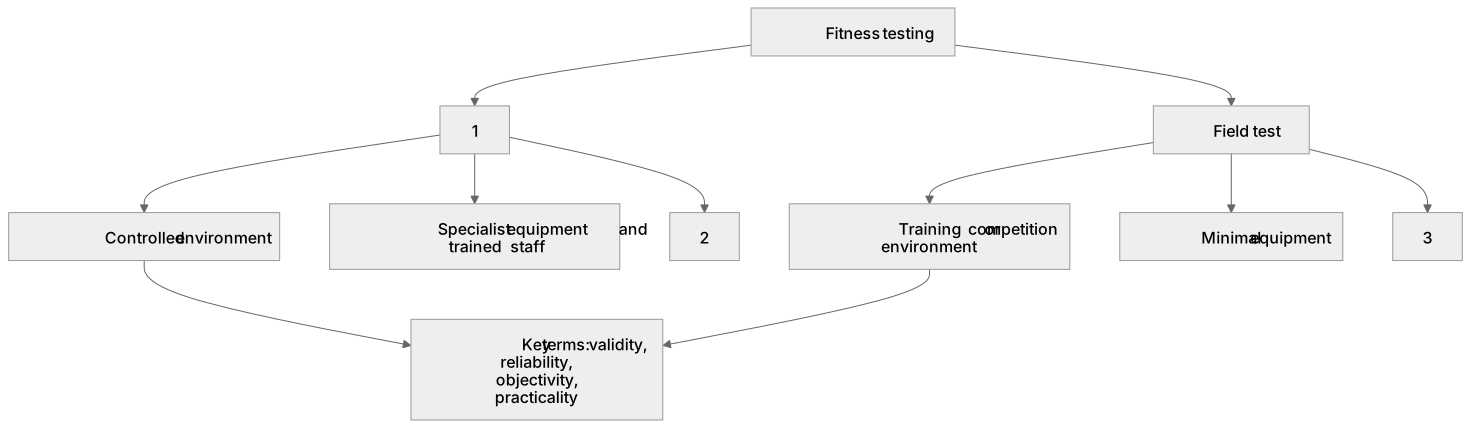
1Box 1
2Box 2
3Box 3
There is more to this lesson
The full lesson goes on to check your understanding and help you earn the marks. Create a free account to carry on, with your progress saved.
A week of Premium from your first lesson · Then the free plan continues · No card, no charge
Test your understanding of Preparation and training methods in relation to maintaining physical activity and performance: Understanding of the key terms relating to laboratory conditions and field tests.
Active recall beats re-reading. Take an instant quiz now to test what you’ve learned and lock it into long-term memory.
A week of Premium from your first lesson · Then the free plan continues · No card, no charge