AQA · A-Level · Physical Education
Course version: 7582 · Version from Sept 2016
Validity and reliability.
Full specification wording
Preparation and training methods in relation to maintaining physical activity and performance: Validity and reliability.
Validity and reliability describe the quality of data collected when preparing for and monitoring training.
Checked against the AQA 7582 specification (opens in a new tab) on .
- Point 4 of 19
- 4 key terms
Study notes
From the checked teaching notes for this specification point.
The idea
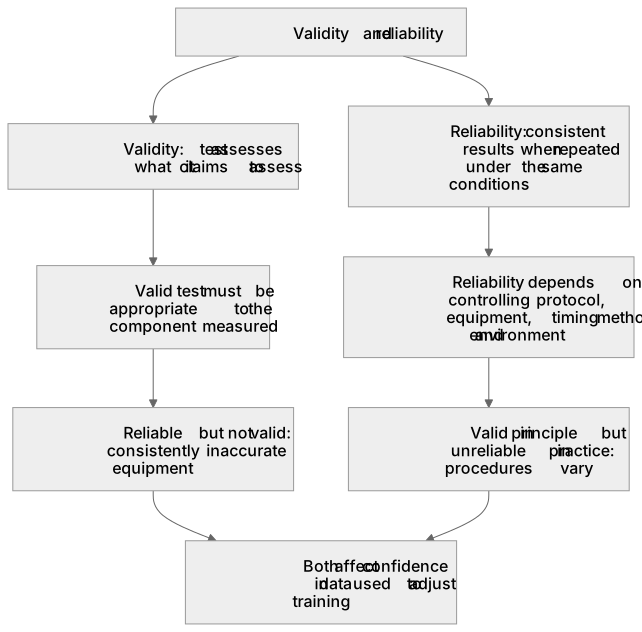
Validity and reliability describe the quality of data collected when preparing for and monitoring training. Validity means the test or measure assesses what it claims to assess: a vertical jump test is valid for explosive leg power but not for aerobic endurance. Reliability means the test produces consistent results when repeated under the same conditions: a stopwatch-timed sprint is reliable if the same protocol, timing method and surface are used each time. A measure can be reliable but not valid, for example a consistently miscalibrated set of scales giving the same wrong mass. A measure can also be valid in principle but unreliable in practice if procedures vary. Together they determine how much confidence a performer or coach can place in data when adjusting a programme.
What earns the marks
- Validity is the extent to which a test or measure assesses what it claims to assess.
- Reliability is the extent to which a test or measure produces consistent results when repeated under the same conditions.
- A valid test must be appropriate to the component being measured, for example a vertical jump test for explosive leg power rather than aerobic endurance.
- Reliability depends on controlling conditions such as protocol, equipment, timing method and environment.
- A measure can be reliable but not valid, for example consistently inaccurate equipment.
- A measure can be valid in principle but unreliable in practice if procedures are not standardised.
Common mistakes and how to put them right
Treating validity and reliability as the same thing.
Put it right: Validity concerns whether the right quality is measured, while reliability concerns consistency of results.
Assuming a reliable test is automatically valid.
Put it right: A test can give consistent results while measuring the wrong quality.
Assuming a valid test is automatically reliable.
Put it right: A test can be appropriate in principle but give inconsistent results if conditions vary.
Ignoring standardisation when judging reliability.
Put it right: Reliability depends on controlling protocol, equipment, timing and environment.
Exam tips
- Define both terms precisely before applying them to a sporting example.
- Use a paired example to show the difference, such as a vertical jump test being valid for leg power but unreliable if jump technique is not controlled.
- When evaluating a test, comment on both validity and reliability rather than only one, and link each to the purpose of the monitoring.
Try the lesson
The start of the Preparation and training methods in relation to maintaining physical activity and performance: Validity and reliability. lesson, made from checked teaching notes for this specification point.
Have a go first
A test is described as reliable when it produces which of the following?
Listen
Validity and reliability describe the quality of data collected when preparing for and monitoring training. Validity means the test or measure assesses what it claims to assess: a vertical jump test is valid for explosive leg power but not for aerobic endurance. Reliability means the test produces consistent results when repeated under the same conditions: a stopwatch-timed sprint is reliable if the same protocol, timing method and surface are used each time. A measure can be reliable but not valid, for example a consistently miscalibrated set of scales giving the same wrong mass. A measure can also be valid in principle but unreliable in practice if procedures vary. Together they determine how much confidence a performer or coach can place in data when adjusting a programme. A strong answer earns marks for these points. Validity is the extent to which a test or measure assesses what it claims to assess. Reliability is the extent to which a test or measure produces consistent results when repeated under the same conditions. A valid test must be appropriate to the component being measured, for example a vertical jump test for explosive leg power rather than aerobic endurance. Reliability depends on controlling conditions such as protocol, equipment, timing method and environment. A common slip: Treating validity and reliability as the same thing. Instead, validity concerns whether the right quality is measured, while reliability concerns consistency of results. Exam tip: Define both terms precisely before applying them to a sporting example.
See it
Key words
Say what each word means before you turn the card.
Validity
Try answering aloud or in your head before turning the card.
Reliability
Try answering aloud or in your head before turning the card.
Standardisation
Try answering aloud or in your head before turning the card.
Confidence in data
Try answering aloud or in your head before turning the card.
See every definition
- Validity
- The extent to which a test or measure assesses what it claims to assess, such as a vertical jump test for explosive leg power rather than aerobic endurance.
- Reliability
- The extent to which a test or measure produces consistent results when repeated under the same conditions, with the same protocol, timing method and surface used each time.
- Standardisation
- Controlling conditions such as protocol, equipment, timing method and environment, on which reliability depends.
- Confidence in data
- How much a performer or coach can place in data when adjusting a programme, determined by validity and reliability together.
Label the diagram
Some boxes have lost their names. Pick the right name for each number.
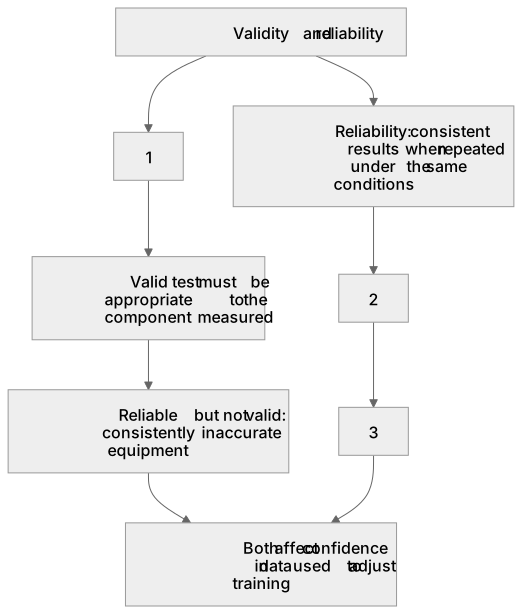
1Box 1
2Box 2
3Box 3
There is more to this lesson
The full lesson goes on to check your understanding and help you earn the marks. Create a free account to carry on, with your progress saved.
A week of Premium from your first lesson · Then the free plan continues · No card, no charge
Test your understanding of Preparation and training methods in relation to maintaining physical activity and performance: Validity and reliability.
Active recall beats re-reading. Take an instant quiz now to test what you’ve learned and lock it into long-term memory.
A week of Premium from your first lesson · Then the free plan continues · No card, no charge