AQA · A-Level · Physical Education
Course version: 7582 · Version from Sept 2016
Objective and subjective.
Full specification wording
Preparation and training methods in relation to maintaining physical activity and performance: Objective and subjective.
Objective and subjective describe two broad types of data used when preparing for and monitoring training.
Checked against the AQA 7582 specification (opens in a new tab) on .
- Point 3 of 19
- 4 key terms
Study notes
From the checked teaching notes for this specification point.
The idea
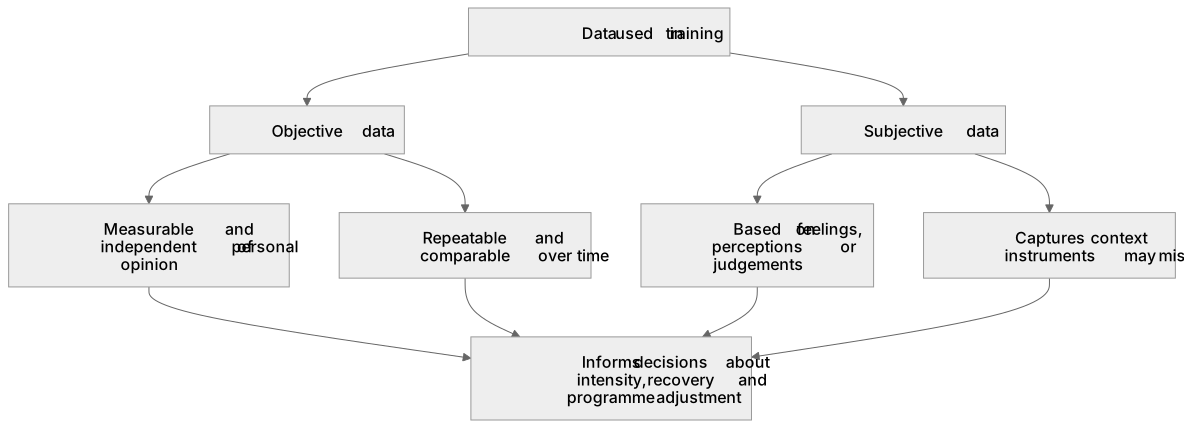
Objective and subjective describe two broad types of data used when preparing for and monitoring training. Objective data are measurable and independent of personal opinion, such as a heart rate of 60 beats per minute, a vertical jump of 45 cm or a timed 30 m sprint of 4.2 s. Subjective data rely on the performer's own feelings or judgements, such as a rating of perceived exertion of 7 out of 10, a self-reported sleep-quality score or a coach's observation that a lift looked laboured. Both can inform decisions about intensity, recovery and programme adjustment. Objective measures are repeatable and comparable over time, while subjective measures capture context that instruments may miss. Neither type is automatically superior; the choice depends on what is being monitored and the resources available.
What earns the marks
- Objective data are measurable, factual and independent of personal opinion, for example a heart rate reading or a timed sprint.
- Subjective data are based on personal feelings, perceptions or judgements, for example a rating of perceived exertion or a coach's observation.
- Objective measures tend to be repeatable and comparable across sessions, which supports tracking change over time.
- Subjective measures can capture information that objective instruments miss, such as fatigue, motivation or perceived effort.
- Neither type is automatically better; the appropriate type depends on what is being monitored and the context of the programme.
Common mistakes and how to put them right
Assuming objective data are always better than subjective data.
Put it right: Each type has strengths, and subjective measures can reveal fatigue or motivation that instruments miss.
Treating a coach's observation as objective because it comes from an adult.
Put it right: A coach's judgement is still a personal perception, so it is subjective.
Believing subjective data cannot be used in serious training.
Put it right: Ratings of perceived exertion and wellness scores are widely used to guide intensity and recovery.
Confusing the terms with quantitative and qualitative generally.
Put it right: In this context the distinction is whether the measure depends on personal opinion, not simply whether it is numerical.
Exam tips
- Define both terms before applying them, so the examiner can see the distinction clearly.
- Use a specific sporting example for each type, such as a heart-rate reading for objective and a rating of perceived exertion for subjective.
- When a question asks which type is more useful, justify your choice by referring to the purpose of the monitoring rather than stating a general preference.
Try the lesson
The start of the Preparation and training methods in relation to maintaining physical activity and performance: Objective and subjective. lesson, made from checked teaching notes for this specification point.
Have a go first
A coach records the distance a performer sprints in a set time using a stopwatch and tape measure. Which type of data does this measurement produce?
Listen
Objective and subjective describe two broad types of data used when preparing for and monitoring training. Objective data are measurable and independent of personal opinion, such as a heart rate of 60 beats per minute, a vertical jump of 45 cm or a timed 30 m sprint of 4.2 s. Subjective data rely on the performer's own feelings or judgements, such as a rating of perceived exertion of 7 out of 10, a self-reported sleep-quality score or a coach's observation that a lift looked laboured. Both can inform decisions about intensity, recovery and programme adjustment. Objective measures are repeatable and comparable over time, while subjective measures capture context that instruments may miss. Neither type is automatically superior; the choice depends on what is being monitored and the resources available. A strong answer earns marks for these points. Objective data are measurable, factual and independent of personal opinion, for example a heart rate reading or a timed sprint. Subjective data are based on personal feelings, perceptions or judgements, for example a rating of perceived exertion or a coach's observation. Objective measures tend to be repeatable and comparable across sessions, which supports tracking change over time. Subjective measures can capture information that objective instruments miss, such as fatigue, motivation or perceived effort. A common slip: Assuming objective data are always better than subjective data. Instead, each type has strengths, and subjective measures can reveal fatigue or motivation that instruments miss. Exam tip: Define both terms before applying them, so the examiner can see the distinction clearly.
See it
Key words
Say what each word means before you turn the card.
Objective data
Try answering aloud or in your head before turning the card.
Subjective data
Try answering aloud or in your head before turning the card.
Perceived effort and wellbeing
Try answering aloud or in your head before turning the card.
Informed programme adjustment
Try answering aloud or in your head before turning the card.
See every definition
- Objective data
- Measurable and factual information that is independent of personal opinion, such as a heart rate reading or a timed sprint.
- Subjective data
- Information based on the performer's own feelings, perceptions or judgements, such as a rating of perceived exertion or a coach's observation.
- Perceived effort and wellbeing
- Personal feelings such as a rating of perceived exertion, a self-reported sleep-quality score or perceived fatigue, which can capture context that instruments may miss.
- Informed programme adjustment
- Using both objective and subjective data together to inform decisions about intensity, recovery and programme adjustment, with the choice depending on what is being monitored and the resources available.
Label the diagram
Some boxes have lost their names. Pick the right name for each number.
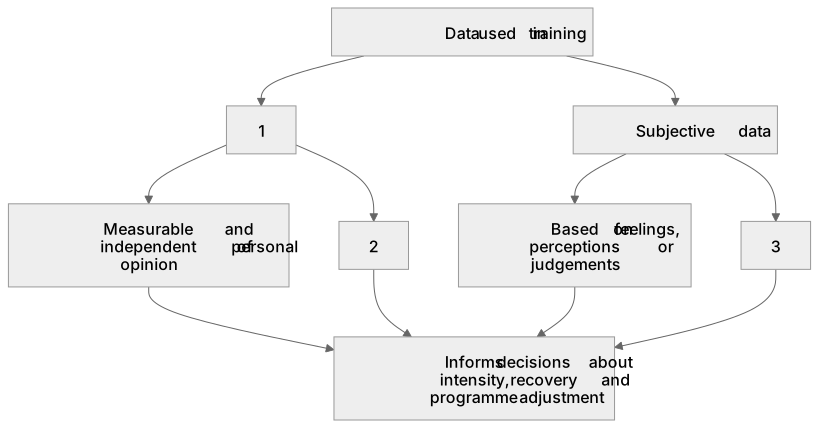
1Box 1
2Box 2
3Box 3
There is more to this lesson
The full lesson goes on to check your understanding and help you earn the marks. Create a free account to carry on, with your progress saved.
A week of Premium from your first lesson · Then the free plan continues · No card, no charge
Test your understanding of Preparation and training methods in relation to maintaining physical activity and performance: Objective and subjective.
Active recall beats re-reading. Take an instant quiz now to test what you’ve learned and lock it into long-term memory.
A week of Premium from your first lesson · Then the free plan continues · No card, no charge