AQA · A-Level · Physical Education
Course version: 7582 · Version from Sept 2016
Cognitive, associative, autonomous.
Full specification wording
Principles and theories of learning and performance: Cognitive, associative, autonomous.
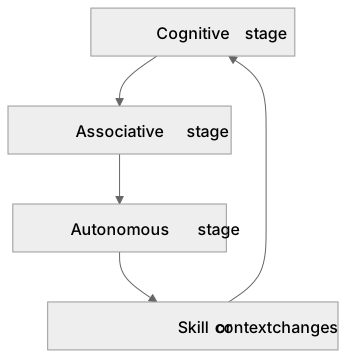
Fitts and Posner describe three stages of motor learning.
Checked against the AQA 7582 specification (opens in a new tab) on .
- Point 2 of 12
- 4 key terms
Study notes
From the checked teaching notes for this specification point.
The idea
Fitts and Posner describe three stages of motor learning. In the cognitive stage the beginner thinks hard about what to do, makes many errors and needs demonstrations and feedback. In the associative stage practice refines the skill: errors shrink, timing and consistency improve, and the performer links parts of the action together. In the autonomous stage the skill is largely automatic, so attention frees up for tactics, opponents or environment; a tennis player can watch the ball and opponent rather than their own racket. Progress is not fixed to a timescale and learners may move back a stage when the skill or context changes.
What earns the marks
- Cognitive stage: the learner is a beginner who relies on conscious thought, demonstration and guidance, and makes frequent errors.
- Associative stage: practice reduces errors and improves consistency, timing and coordination as parts of the skill are linked.
- Autonomous stage: the skill becomes largely automatic, so attention can be directed to tactics, opponents or the environment.
- Progress through the stages is not fixed to a set time and a performer can regress when the skill or context changes.
Common mistakes and how to put them right
Thinking the stages are tied to fixed timescales.
Put it right: Progress depends on practice quality and the task, not a set number of weeks.
Believing the autonomous stage means no errors ever occur.
Put it right: It means the skill is largely automatic, but errors can still happen under pressure.
Assuming a performer cannot return to an earlier stage.
Put it right: A new skill or changed context can move a learner back to more conscious control.
Exam tips
- Link each stage to observable behaviour, such as amount of thinking, error rate and use of feedback, rather than just naming the stage.
- Use a sporting example and say what the performer can attend to at that stage, for example watching an opponent rather than their own feet.
- If asked to identify a stage from a description, match the key clue: heavy conscious thought, refining with practice, or automatic performance.
Try the lesson
The start of the Principles and theories of learning and performance: Cognitive, associative, autonomous. lesson, made from checked teaching notes for this specification point.
Have a go first
A coach describes a performer who is still working out what the skill involves and makes many errors. Which stage of skill learning is this performer in?
Listen
Fitts and Posner describe three stages of motor learning. In the cognitive stage the beginner thinks hard about what to do, makes many errors and needs demonstrations and feedback. In the associative stage practice refines the skill: errors shrink, timing and consistency improve, and the performer links parts of the action together. In the autonomous stage the skill is largely automatic, so attention frees up for tactics, opponents or environment; a tennis player can watch the ball and opponent rather than their own racket. Progress is not fixed to a timescale and learners may move back a stage when the skill or context changes. A strong answer earns marks for these points. Cognitive stage: the learner is a beginner who relies on conscious thought, demonstration and guidance, and makes frequent errors. Associative stage: practice reduces errors and improves consistency, timing and coordination as parts of the skill are linked. Autonomous stage: the skill becomes largely automatic, so attention can be directed to tactics, opponents or the environment. Progress through the stages is not fixed to a set time and a performer can regress when the skill or context changes. A common slip: Thinking the stages are tied to fixed timescales. Instead, progress depends on practice quality and the task, not a set number of weeks. Exam tip: Link each stage to observable behaviour, such as amount of thinking, error rate and use of feedback, rather than just naming the stage.
See it
Key words
Say what each word means before you turn the card.
Stages of motor learning
Try answering aloud or in your head before turning the card.
Cognitive stage
Try answering aloud or in your head before turning the card.
Associative stage
Try answering aloud or in your head before turning the card.
Autonomous stage
Try answering aloud or in your head before turning the card.
See every definition
- Stages of motor learning
- Fitts and Posner describe three stages of motor learning: cognitive, associative and autonomous.
- Cognitive stage
- The beginner thinks hard about what to do, makes many errors and needs demonstrations and feedback.
- Associative stage
- Practice refines the skill: errors shrink, timing and consistency improve, and the performer links parts of the action together.
- Autonomous stage
- The skill is largely automatic, so attention frees up for tactics, opponents or environment.
Label the diagram
Some boxes have lost their names. Pick the right name for each number.
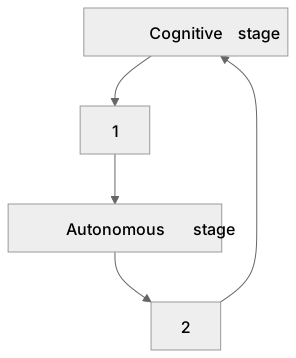
1Box 1
2Box 2
There is more to this lesson
The full lesson goes on to check your understanding and help you earn the marks. Create a free account to carry on, with your progress saved.
A week of Premium from your first lesson · Then the free plan continues · No card, no charge
Test your understanding of Principles and theories of learning and performance: Cognitive, associative, autonomous.
Active recall beats re-reading. Take an instant quiz now to test what you’ve learned and lock it into long-term memory.
A week of Premium from your first lesson · Then the free plan continues · No card, no charge